
Yield Farming in DeFi: An Introduction to Earning in Decentralized Finance


Welcome to Blockchain Trends, your compass in the rapidly evolving world of decentralized technology. Beyond the headlines about cryptocurrencies, lies a universe of innovation, from enterprise applications to revolutionary regulatory frameworks. Intrigued by the potential of earning passive income in the digital age? Dive in as we demystify the DeFi yield farming basics and unlock the secrets of decentralized finance. Discover how you can participate in this groundbreaking financial revolution and what the future holds. Ready to explore?
Yield Farming in DeFi: An Introduction to Earning in Decentralized Finance
- Understanding DeFi Yield Farming Basics: An Overview
- How DeFi Yield Farming Works: A Deep Dive
- Key Concepts in DeFi Yield Farming Strategies
- Risks and Challenges of DeFi Yield Farming
- Getting Started with DeFi Yield Farming: A Beginner's Guide
- Advanced Yield Farming Techniques and Strategies
- The Future of Yield Farming in Decentralized Finance
- Frequently Asked Questions
- Final Reflection: Cultivating the Future of Finance
- Unleash Your DeFi Potential: Start Earning Now!
Understanding DeFi Yield Farming Basics: An Overview
What is Decentralized Finance (DeFi)? A Blockchain Trends Perspective
Decentralized Finance, or DeFi, represents a paradigm shift in financial services, moving away from traditional intermediaries like banks and brokers towards peer-to-peer transactions facilitated by blockchain technology. Built primarily on programmable blockchains such as Ethereum, DeFi leverages smart contracts – self-executing agreements with the terms directly written into code – to automate financial operations. This creates an open, transparent, and permissionless ecosystem where anyone with an internet connection can access lending, borrowing, trading, and other financial instruments without needing approval from a central authority.
From the perspective of Blockchain Trends, DeFi embodies the transformative potential of blockchain beyond cryptocurrencies. It's about rebuilding financial infrastructure from the ground up, offering increased efficiency, reduced costs, and greater accessibility compared to traditional finance. Understanding the fundamental concepts of DeFi is crucial before diving into specific strategies like yield farming, as it provides the necessary context for how these earning opportunities arise within this decentralized framework. The core innovation lies in replacing trusted third parties with cryptographic proof and decentralized consensus, opening up new possibilities for financial interaction and wealth creation.
The Core Concept of Yield Farming: Earning Crypto Rewards
Yield farming is a strategy within DeFi where participants earn rewards by providing liquidity to decentralized protocols. Essentially, it involves locking up or staking crypto assets in a DeFi protocol to support its operations, such as facilitating trading on a decentralized exchange or providing capital for lending pools. In return for contributing their assets, yield farmers receive compensation, typically in the form of cryptocurrency tokens. This compensation can be a portion of the transaction fees generated by the protocol or newly minted tokens specifically designed to incentivize participation and distribute governance rights.
The fundamental idea behind DeFi yield farming basics is to put otherwise idle crypto assets to work. Instead of holding tokens in a wallet, users can deposit them into various DeFi protocols to generate passive income. This process is often described as "farming" because users "plant" their crypto assets (seeds) and "harvest" returns (yield) over time.
The potential yields can vary significantly depending on the protocol, the specific asset pair provided, market conditions, and the level of risk involved. It has become a popular method for crypto holders looking to maximize returns on their digital assets within the burgeoning decentralized financial landscape.
Why is Yield Farming Popular? Benefits and Opportunities in DeFi
Yield farming has gained immense popularity in the DeFi space due to several compelling benefits and opportunities it presents to participants. One major draw is the potential for high returns, often significantly exceeding interest rates available in traditional finance or even simple crypto staking. These high yields are driven by various factors, including protocol incentives to attract liquidity, trading fees generated by high volume, and the speculative nature of the DeFi market itself. The ability to earn passive income on existing crypto holdings is a powerful motivator for many users.
Furthermore, yield farming offers opportunities for participation in the growth of new DeFi protocols. Many protocols distribute their native governance tokens to yield farmers as a reward. This not only provides an additional stream of income but also gives participants a stake in the future development and direction of the protocol through voting rights. This democratic aspect, combined with the transparency of on-chain transactions and the accessibility of DeFi platforms (requiring only a crypto wallet), makes yield farming an attractive and empowering option for individuals seeking to explore earning potential within the decentralized financial ecosystem.
How DeFi Yield Farming Works: A Deep Dive
Providing Liquidity: The Foundation of Yield Farming Strategies
At the heart of most DeFi yield farming strategies lies the act of providing liquidity. Decentralized exchanges (DEXs), lending platforms, and other DeFi protocols rely on pools of deposited assets to function. For instance, a DEX needs pools of different token pairs (like ETH/USDC) so that users can swap between them without needing a traditional buyer and seller to match orders directly. By depositing an equal value of both tokens into such a pool, a user becomes a liquidity provider (LP). Their deposited assets contribute to the total liquidity available, enabling trades to occur seamlessly.
In exchange for providing this essential service, liquidity providers earn a portion of the transaction fees generated within that specific pool. This fee-sharing mechanism is the primary way LPs are compensated for putting their capital at work and taking on certain risks. The fees accumulated are typically proportional to the amount of liquidity the LP has contributed to the pool. Understanding this fundamental role of liquidity provision is key to grasping the basics of DeFi yield farming, as it is the mechanism that generates the initial revenue stream before additional yield farming incentives come into play.
Liquidity Pools and Automated Market Makers (AMMs) Explained
Liquidity pools are collections of funds locked in a smart contract, used to facilitate trading on decentralized exchanges and power other DeFi applications. Instead of using traditional order books where buyers and sellers list their desired prices, most modern DEXs utilize an Automated Market Maker (AMM) model. AMMs use mathematical formulas to determine the price of assets within a liquidity pool based on the ratio of the assets it holds. For example, a simple AMM might use the formula x * y = k, where x and y are the quantities of the two tokens in the pool, and k is a constant.
When a trader swaps one token for another in an AMM pool, the balance of the two tokens changes, causing the price to adjust according to the formula. The fees paid by traders for these swaps are then distributed proportionally to the liquidity providers who contributed assets to that pool. Protocols like Uniswap, Curve, and Sushiswap are prominent examples of platforms utilizing AMMs and liquidity pools. Understanding how these pools function and how AMMs price assets is fundamental to understanding the mechanics behind earning potential when exploring DeFi yield farming basics.
Yield Farming Protocols and Platforms: Examples and Use Cases
Numerous protocols and platforms have emerged as key players in the DeFi yield farming space, each offering different opportunities and mechanisms for earning rewards. Some of the earliest and most well-known examples include Compound and Aave, which started as decentralized lending protocols. Users can deposit assets to earn interest (acting as lenders) or borrow assets by providing collateral. While not purely yield farming initially, these platforms paved the way for incentivizing participation, and depositing assets into them often forms part of broader yield farming strategies, sometimes earning governance tokens like COMP or AAVE in addition to interest.
Decentralized exchanges like Uniswap and Sushiswap are central to liquidity farming. Users provide liquidity to trading pairs and earn a share of trading fees, often supplemented by protocol tokens (like UNI or SUSHI) as an extra incentive. Platforms like Yearn.Finance (YFI) emerged as yield aggregators, automatically moving users' deposited funds between different protocols to find the highest possible yield, abstracting away some of the complexity.
Curve Finance is another specialized DEX focusing on stablecoin swaps, known for its efficiency and often attractive yields for stablecoin LPs. Exploring these diverse platforms is essential when delving into the practical application of DeFi yield farming basics.
Key Concepts in DeFi Yield Farming Strategies
Annual Percentage Yield (APY) vs. Annual Percentage Rate (APR) in DeFi
When evaluating yield farming opportunities, two key metrics are frequently used to express potential returns: Annual Percentage Rate (APR) and Annual Percentage Yield (APY). Understanding the difference between these is crucial for assessing potential earnings accurately. APR represents a simple interest rate – the percentage return on your principal investment over a year, without compounding. If a yield farming pool offers 10% APR, depositing 100 tokens would theoretically earn you 10 tokens over 12 months, assuming no compounding of the earned rewards.
APY, on the other hand, accounts for the effect of compounding. It assumes that the rewards earned are reinvested back into the pool, allowing subsequent earnings to be calculated on a larger principal. This can significantly increase the total return over time, especially with higher rates and frequent compounding.
If the same pool offered 10% APY (assuming daily compounding), your actual return would be higher than 10 tokens on a 100-token deposit. DeFi platforms often display APY because yield farming rewards are frequently added to the user's position, facilitating compounding. However, it's vital to remember that both APR and APY are often projected figures based on current conditions, which can change rapidly due to market volatility and fluctuating incentives in DeFi yield farming basics.
Understanding Impermanent Loss in Liquidity Pools
One of the most significant risks faced by liquidity providers in AMM-based yield farming is impermanent loss. This phenomenon occurs when the price ratio of the tokens within a liquidity pool changes relative to the price ratio at the time the liquidity provider deposited their assets. If, for example, you deposit ETH and USDC into a pool, and the price of ETH doubles relative to USDC, the AMM's rebalancing mechanism will mean that when you withdraw your liquidity, you will have more USDC and less ETH than you initially deposited.
The "loss" is considered "impermanent" because if the token prices eventually return to their original ratio from the time of deposit, the impermanent loss disappears. However, if you withdraw your liquidity before the prices return, the loss becomes permanent. In the scenario where ETH doubled, you would have been better off simply holding the initial amount of ETH and USDC outside the pool.
The trading fees earned by providing liquidity are intended to compensate for this risk, but they do not always fully offset the impermanent loss, especially during periods of high price volatility. Managing or mitigating impermanent loss is a critical consideration when exploring DeFi yield farming basics.
Staking Tokens for Rewards: A Simple Yield Farming Approach
Staking is a related but often simpler form of earning rewards in DeFi, frequently considered a component or a more straightforward version of yield farming basics. Staking typically involves locking up a single type of cryptocurrency token to support the operations of a blockchain network or a specific protocol. In Proof-of-Stake (PoS) blockchain networks, staking is fundamental to consensus; users stake tokens to validate transactions and secure the network, earning newly minted tokens or transaction fees as rewards. Examples include staking ETH on Ethereum 2.0 or staking SOL on Solana.
Within the DeFi context, staking often refers to locking tokens to earn rewards specific to a protocol. This could involve staking governance tokens (like staking UNI or SUSHI) to earn more of the same token or other assets, or staking LP tokens (representing a share in a liquidity pool) in a separate contract to earn additional yield farming incentives.
This latter case is a common yield farming strategy: provide liquidity to get LP tokens, then stake those LP tokens to earn extra rewards from the protocol. While basic staking involves less active management than complex yield farming strategies, it remains a popular method for earning passive income on crypto assets within the decentralized ecosystem.
Risks and Challenges of DeFi Yield Farming
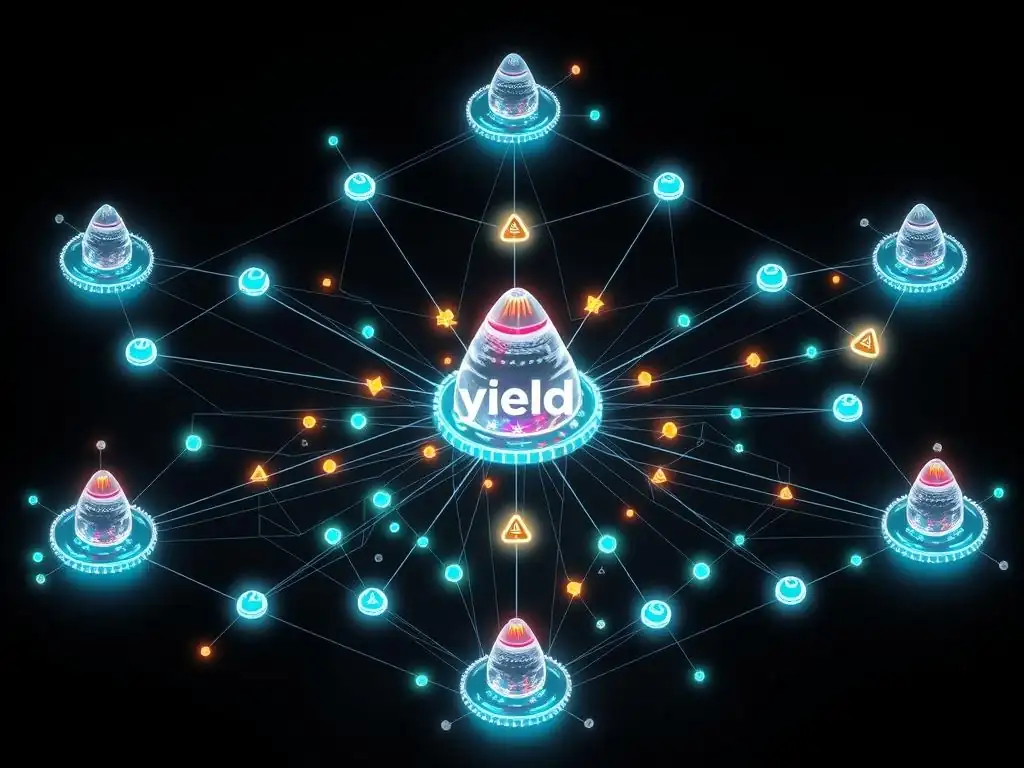
Smart Contract Risks and Security Audits in DeFi
One of the primary risks associated with DeFi yield farming is the potential for smart contract vulnerabilities. Since DeFi protocols operate based on code executed by smart contracts on the blockchain, any bug, exploit, or oversight in this code can lead to significant financial losses for users. Malicious actors can exploit flaws to drain funds from liquidity pools or manipulate protocol mechanics to their advantage. High-profile incidents involving millions of dollars lost to smart contract exploits have occurred in the past, highlighting this critical risk.
To mitigate these risks, reputable DeFi protocols typically undergo security audits conducted by independent third-party firms specializing in blockchain security. These audits review the smart contract code line by line to identify potential vulnerabilities before the protocol is deployed or updated. While audits significantly reduce the risk of exploits, they do not eliminate it entirely. Users engaging in DeFi yield farming basics must understand that even audited contracts carry some residual risk, and the security of the underlying smart contract is paramount when choosing where to deposit funds.
Volatility and Impermanent Loss Mitigation Strategies
Market volatility poses a significant challenge for yield farmers, primarily through the risk of impermanent loss as discussed earlier. Sharp price movements in the tokens held within a liquidity pool can lead to substantial impermanent loss, potentially wiping out or even exceeding the yield earned from trading fees and farming rewards. While impermanent loss is inherent to providing liquidity in AMM pools, some strategies aim to mitigate its impact.
One approach is to provide liquidity for asset pairs that are expected to have low price volatility relative to each other, such as stablecoin-to-stablecoin pools (e.g., USDC/DAI) or wrapped asset pairs (e.g., wBTC/renBTC). Protocols like Curve Finance specialize in such stablecoin swaps, often resulting in lower impermanent loss compared to volatile crypto-to-crypto pairs like ETH/BTC. Another strategy involves actively managing positions, although this goes beyond the basics of DeFi yield farming and can incur high transaction costs on some blockchains. Ultimately, understanding the relationship between volatility and impermanent loss is crucial for managing risk effectively.
Regulatory Considerations and Compliance in the DeFi Space
The regulatory landscape surrounding decentralized finance, including yield farming, is still evolving and presents significant uncertainties and challenges. As DeFi grows, regulators worldwide are paying closer attention, seeking to understand and potentially regulate these activities. The decentralized and global nature of DeFi makes traditional regulatory frameworks difficult to apply, creating a complex environment for both users and protocol developers.
Potential regulatory actions could impact yield farming in various ways, such as requiring identity verification (KYC/AML) for accessing certain protocols, imposing taxes on yield farming rewards (which are often considered income or capital gains), or even classifying certain DeFi tokens or activities as securities. The lack of clear guidelines in many jurisdictions creates legal uncertainty. While the core principles of DeFi yield farming basics emphasize permissionless access, future regulations could introduce barriers or reporting requirements, impacting the accessibility and operation of existing protocols. Staying informed about regulatory developments is increasingly important for participants in the DeFi space.
Getting Started with DeFi Yield Farming: A Beginner's Guide
Choosing the Right DeFi Platform for Yield Farming
For beginners looking to explore DeFi yield farming basics, selecting the appropriate platform is a critical first step. The choice depends on factors like the type of assets you hold, your risk tolerance, and the network you prefer to use (e.g., Ethereum, Binance Smart Chain, Polygon, Solana, etc.). Different platforms specialize in different areas: some are primarily decentralized exchanges (like Uniswap, Sushiswap), others are lending protocols (like Aave, Compound), and some are yield aggregators (like Yearn.Finance).
Researching the platform's reputation, security history (checking for past exploits or audits), the types of pools available, the reported APY/APR (while understanding their variability), and the community sentiment is essential. For newcomers, starting with more established and audited protocols, perhaps with stablecoin pools to minimize impermanent loss risk, can be a prudent approach. Understanding the specific mechanics and risks of the chosen platform is paramount before committing any funds.
Connecting Your Wallet and Funding Your Account
Once a suitable platform is chosen, the next step in getting started with DeFi yield farming basics is connecting a compatible non-custodial cryptocurrency wallet. Wallets like MetaMask, WalletConnect-compatible mobile wallets (e.g., Trust Wallet, Argent), or hardware wallets (like Ledger, Trezor) are commonly used. These wallets allow you to directly interact with decentralized applications (dApps) on the blockchain without needing to create an account with a central entity.
After connecting your wallet, you will need to fund it with the necessary cryptocurrencies required for the specific yield farming activity you plan to undertake. For example, if you plan to provide liquidity to an ETH/USDC pool on Uniswap, you will need both ETH (often also required for transaction fees, known as 'gas' on Ethereum) and USDC in your wallet. The process involves sending these assets from another exchange or wallet to your connected wallet address. Ensure you are on the correct blockchain network compatible with the DeFi platform you intend to use.
Participating in Liquidity Pools and Earning Rewards
With your wallet connected and funded, you can now participate in liquidity pools or staking programs to begin earning rewards. On a DEX like Uniswap, you would navigate to the 'Pool' or 'Liquidity' section, select the asset pair you wish to provide liquidity for, and specify the amount of each token you want to deposit. The platform will typically require an equal value of each token based on the current price ratio. After approving the smart contract to spend your tokens (which requires a transaction), you can then confirm the deposit transaction.
Upon successfully depositing assets into a liquidity pool, you will receive LP tokens representing your share of the pool. These tokens accrue a portion of the trading fees generated by the pool. To earn additional yield farming incentives offered by the protocol, you often need to take these LP tokens and 'stake' them in a separate farming contract, usually found in a 'Farm' or 'Earn' section of the platform. This second staking action earns you the protocol's native token or other specified rewards, adding another layer to the earning potential beyond the basic trading fees.
Advanced Yield Farming Techniques and Strategies
Leveraged Yield Farming: Amplifying Returns (and Risks)
Leveraged yield farming is an advanced strategy that aims to amplify potential returns by borrowing additional funds to increase the amount of capital deployed in yield farming activities. Protocols offering leveraged yield farming allow users to deposit a certain amount of capital as collateral and then borrow more assets, often stablecoins or other cryptocurrencies, to provide a larger amount of liquidity to a pool or stake in a farm. For example, a user might deposit $10,000, borrow an additional $20,000, and then provide $30,000 in liquidity to a pool.
While this strategy can significantly increase the amount of yield earned from trading fees and farming rewards, it also introduces substantial risks, primarily liquidation risk. If the value of the deposited collateral drops significantly relative to the borrowed amount, or if the borrowed assets' price increases sharply, the user's position can fall below the required collateralization ratio, triggering liquidation. During liquidation, the protocol automatically sells the user's collateral to repay the borrowed funds, often resulting in a total loss of the initial deposit. This technique is complex and significantly increases risk beyond basic DeFi yield farming.
Yield Aggregators: Automating Yield Optimization
Yield aggregators are platforms designed to automate the process of finding and participating in the most profitable yield farming opportunities across various DeFi protocols. Instead of manually researching different pools, calculating potential yields, and moving funds between platforms, users can deposit their assets into a yield aggregator vault. The aggregator's smart contracts then automatically allocate these funds to different farming strategies and protocols, seeking to maximize returns based on predefined algorithms and current market conditions.
Platforms like Yearn.Finance, Harvest Finance, and Convex Finance are prominent examples of yield aggregators. They can employ complex strategies, including automatically compounding rewards, utilizing flash loans for rebalancing, and shifting capital between different pools or protocols as yields fluctuate. Yield aggregators simplify the process for users but also introduce their own set of risks, primarily smart contract risk associated with the aggregator itself and the underlying protocols it interacts with. They represent a step beyond understanding the fundamental DeFi yield farming basics towards automating and optimizing the process.
Cross-Chain Yield Farming: Exploring Opportunities on Multiple Blockchains
As the decentralized finance ecosystem expands beyond its origins on Ethereum, cross-chain yield farming has emerged as a strategy to leverage opportunities available on different blockchain networks. While Ethereum hosts a large portion of DeFi activity, high transaction costs (gas fees) can make yield farming less profitable for users with smaller amounts of capital. Other blockchains like Binance Smart Chain (BSC), Polygon, Solana, Avalanche, and others have developed their own DeFi ecosystems with distinct protocols and yield opportunities.
Cross-chain yield farming involves moving assets between different blockchains, often using bridges, to access farming pools or staking programs on networks with potentially lower fees or higher yields. For instance, a user might bridge stablecoins from Ethereum to Polygon to participate in yield farms on Polygon-based protocols like Aave or QuickSwap, benefiting from significantly lower transaction costs. This strategy requires familiarity with blockchain bridges and the specific DeFi landscapes of multiple networks, adding complexity but also expanding the range of potential earning opportunities beyond a single chain when applying DeFi yield farming basics.
The Future of Yield Farming in Decentralized Finance
Innovations and Trends in DeFi Yield Farming
The field of DeFi yield farming is constantly evolving, driven by continuous innovation in smart contract design, protocol mechanics, and economic incentives. Several key trends are shaping its future. One trend is the increasing focus on capital efficiency, with protocols developing ways for users to earn yield on assets while they are simultaneously being used as collateral or in other applications. This 'yield stacking' allows assets to perform multiple functions, potentially increasing overall returns.
Another area of innovation is the development of more sophisticated risk management tools and protocols. As impermanent loss and smart contract risk remain significant concerns, new solutions are emerging, such as insurance protocols specifically designed to cover smart contract exploits or structured products that offer varying levels of risk and return. Furthermore, the integration of real-world assets (RWAs) into DeFi could open up new classes of yield-bearing opportunities based on tangible assets rather than purely crypto-native ones. These innovations are pushing the boundaries of what's possible with DeFi yield farming basics.
The Role of Yield Farming in the Broader DeFi Ecosystem
Yield farming has become an integral and foundational component of the broader decentralized finance ecosystem. It serves a critical function by incentivizing the provision of liquidity, which is the lifeblood of decentralized exchanges, lending platforms, and other financial protocols. Without sufficient liquidity, these platforms cannot function effectively, leading to poor execution prices for traders, limited borrowing availability, and overall reduced utility.
Beyond providing liquidity, yield farming plays a significant role in the distribution and adoption of new protocol tokens. By rewarding early participants with governance tokens, protocols foster decentralized ownership and encourage community engagement. This helps bootstrap network effects and build a loyal user base. Yield farming also acts as a key driver of total value locked (TVL) in DeFi protocols, often used as a metric for the size and adoption of the space. Its role in attracting capital and distributing ownership solidifies its position as a core mechanism within DeFi.
The Evolution of Risk Management in Yield Farming
As DeFi yield farming matures, the focus on robust risk management is becoming increasingly important. Early yield farming was often characterized by high-risk, high-reward opportunities with limited tools for assessing or mitigating potential downsides. However, the ecosystem is developing more sophisticated approaches to address the inherent risks, moving beyond just understanding the basic DeFi yield farming risks like impermanent loss.
Tools and services providing detailed analytics on liquidity pools, potential impermanent loss calculations based on price volatility forecasts, and historical yield data are becoming more prevalent. Decentralized insurance protocols (like Nexus Mutual, InsurAce) offer coverage against specific smart contract risks, allowing users to hedge some of their exposure. Furthermore, structured finance products and yield optimization strategies employed by aggregators are incorporating more complex risk assessment models. This evolution towards more sophisticated risk management is crucial for the sustainability and broader adoption of yield farming, enabling participants to make more informed decisions beyond just chasing the highest advertised APY.
Frequently Asked Questions
What exactly is DeFi yield farming?
DeFi yield farming involves staking or lending your cryptocurrency assets in decentralized finance (DeFi) protocols to earn rewards. These rewards are often paid in the form of additional tokens or a share of transaction fees. It's essentially like earning interest in a traditional bank, but with potentially higher returns and greater risk.
How does DeFi yield farming work?
Users provide liquidity to DeFi platforms, typically by depositing tokens into liquidity pools. These pools enable trading and other DeFi activities. In return, the liquidity providers receive rewards, often in the form of LP tokens, which represent their share of the pool and entitle them to a portion of the trading fees and newly minted tokens.
What are the main risks involved in DeFi yield farming?
Yield farming carries significant risks, including impermanent loss, which occurs when the value of deposited assets changes relative to each other. Other risks include smart contract vulnerabilities that could lead to loss of funds and the potential for rug pulls, where developers abandon a project after attracting significant investment.
What are some popular platforms for DeFi yield farming?
Several platforms offer yield farming opportunities, including Aave, Compound, and Uniswap. These platforms each have their own unique features, risk profiles, and reward structures. It's crucial to research thoroughly before participating in any yield farming activity.
What are the basic requirements to start DeFi yield farming?
To start, you'll need a crypto wallet compatible with the DeFi platform, such as MetaMask. You'll also need to acquire the necessary tokens to provide liquidity or stake on the platform. Finally, it's essential to understand the platform's terms and conditions and be aware of the associated risks before depositing any funds.
Okay, here's a final reflection you can use for your article "Yield Farming in DeFi: An Introduction to Earning in Decentralized Finance," optimized for the keyword "DeFi yield farming basics" and following the structure you provided:
Final Reflection: Cultivating the Future of Finance
The exploration of DeFi yield farming, as we've seen, is more than just a technical overview; it's a glimpse into a rapidly evolving financial landscape. The democratization of finance, powered by decentralized protocols, is no longer a futuristic concept but a present-day reality. Understanding the basics of DeFi yield farming is now crucial for anyone seeking to navigate the complexities and opportunities of this new era.
The impact of DeFi yield farming extends far beyond the individual investor, influencing the very fabric of our financial systems. The potential for financial inclusion and empowerment, particularly for those traditionally excluded from mainstream finance, is immense. The future of finance is decentralized, and yield farming is one of the key mechanisms driving its growth and adoption.
This quote encapsulates the transformative power of DeFi and its ability to reshape how we interact with money.
As you delve deeper into the world of DeFi, remember that knowledge is your most valuable asset. Take the foundational understanding of DeFi yield farming basics you've gained here and use it to critically evaluate opportunities, manage risks, and contribute to the responsible growth of this exciting new frontier. The future of finance is being written now, and your informed participation can help shape it for the better.
Unleash Your DeFi Potential: Start Earning Now!
Thanks for exploring the world of yield farming with us at Blockchain Trends! We hope you now have a clearer understanding of how to navigate this exciting space. Are you ready to take the next step and put your knowledge into action?
Here are a few ways to get started:
- Start Small: Investigate a reputable DeFi protocol and experiment by supplying a small amount of cryptocurrency.
- Expand Your Knowledge: Explore liquidity pools on decentralized exchanges for alternative earning opportunities.
- Share Your Insights: Discuss your yield farming experiences and lessons learned with others in the Blockchain Trends community forum.
Which DeFi protocol are you most excited to explore first, and what's one key insight you'll remember? Share your thoughts in the comments below!
Leave a Reply