
Blockchain vs. Cloud Computing: Understanding the Complementary Technologies


Welcome to Blockchain Trends, your guide to navigating the revolutionary world of decentralized technologies!
Ever wondered how blockchain stacks up against traditional cloud computing? Dive into our in-depth blockchain vs. cloud comparison and uncover the surprising ways these technologies complement each other, powering the future of data management and security. Explore how blockchain is pushing boundaries beyond cryptocurrency, from transforming enterprise solutions to shaping the landscape of decentralized finance. Ready to unlock the potential? Let's begin.
- Blockchain vs. Cloud Computing: Understanding the Complementary Technologies
- What is Blockchain Technology? A Decentralized Ledger Explained
- What is Cloud Computing? Centralized Resources on Demand
-
Blockchain vs. Cloud Computing: A Detailed Comparison
- Data Storage: Decentralization vs. Centralization
- Security: Blockchain's Immutable Nature vs. Cloud's Security Protocols
- Scalability: Addressing Blockchain's Scalability Challenges vs. Cloud's Elasticity
- Trust and Transparency: Blockchain's Verifiable Records vs. Cloud's Reliance on Providers
- Cost: Evaluating Blockchain's Operational Costs vs. Cloud's Subscription Model
- Key Differences Between Blockchain and Cloud: A Side-by-Side Look
- How Blockchain and Cloud Computing Complement Each Other
- Real-World Examples of Blockchain and Cloud Integration
- The Future of Blockchain and Cloud: A Synergistic Outlook
- Conclusion: Embracing the Power of Complementary Technologies
-
Frequently Asked Questions
- What are the fundamental differences between blockchain and cloud computing?
- How can blockchain and cloud computing complement each other in enterprise applications?
- What are the key advantages of using blockchain over cloud computing for data security?
- What are the regulatory considerations when implementing blockchain and cloud solutions?
- In what scenarios is a blockchain vs cloud comparison crucial for making informed technology decisions?
- Final Reflection: Embracing the Symbiotic Future of Tech
- Unleash the Power: Integrate Blockchain & Cloud Today!
Blockchain vs. Cloud Computing: Understanding the Complementary Technologies
Introduction: Demystifying Blockchain and Cloud Synergies
In the rapidly evolving landscape of digital infrastructure, two technologies frequently discussed for their transformative potential are blockchain and cloud computing. While often perceived as competitors, a closer examination reveals that they are, in fact, fundamentally different yet highly complementary. Cloud computing provides scalable, on-demand access to computing resources over the internet, essentially centralizing processing power and storage.
Blockchain, on the other hand, offers a decentralized, distributed ledger technology that ensures transparency, security, and immutability of data records. This article delves into a comprehensive blockchain vs cloud comparison, exploring their core principles, differences, and the powerful synergies that emerge when they are integrated.
Understanding the nuances of these technologies is crucial for businesses and developers navigating the future of digital systems. While cloud platforms like AWS, Azure, and Google Cloud have become ubiquitous, powering everything from streaming services to enterprise applications, blockchain is gaining traction for use cases requiring high degrees of trust and verifiable data integrity, such as supply chain management and digital identity. Examining their distinct characteristics and potential for integration provides valuable insights into building robust, secure, and efficient digital infrastructures that leverage the strengths of both blockchain and cloud technologies.
What is Blockchain Technology? A Decentralized Ledger Explained
Blockchain technology is a decentralized, distributed ledger that records transactions across many computers. This distributed nature means there is no single point of failure, and data is not stored in one central location. Transactions are grouped into blocks, and these blocks are linked together chronologically using cryptographic hashes, forming a 'chain' of blocks.
Once a block is added to the chain, it is extremely difficult to alter or remove, ensuring the immutability of the record. Consensus mechanisms, such as Proof-of-Work (PoW) or Proof-of-Stake (PoS), are used to validate new transactions and blocks before they are added to the ledger, ensuring agreement across the network participants.
The core innovation of blockchain lies in its ability to enable trust among parties who may not know or trust each other. By distributing the ledger and requiring consensus for updates, it eliminates the need for a central authority or intermediary to verify transactions. This has profound implications for various industries, promising increased efficiency, reduced costs, and enhanced security in recording and verifying data. While Bitcoin introduced blockchain to the world primarily for cryptocurrency transactions, its underlying technology is far more versatile, applicable to any scenario where secure, transparent, and tamper-proof record-keeping is required.
Understanding Blockchain's Core Principles: Immutability, Transparency, and Security
At the heart of blockchain technology lie several fundamental principles that distinguish it from traditional databases and centralized systems. Immutability is perhaps one of the most significant; once data is recorded on a blockchain and a block is added to the chain, it becomes virtually impossible to alter or delete it without invalidating subsequent blocks and requiring the consensus of the majority of network participants.
This characteristic makes blockchain ideal for recording historical data, audit trails, and ownership records where integrity and permanence are paramount. For instance, a land registry on a blockchain would provide an unalterable record of property ownership.
Transparency is another key principle, particularly in public blockchains like Bitcoin or Ethereum. While participants may be pseudonymous, the transactions themselves are typically visible to anyone on the network. This allows for audits and verification by any party, fostering trust and accountability. Security is inherent in blockchain's design, relying on advanced cryptography to secure individual transactions and link blocks together.
Each block contains a hash of the previous block, creating a secure chain. If an attacker were to tamper with data in an old block, the hash of that block would change, breaking the link to the next block and immediately alerting the network to the attempted modification. This cryptographic linking, combined with the distributed nature and consensus mechanisms, provides a robust defense against fraud and data tampering.
Blockchain Use Cases Beyond Cryptocurrency: A Brief Overview
While cryptocurrency is the most widely known application, blockchain technology has a vast and growing array of use cases across diverse sectors. In supply chain management, blockchain can track goods from origin to destination, providing an immutable and transparent record of every transfer and handling point. This enhances traceability, reduces fraud, and improves efficiency. For example, IBM Food Trust uses blockchain to allow participants to trace the origin of food items in seconds, compared to days or weeks with traditional methods.
Beyond supply chains, blockchain is being explored for digital identity management, enabling individuals to control their personal data and share it securely and selectively. In healthcare, it can facilitate secure sharing of patient records among authorized parties while maintaining privacy and integrity.
Industries like finance are leveraging blockchain for faster, cheaper cross-border payments (e.g., RippleNet) and for tokenizing assets like real estate or art, making them more liquid. Even voting systems and intellectual property rights management are potential areas where blockchain's properties of transparency and immutability can offer significant advantages over existing centralized systems, demonstrating its potential far beyond its origins in digital currency.
What is Cloud Computing? Centralized Resources on Demand
Cloud computing refers to the delivery of computing services—including servers, storage, databases, networking, software, analytics, and intelligence—over the Internet ("the cloud") to offer faster innovation, flexible resources, and economies of scale. Instead of owning and maintaining their own data centers and servers, organizations can rent access to these resources from a third-party provider on a pay-as-you-go basis. This model allows users to access computing power and storage on demand, scaling resources up or down based on their needs, without significant upfront investment in hardware.
The core concept is resource pooling, where the provider's computing resources are pooled to serve multiple consumers using a multi-tenant model, with different physical and virtual resources dynamically assigned and reassigned according to consumer demand. This centralization and pooling enable providers like Amazon Web Services (AWS), Microsoft Azure, and Google Cloud Platform (GCP) to achieve massive economies of scale, offering services at competitive prices. Cloud computing has revolutionized IT infrastructure, making sophisticated computing resources accessible to businesses of all sizes and enabling rapid deployment of applications and services globally.
Exploring Cloud Computing Models: IaaS, PaaS, and SaaS
Cloud computing services are typically offered in three main models, representing different levels of abstraction and management responsibility. Infrastructure as a Service (IaaS) provides the foundational computing resources over the internet, including virtual machines, storage, networks, and operating systems. Users manage the operating system, applications, and data, while the provider manages the underlying hardware and infrastructure. Examples include AWS EC2, Azure Virtual Machines, and Google Compute Engine. This model offers the most flexibility but requires the most management from the user.
Platform as a Service (PaaS) builds upon IaaS by providing a platform that includes hardware, software development tools, databases, and operating systems. Users can develop, run, and manage applications without building and maintaining the infrastructure typically associated with the process. The provider manages the operating system and underlying infrastructure, while the user manages the application and data.
Examples include Google App Engine, Heroku, and AWS Elastic Beanstalk. This model is ideal for developers who want to focus on writing code rather than managing infrastructure. Finally, Software as a Service (SaaS) is the most comprehensive model, where the provider hosts and manages the entire software application and underlying infrastructure, delivering it to users over the internet, typically via a web browser.
Users simply access and use the software. Examples include Google Workspace (Gmail, Docs), Salesforce, and Microsoft 365. SaaS requires the least management from the user and is widely adopted for various business functions.
Benefits of Cloud Computing: Scalability, Cost-Effectiveness, and Accessibility
Cloud computing offers numerous advantages that have driven its widespread adoption. Scalability is a primary benefit, allowing businesses to quickly and easily adjust their computing resources to meet changing demands. If a website experiences a surge in traffic, cloud resources can be scaled up automatically or with minimal effort, ensuring consistent performance. Conversely, resources can be scaled down during periods of low demand, optimizing costs. A report by Flexera in 2023 indicated that optimizing cloud spending is a top priority for companies, highlighting the dynamic nature of cloud resource management.
Cost-effectiveness is another major draw. The pay-as-you-go model eliminates the need for significant upfront capital expenditure on hardware and infrastructure. Businesses only pay for the resources they consume, which can lead to substantial cost savings compared to maintaining on-premises data centers.
Furthermore, cloud providers handle the maintenance, updates, and power costs, reducing operational expenses. Accessibility is also greatly enhanced, as cloud services can be accessed from virtually anywhere with an internet connection, facilitating remote work and global collaboration. This accessibility, combined with the ease of deployment, allows organizations to innovate faster and bring new products and services to market more quickly.
Blockchain vs. Cloud Computing: A Detailed Comparison
Comparing blockchain vs cloud technologies reveals fundamental differences in their architecture, purpose, and operational models. While cloud computing centralizes resources to provide scale and flexibility, blockchain decentralizes data to ensure trust and immutability. Understanding these distinctions is key to identifying where each technology excels and how they can potentially complement each other. This blockchain cloud comparison highlights the core areas where they diverge.
| Feature | Blockchain | Cloud Computing |
|---|---|---|
| Architecture | Decentralized, Distributed Ledger | Centralized Data Centers |
| Data Control | Shared across network, no single owner | Controlled by the provider, accessed by user |
| Trust Model | Cryptography & Consensus (Trustless) | Reliance on provider's security & reputation |
| Data Immutability | High (difficult to alter past records) | Standard database immutability (can be altered) |
| Primary Goal | Transparency, Security, Immutability | Scalability, Accessibility, Cost-Efficiency |
| Operational Model | Peer-to-peer network with validation | Client-server model, resource pooling |
This table provides a high-level blockchain vs cloud comparison across key features, illustrating their opposing architectural philosophies and primary objectives.
Data Storage: Decentralization vs. Centralization
One of the most significant differences in this blockchain vs cloud comparison lies in how data is stored and managed. Cloud computing relies on a centralized model, where data is stored in large data centers managed by cloud providers. While data may be replicated across multiple servers or regions for redundancy and availability, the underlying infrastructure is centrally controlled.
Users access their data through the provider's network, and the provider is responsible for managing the physical storage, security, and accessibility of the data. This centralization allows for efficient resource management and scalability but introduces a single point of control and potential failure from a decentralization perspective.
Blockchain, conversely, employs a decentralized and distributed data storage model. Copies of the entire ledger (or a portion, in some cases like sharding) are distributed across multiple nodes in the network. Every participant node typically holds a copy of the ledger. When new data (transactions) is added, it is validated by the network and added to a new block, which is then appended to the chain and propagated across all nodes.
This distribution means that data is not stored in one place; it exists simultaneously on potentially thousands or millions of computers worldwide. This architecture makes the data highly resistant to censorship and single-point failures, as the network can continue to function even if many nodes go offline. However, storing the entire ledger on every node can lead to significant storage requirements and potential scalability bottlenecks compared to centralized cloud storage solutions.
Security: Blockchain's Immutable Nature vs. Cloud's Security Protocols
Security is a critical aspect for both technologies, but they approach it with different mechanisms and inherent properties. Blockchain's security is deeply rooted in its cryptographic nature, immutability, and decentralized consensus. Once data is recorded in a block and added to the chain through the consensus process, altering it is computationally infeasible.
An attacker would need to control a majority of the network's computing power (in PoW) or stake (in PoS) to rewrite history, which is economically impractical for large, established public blockchains like Bitcoin or Ethereum. This makes blockchain exceptionally secure against data tampering and fraud within the ledger itself. However, the security of a blockchain application also depends on the security of smart contracts and the wallets used to access assets.
Cloud computing security relies on robust security protocols implemented by the cloud providers. Major cloud providers invest billions annually in physical security for data centers, network security (firewalls, intrusion detection), data encryption (at rest and in transit), identity and access management (IAM), and compliance certifications (like ISO 27001, SOC 2, HIPAA). While providers offer a secure infrastructure, users are responsible for securing their applications, data, and access within that infrastructure (the "shared responsibility model").
Cloud security is highly advanced and protects against various threats, but it relies on the provider's infrastructure and security measures. Unlike blockchain, data stored in a centralized cloud database can typically be altered or deleted by authorized parties (or potentially compromised through breaches), lacking the inherent immutability of a blockchain ledger. The blockchain vs cloud comparison in security highlights a difference between inherent architectural security (blockchain) and sophisticated infrastructure security (cloud).
Scalability: Addressing Blockchain's Scalability Challenges vs. Cloud's Elasticity
Scalability is a major point of distinction in the blockchain vs cloud comparison. Cloud computing is renowned for its elasticity and scalability. Cloud platforms are designed to handle vast amounts of data and traffic, allowing users to scale resources up or down almost instantly based on demand. This is achieved through massive pools of hardware resources managed by the provider. Need more computing power for a peak load?
Provision more virtual machines. Need more storage? Allocate more space. This flexibility is a core strength of the cloud model, enabling businesses to handle fluctuating workloads efficiently. Hyperscale cloud providers like AWS, Azure, and GCP manage infrastructure spanning millions of servers globally, offering unparalleled scalability.
Blockchain, in contrast, has historically faced significant scalability challenges, often referred to as the "blockchain trilemma" (balancing decentralization, security, and scalability). Public blockchains, especially those using PoW like Bitcoin, process a limited number of transactions per second (e.g., Bitcoin handles around 7 transactions per second, Ethereum around 15-30 on the mainnet before upgrades). This limitation is often a consequence of requiring every node to validate every transaction and maintain a copy of the entire ledger to ensure decentralization and security.
While significant research and development are underway on Layer 2 solutions (like Lightning Network for Bitcoin, Optimistic Rollups, and ZK-Rollups for Ethereum) and alternative consensus mechanisms (like PoS and sharding in Ethereum 2.0) to improve throughput, achieving the same level of transaction volume as centralized systems remains a challenge for many decentralized blockchains. This blockchain cloud comparison on scalability clearly shows the cloud's current advantage for high-volume, high-frequency operations.
Trust and Transparency: Blockchain's Verifiable Records vs. Cloud's Reliance on Providers
The trust models of blockchain and cloud computing are fundamentally different. Blockchain is often described as "trustless" in the sense that it doesn't require participants to trust a central authority or intermediary. Instead, trust is established through cryptography, consensus mechanisms, and the distributed nature of the ledger.
The transparency of public blockchains allows anyone to verify transactions and the state of the ledger, fostering accountability. Even in private or permissioned blockchains, while access might be restricted, the participants within the network can trust the integrity of the data recorded on the chain because of its immutability and the consensus process. This verifiable nature of records is a core value proposition of blockchain for applications requiring high levels of integrity and auditability.
Cloud computing, conversely, operates on a trust model where users place their trust in the cloud provider. Users trust that the provider will securely store their data, maintain the infrastructure, ensure availability, and adhere to service level agreements (SLAs). While cloud providers employ rigorous security measures and compliance standards, users rely on the provider's reputation and contractual obligations.
Data stored in the cloud is not inherently public or verifiable by the user community in the same way as a public blockchain ledger. Transparency exists in terms of service monitoring and reporting provided by the vendor, but not in the form of a publicly auditable, distributed ledger. This blockchain vs cloud comparison highlights a key philosophical difference: trust through distributed verification versus trust through reliance on a reputable central entity.
Cost: Evaluating Blockchain's Operational Costs vs. Cloud's Subscription Model
Evaluating the cost aspect in a blockchain vs cloud comparison requires looking at different factors. Cloud computing typically follows a subscription or pay-as-you-go model, where costs are based on resource consumption (compute time, storage used, data transfer). This model offers predictable operational expenses (OpEx) and avoids large upfront capital expenditures (CapEx) associated with building and maintaining on-premises infrastructure. For many businesses, this OpEx model is highly attractive, providing flexibility and cost optimization opportunities by scaling resources according to demand.
Blockchain costs can be more complex and depend heavily on the type of blockchain (public vs. private), the consensus mechanism, and the specific application. For public blockchains using PoW, transaction costs (gas fees) can fluctuate based on network congestion and cryptocurrency prices.
Running a node on a public blockchain also requires hardware and electricity costs (especially for mining). For private or permissioned blockchains, operational costs include setting up and maintaining the network infrastructure (which might run on cloud servers), development costs for smart contracts and applications, and transaction fees (though often fixed or lower than public chains).
While blockchain can reduce costs associated with intermediaries and manual processes in specific use cases, the underlying infrastructure and transaction costs need careful consideration. A direct blockchain vs cloud comparison on cost is difficult without a specific use case, but generally, cloud offers a more predictable, consumption-based cost structure for standard IT resources, while blockchain costs are tied to network activity, consensus mechanisms, and specific implementation details.
Key Differences Between Blockchain and Cloud: A Side-by-Side Look
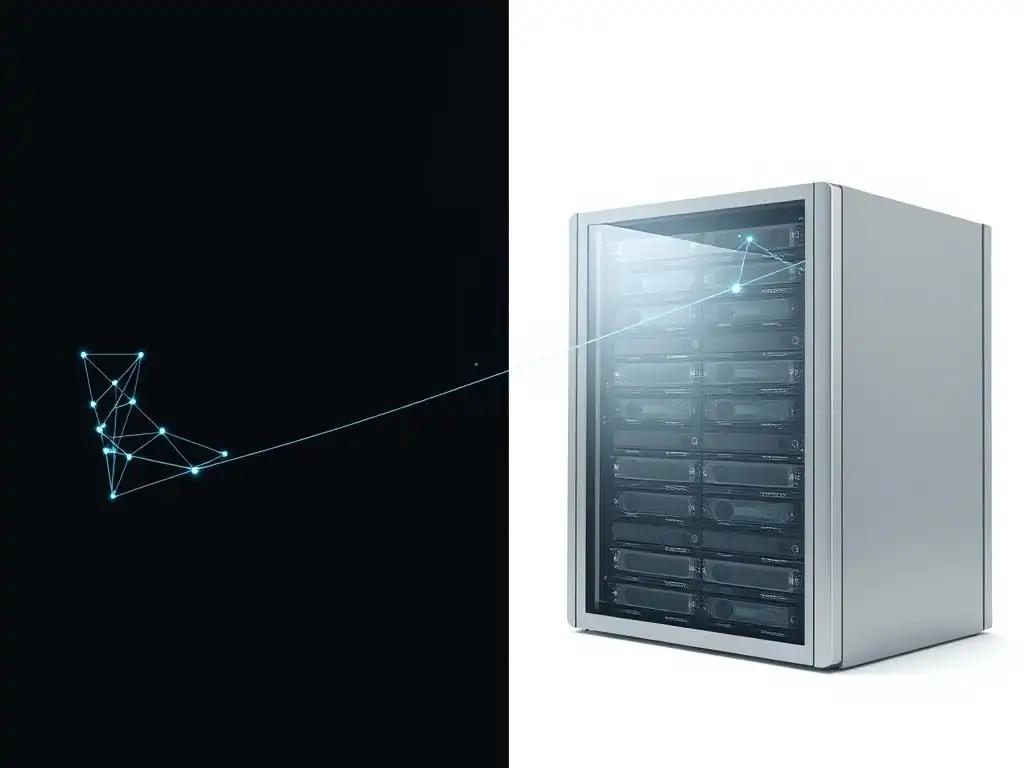
Understanding the fundamental differences is crucial when considering a blockchain vs cloud comparison for specific technological needs. While cloud computing provides a scalable, flexible, and cost-efficient infrastructure for hosting applications and storing data centrally, blockchain offers a decentralized, immutable, and transparent ledger for recording transactions and establishing trust without intermediaries.
- Architecture: Cloud is centralized/distributed across provider data centers; Blockchain is decentralized/distributed across network nodes.
- Control: Cloud provider controls infrastructure; Blockchain control is distributed across network participants via consensus.
- Data Model: Cloud uses traditional databases (relational, NoSQL); Blockchain uses a chain of cryptographically linked blocks.
- Immutability: Data in the cloud can typically be altered by authorized users; Data on blockchain is extremely difficult to alter once confirmed.
- Trust: Relies on trust in the cloud provider; Relies on cryptographic proof and network consensus ("trustless").
- Scalability: Highly scalable and elastic for compute/storage resources; Scalability varies greatly depending on blockchain type and design, often facing challenges compared to cloud.
- Cost Structure: Consumption-based (pay-as-you-go) OpEx model; Costs include infrastructure (often cloud), transaction fees, development.
- Primary Use Case: General-purpose computing, hosting applications, data storage, analytics; Secure, transparent, immutable record-keeping, enabling trust in decentralized systems.
- [x] Centralized vs. Decentralized Architecture
- [x] Data Mutability vs. Immutability
- [x] Trust in Provider vs. Trust via Consensus
- [x] Scalability Model (Elastic vs. Consensus-bound)
- [x] Cost Allocation (Consumption vs. Transaction/Infrastructure)
This task list summarizes the core areas of divergence in the blockchain vs cloud comparison, providing a quick reference for their fundamental differences.
How Blockchain and Cloud Computing Complement Each Other
Despite their fundamental differences, blockchain and cloud computing are not mutually exclusive. In fact, they can be highly complementary, with cloud platforms providing the scalable, reliable, and accessible infrastructure needed to build, deploy, and operate blockchain networks and applications. Cloud computing can offer the necessary computational power and storage for blockchain nodes, smart contract execution, and the development environments required for blockchain solutions.
Conversely, blockchain can enhance cloud services by providing decentralized security, data integrity, and transparency for specific cloud applications and data storage solutions. For instance, storing sensitive audit trails or critical metadata on a blockchain while the bulk data resides in the cloud can combine the scalability of cloud storage with the immutability and verifiability of a blockchain ledger. This synergistic approach leverages the strengths of each technology to create more robust and innovative solutions than either could achieve alone.
Hybrid Solutions: Combining Blockchain's Security with Cloud's Scalability
Hybrid solutions that integrate both blockchain and cloud computing are emerging as a powerful paradigm. In this model, organizations can leverage the vast scalability, flexibility, and range of services offered by cloud platforms while utilizing blockchain for specific functions where its unique properties are required.
For example, an enterprise might host its core business applications and large databases on a cloud infrastructure like AWS or Azure, benefiting from their elastic compute and storage. Simultaneously, critical transaction records, supply chain provenance data, or digital identity verification processes related to these applications could be recorded on a private or permissioned blockchain network, potentially also hosted on the same cloud infrastructure.
This approach allows businesses to maintain the performance and cost efficiencies of cloud computing for general operations while ensuring the integrity and immutability of sensitive data via the blockchain. According to a 2023 report by Grand View Research, the global blockchain technology market size was valued at approximately $11.5 billion and is expected to grow significantly, with enterprise solutions and integration into existing IT infrastructure (including cloud) being key drivers.
Hybrid blockchain-cloud deployments represent a practical way for enterprises to adopt blockchain without rebuilding their entire IT stack, demonstrating a key benefit in the blockchain vs cloud comparison when viewed from an integration perspective.
Blockchain as a Service (BaaS) on Cloud Platforms: Streamlining Blockchain Adoption
A significant development facilitating the integration of these technologies is the emergence of Blockchain as a Service (BaaS) offerings from major cloud providers. BaaS provides pre-configured network infrastructure, development tools, and management services to help businesses build, deploy, and manage their blockchain applications without needing deep expertise in underlying blockchain protocols or managing complex infrastructure. Cloud providers like AWS (Amazon Managed Blockchain), Azure (Azure Blockchain Service - though being deprecated/evolved), and Google Cloud (Google Cloud Blockchain Node Engine) offer BaaS platforms supporting various blockchain frameworks like Hyperledger Fabric, Ethereum, and Corda.
These BaaS platforms simplify the process of setting up and scaling blockchain networks, allowing developers to focus on building the application logic (smart contracts, dApps) rather than managing nodes, security patches, or network configurations. This significantly lowers the barrier to entry for organizations looking to explore or implement blockchain solutions.
By offering BaaS, cloud providers are effectively positioning themselves as the infrastructure layer for the decentralized web, highlighting how cloud computing can accelerate the adoption and development of blockchain technology. This symbiotic relationship shows how the cloud is essential infrastructure for many blockchain deployments today, moving beyond a simple blockchain vs cloud comparison to one of collaboration.
Use Cases for Blockchain and Cloud Integration: Secure Data Sharing, Enhanced Security, Improved Efficiency
The integration of blockchain and cloud computing unlocks powerful use cases across various industries. One prominent example is secure data sharing. Cloud platforms provide the storage and processing power for large datasets, while blockchain can provide an immutable audit trail of data access and usage, ensuring transparency and control over who accesses sensitive information. For instance, in healthcare, patient data could be stored in the cloud, with a blockchain recording patient consent and every instance the data is accessed by authorized medical professionals or researchers, enhancing privacy and compliance.
Enhanced security is another key benefit. While cloud providers offer robust security, integrating blockchain can add an extra layer of trust and verification for critical data. Blockchain can be used to verify the integrity of data stored in the cloud, ensuring it hasn't been tampered with.
For example, hashing files stored in the cloud and storing these hashes on a blockchain creates a verifiable link, proving the file's integrity at a specific point in time. Furthermore, blockchain can improve efficiency by streamlining processes that require multiple parties to agree on a shared set of data.
Using a shared ledger on a cloud platform allows participants to access and update information in near real-time, reducing delays and manual reconciliation efforts often found in traditional, siloed systems. A 2022 report by Deloitte highlighted that organizations are increasingly exploring how blockchain can augment existing cloud investments for areas like identity management and data provenance.
Real-World Examples of Blockchain and Cloud Integration
Numerous industries are beginning to implement solutions that combine the strengths of blockchain and cloud computing. These real-world applications move beyond theoretical blockchain vs cloud comparisons to demonstrate practical synergy, leveraging cloud for scale and accessibility and blockchain for trust and data integrity.
Supply Chain Management: Enhancing Transparency and Traceability with Blockchain and Cloud
Supply chain management is a prime example where blockchain and cloud integration delivers significant value. Companies like Walmart have partnered with IBM (using IBM Blockchain, often hosted on IBM Cloud) to improve food traceability. In this system, data about food products—from farm to store—is recorded on a blockchain. This includes information about origin, processing, shipping, and handling. The vast amount of data generated and accessed by numerous participants across the supply chain is managed and processed using cloud infrastructure.
The cloud provides the necessary storage, computing power for analytics, and user interfaces (often web or mobile applications hosted on the cloud) for participants to interact with the system. The blockchain ensures that the provenance data is immutable, transparent (to authorized parties), and verifiable. Before this system, tracing a food item back to its source could take days or weeks; with the integrated blockchain and cloud solution, it can often be done in seconds. This enhances food safety, reduces waste, and improves overall supply chain efficiency and trust among partners.
Healthcare: Securely Sharing Medical Records Using Blockchain and Cloud
In the healthcare sector, the combination of blockchain and cloud is being explored to address the challenge of securely sharing patient data while maintaining privacy and compliance with regulations like HIPAA. Electronic Health Records (EHRs) and medical images often reside in disparate systems or cloud storage. Using blockchain, a patient'centric health data management system can be created. The actual medical records (which can be large) are stored securely in the cloud, utilizing the cloud's scalability and accessibility.
A blockchain ledger is then used to store pointers to these records and, crucially, manage access permissions granted by the patient. When a doctor or specialist needs access to a patient's records, they request permission, which is recorded and managed on the blockchain.
The blockchain ensures that only authorized parties can access the data and provides an immutable audit trail of every access attempt. Companies like BurstIQ and Medicalchain are developing platforms leveraging this hybrid approach, demonstrating how cloud storage combined with blockchain's access control and auditability can create more secure and patient-controlled healthcare data systems compared to solely relying on centralized cloud solutions.
Financial Services: Improving Efficiency and Security in Transactions
The financial services industry, already a major consumer of cloud services, is increasingly integrating blockchain for specific transaction types and processes. While core banking systems often run on robust cloud infrastructure, blockchain is being used for areas like cross-border payments, trade finance, and clearing and settlement. For example, platforms like RippleNet (which leverages blockchain technology for payments) often rely on cloud infrastructure to host nodes, run applications, and provide user interfaces for banks and payment providers.
In trade finance, complex processes involving multiple banks, buyers, sellers, and shipping companies require significant coordination and trust. Cloud platforms provide the infrastructure for managing documents and communication, while blockchain can provide a shared, immutable ledger for recording trade agreements, letters of credit, and transaction statuses.
This reduces the potential for fraud and disputes and speeds up the overall process. Initiatives like We.Trade (a trade finance platform built on Hyperledger Fabric, often deployed on cloud) illustrate how cloud provides the backbone for these blockchain-based financial networks, showcasing a powerful synergy in the blockchain vs cloud comparison within a critical industry.
The Future of Blockchain and Cloud: A Synergistic Outlook
The trajectory for both blockchain and cloud computing points towards increased integration and synergy. As blockchain technology matures and addresses some of its current limitations, particularly around scalability and ease of use, cloud platforms will likely play an even more critical role in its widespread adoption. Similarly, blockchain's unique capabilities in ensuring data integrity and enabling decentralized trust will continue to find applications that enhance and secure cloud-based services.
The future likely involves more sophisticated hybrid architectures and specialized BaaS offerings that abstract away the complexity of blockchain deployment. We may see cloud providers offering more integrated services, such as decentralized identity solutions built on blockchain but managed via cloud interfaces, or data integrity services that automatically hash and record critical cloud data changes onto a ledger. This collaborative future suggests that the most impactful digital transformations will come not from choosing one technology over the other in a blockchain vs cloud comparison, but from strategically combining their respective strengths.
Trends in Blockchain and Cloud Integration
Several key trends are shaping the integration of blockchain and cloud technologies. Firstly, the expansion of BaaS offerings is making it easier for enterprises to experiment with and deploy blockchain solutions on familiar cloud infrastructure. Providers are adding support for more protocols and offering more managed services around blockchain nodes, wallets, and smart contract deployment. Secondly, there's a growing focus on interoperability, both between different blockchain networks and between blockchain and traditional IT systems (often cloud-based). Solutions are emerging to allow data and assets to move more freely, enhancing the utility of blockchain within broader enterprise ecosystems.
Thirdly, the development of confidential computing within cloud environments is becoming relevant. This technology allows data to be processed while encrypted, adding a layer of privacy that can complement the transparency of some blockchain applications, particularly in permissioned networks. Finally, the rise of edge computing, often managed via cloud platforms, combined with blockchain could enable decentralized data processing and verification closer to the source, further enhancing efficiency and security for IoT and other distributed systems. These trends highlight a move towards deeper, more sophisticated integration beyond simple hosting.
Potential Challenges and Opportunities
While the synergy between blockchain and cloud offers significant opportunities, there are also challenges to navigate. Integration complexity is a major hurdle; building and managing hybrid systems requires expertise in both domains. Ensuring seamless communication and data flow between centralized cloud databases and decentralized blockchain ledgers can be technically challenging. Security considerations also become more complex, requiring a holistic approach that secures both the cloud infrastructure and the blockchain layer, including smart contracts and private keys. Regulatory uncertainty surrounding both cloud data sovereignty and blockchain assets adds another layer of complexity for global deployments.
Despite these challenges, the opportunities are substantial. The combination can enable entirely new business models built on decentralized trust and scalable infrastructure. It can significantly improve the security and transparency of existing cloud applications.
For example, using blockchain for supply chain provenance on a cloud platform can unlock new levels of efficiency and consumer trust, potentially leading to billions in savings and new market opportunities. The integration also creates opportunities for developers and service providers specializing in these hybrid solutions, driving innovation in decentralized applications (dApps) that leverage cloud scalability. A report by Gartner in 2023 noted that while blockchain adoption is still maturing, its integration with established technologies like cloud is a key factor for enterprise growth.
The Role of Cloud in Accelerating Blockchain Adoption
Cloud computing plays a vital role in accelerating the adoption of blockchain technology, particularly within enterprises. By providing BaaS, cloud providers lower the technical barrier to entry, allowing companies to experiment with blockchain without significant upfront investment in hardware and expertise. This makes prototyping and deploying pilot projects much faster and more cost-effective. The scalability of the cloud also allows blockchain networks to grow with demand, overcoming some of the inherent scalability limitations faced by standalone blockchain deployments.
Furthermore, cloud platforms offer a rich ecosystem of related services – including analytics, AI/ML, IoT platforms, and developer tools – that can be easily integrated with blockchain solutions. This allows businesses to build more sophisticated applications that leverage blockchain for data integrity and trust while using cloud services for processing, analysis, and user interaction.
Essentially, the cloud provides the necessary foundation and tools for blockchain to move beyond niche applications and become a more mainstream enterprise technology. The blockchain vs cloud comparison shifts here from one of competition to one where cloud acts as an enabler for blockchain's broader impact.
Conclusion: Embracing the Power of Complementary Technologies
A comprehensive blockchain vs cloud comparison reveals that these technologies are not rivals but rather powerful complements. Cloud computing offers the essential infrastructure backbone – providing unparalleled scalability, flexibility, and accessibility for computing resources and data storage. Its centralized model excels at handling high volumes of data and transactions efficiently and cost-effectively.
Blockchain, on the other hand, provides a unique set of properties centered around decentralization, immutability, transparency, and trustless verification. It is ideal for use cases requiring secure, verifiable, and tamper-proof record-keeping, especially where multiple parties need to interact without a central authority.
By strategically combining the strengths of cloud's infrastructure capabilities with blockchain's trust and data integrity features, organizations can build innovative, resilient, and secure digital solutions that are greater than the sum of their parts. The future of digital transformation lies in embracing this synergy, moving beyond a simple blockchain cloud comparison to leveraging both technologies in concert to unlock new possibilities across industries.
Frequently Asked Questions
What are the fundamental differences between blockchain and cloud computing?
Blockchain is a decentralized, immutable ledger, while cloud computing provides centralized and scalable computing resources. Data security is handled differently, with blockchain relying on cryptography and cloud on traditional security measures.
How can blockchain and cloud computing complement each other in enterprise applications?
Cloud computing offers the infrastructure for blockchain networks, providing the necessary storage and processing power. Blockchain can enhance cloud security and data integrity through immutable audit trails and verifiable data.
What are the key advantages of using blockchain over cloud computing for data security?
Blockchain offers enhanced transparency and immutability, making data tampering significantly harder. The decentralized nature reduces the risk of a single point of failure, improving overall security.
What are the regulatory considerations when implementing blockchain and cloud solutions?
Regulations surrounding data privacy, such as GDPR, can impact both blockchain and cloud deployments. Compliance requirements vary depending on the jurisdiction and application, requiring careful consideration.
In what scenarios is a blockchain vs cloud comparison crucial for making informed technology decisions?
When deciding on data storage and security, especially where transparency and immutability are paramount. Blockchain is suited for verifying transactions, while cloud is better for general-purpose computing and storage needs.
Final Reflection: Embracing the Symbiotic Future of Tech
The exploration of blockchain and cloud computing reveals not a competition, but a powerful synergy. The true potential lies in understanding how these technologies complement each other, offering solutions that neither could achieve alone. From secure data storage to decentralized applications, the combined force of blockchain and cloud is already reshaping industries and redefining possibilities.
This convergence has deeply influenced the digital landscape, moving us towards a more secure, transparent, and efficient future. Witnessing this evolution firsthand underscores the importance of continuous learning and adaptation in the face of technological advancement. The best way to predict the future is to create it.
- Peter Drucker. This quote resonates deeply as we consider the active role we play in shaping the future powered by these technologies.
Now, consider how you can leverage this understanding in your own endeavors. How can you integrate the security of blockchain with the scalability of the cloud to innovate and solve real-world problems? The future is not about choosing one over the other, but about embracing the symbiotic relationship between these technologies and harnessing their combined power to build a better tomorrow.
Unleash the Power: Integrate Blockchain & Cloud Today!
Thank you for exploring the world of blockchain and cloud computing with us! We hope you've gained a clearer understanding of how these technologies can work together to transform industries. Now, it's time to turn that knowledge into action.
Here are a few steps you can take to further explore this powerful synergy:
- Start small: Identify one area in your current workflow where implementing a simple blockchain solution alongside your existing cloud infrastructure could enhance security or efficiency. Gaining practical experience is invaluable!
- Delve deeper: Research emerging hybrid blockchain-cloud platforms and use cases to expand your understanding of advanced integration strategies. Look for platforms that facilitate easy setup and development for both technologies.
- Join the conversation: Share this article with your network and initiate a discussion about the future of blockchain and cloud computing across various industries. What innovative applications do you foresee?
What is the first practical application of blockchain and cloud computing you plan to explore this week? Let us know in the comments below!
Leave a Reply