
Smart Contracts: Automating Trust on the Blockchain


Welcome to Blockchain Trends!
Dive into the groundbreaking world where trust is encoded and automation reigns supreme. Are you ready to explore how blockchain smart contracts are revolutionizing industries, eliminating intermediaries, and forging a new era of verifiable agreements? This article unpacks the fundamentals of blockchain smart contracts, revealing how they are automating trust and shaping the future of decentralized systems. Discover how this technology transcends cryptocurrency and unlocks unprecedented possibilities. Intrigued? Let's delve deeper...
Smart Contracts: Automating Trust on the Blockchain
- Understanding Smart Contracts and Blockchain Technology
- The Mechanics of Smart Contract Automation
- Benefits of Automating Trust with Smart Contracts
-
Real-World Applications of Smart Contracts
- Smart Contracts in Supply Chain Management: Tracking and Traceability
- Smart Contracts in Decentralized Finance (DeFi): Lending, Borrowing, and Trading
- Smart Contracts in Healthcare: Secure Data Sharing and Patient Empowerment
- Smart Contracts in Voting Systems: Enhancing Security and Transparency
- Smart Contracts in Digital Identity Management: Secure and Self-Sovereign Identities
- Challenges and Limitations of Smart Contracts
- The Future of Smart Contracts and Blockchain Automation
- Conclusion: Embracing the Power of Smart Contracts for Trust and Automation
-
Frequently Asked Questions
- How do smart contracts automate trust on the blockchain?
- What are some practical applications of smart contracts beyond cryptocurrencies?
- What role does regulation play in the adoption of smart contracts?
- How do smart contracts contribute to the future of decentralized systems?
- What are the key considerations when designing and deploying secure smart contracts?
- Final Reflection: Embracing Trustless Automation
- Unveil Your Smart Contract Potential!
Understanding Smart Contracts and Blockchain Technology
What are Smart Contracts? A Definition
At their core, smart contracts are self-executing agreements where the terms of the agreement between buyer and seller are directly written into lines of code. This code and the agreements contained therein exist across a distributed, decentralized blockchain network. The code controls the execution, and transactions are trackable and irreversible. Think of them as digital vending machines: you put in your crypto (input), the code verifies the input (condition met), and the machine dispenses your item (output) automatically.
Unlike traditional contracts that rely on intermediaries (like lawyers or banks) and legal systems for enforcement, smart contracts automate the enforcement directly through cryptographic code. They operate on an "if-then" logic: if condition X is met, then action Y is automatically executed. This fundamental mechanism allows for the automation of trust in various digital transactions, removing the need for faith in a third party's reliability or integrity. The blockchain provides the secure, immutable environment for these contracts to live and operate.
The Role of Smart Contracts in Blockchain Ecosystems
Smart contracts are the backbone of many modern blockchain applications, extending the technology's utility far beyond simple cryptocurrency transfers. They enable the creation of complex decentralized applications (dApps), facilitating interactions between users and protocols without a central authority. From managing digital assets to coordinating complex workflows, smart contracts provide the logic and execution layer for these systems.
In blockchain ecosystems, smart contracts serve as programmable agents that react to specific triggers. They can hold funds, verify identities, manage access permissions, or automate payment flows based on predefined conditions. This capability is crucial for building sophisticated platforms like decentralized exchanges (DEXs), lending protocols, and supply chain tracking systems, where automated, trustless execution is paramount for efficiency and security.
How Smart Contracts Enhance Trust and Security in Decentralized Systems
Blockchain smart contracts automation trust by embedding the terms of an agreement directly into transparent, tamper-proof code. Because the code is deployed on a blockchain, it benefits from the network's inherent security features, such as cryptographic hashing and decentralized consensus mechanisms. Once deployed, the contract's code and state are typically immutable, meaning they cannot be altered by any single party, including the creator.
This immutability, combined with the transparency of the blockchain ledger (where all transactions and state changes are publicly verifiable), significantly enhances trust. Participants don't need to trust each other; they only need to trust the underlying code and the blockchain network's integrity. The deterministic nature of smart contract execution ensures that the outcome of a contract's logic is predictable and reliable, further solidifying this trust model. This approach to blockchain smart contracts automation trust is a paradigm shift from traditional reliance on intermediaries.
The Mechanics of Smart Contract Automation
Smart Contract Creation and Deployment on the Blockchain
The journey of a smart contract begins with writing the code. Popular languages like Solidity (for Ethereum and compatible networks) or Rust (for networks like Solana and Polana) are used to define the contract's logic, state variables, and functions. Developers specify the conditions under which certain actions should occur and the data the contract will manage. Rigorous testing is crucial at this stage to identify potential bugs or vulnerabilities.
Once the code is written and tested, it is compiled into bytecode, which is the machine-readable format understood by the blockchain's virtual machine (e.g., the Ethereum Virtual Machine, or EVM). This bytecode is then deployed as a transaction to the blockchain network. Deployment typically requires paying a transaction fee, often called "gas," which compensates network validators for processing and storing the contract data. After deployment, the smart contract resides at a specific address on the blockchain, ready to interact with users and other contracts.
Smart Contract Execution: How Transactions are Automatically Processed
Smart contract execution is triggered by a transaction sent to the contract's address. This transaction can be initiated by an external user account (like a wallet) or by another smart contract. The transaction includes data that specifies which function within the smart contract should be called and any necessary input parameters. For example, a transaction might call a transfer() function on a token contract or a deposit() function on a lending protocol contract.
When the transaction reaches the network, it is processed by validators (or miners, depending on the consensus mechanism). The virtual machine executes the smart contract's code based on the transaction's data and the contract's current state.
If the conditions specified in the contract's logic are met (e.g., the sender has sufficient funds, the input parameters are valid), the contract performs the programmed actions, such as transferring tokens, updating internal balances, or emitting events. The result of the execution, including any changes to the contract's state, is then recorded on the blockchain as part of a new block, making it a permanent and verifiable record.
The Immutable Nature of Smart Contracts: Ensuring Transparency and Auditability
A key characteristic of blockchain smart contracts is their typical immutability after deployment. Once the compiled bytecode is added to the blockchain, it generally cannot be altered. This provides a high degree of assurance that the rules and logic of the contract will remain exactly as they were written, preventing one party from unilaterally changing the terms of an agreement after it has begun.
This immutability is fundamental to ensuring transparency and auditability. Anyone can view the deployed code on the public ledger (or through block explorers) and verify its logic. Furthermore, every interaction with the contract and every state change it undergoes is recorded on the blockchain, creating a comprehensive and permanent audit trail. This allows participants and external auditors to independently verify that the contract executed as intended and that no unauthorized modifications occurred, reinforcing the trust model built on blockchain smart contracts automation trust.
Benefits of Automating Trust with Smart Contracts
Enhanced Security and Reduced Risk of Fraud with Smart Contracts
Blockchain smart contracts significantly enhance security by replacing fallible human processes and vulnerable centralized databases with cryptographically secured, automated code. The logic is predefined and executed deterministically, removing opportunities for human error, manipulation, or selective enforcement of terms. Funds or assets involved in a smart contract are often held in escrow within the contract itself, released automatically only when the agreed-upon conditions are met, reducing counterparty risk.
Furthermore, the decentralized nature of the blockchain makes smart contracts highly resistant to single points of failure or malicious attacks aimed at altering the agreement. While smart contracts can have code vulnerabilities (which are a separate challenge), the execution environment provided by the blockchain is inherently more secure and tamper-proof than traditional centralized systems. This inherent security is a core component of achieving blockchain smart contracts automation trust.
Increased Efficiency and Cost Reduction Through Smart Contract Automation
Automating agreements with smart contracts dramatically increases efficiency by eliminating intermediaries and manual processing steps. Tasks such as verification, approval, and execution that previously required human intervention, paper trails, and multiple third parties can be handled instantly and automatically by the code. This speeds up transaction times from days or weeks to minutes or seconds, depending on the blockchain network's speed.
The removal of intermediaries like brokers, agents, or escrow services also leads to significant cost reductions. Fees associated with these third parties are often substantial. By automating these functions through smart contracts, businesses and individuals can transact directly and more economically. For example, processing a complex insurance claim or settling a cross-border payment can be streamlined and made cheaper through smart contract automation.
Improved Transparency and Accountability in Business Processes
The public and immutable nature of most blockchains on which smart contracts are deployed provides unparalleled transparency. The terms of the smart contract (the code) are often publicly visible, and every transaction that interacts with the contract is recorded on the ledger, accessible to anyone. This means that the execution of agreements is not a black box but an open, auditable process.
This transparency fosters accountability. Since all actions and state changes are recorded on-chain, it is clear when conditions were met, who initiated a transaction, and how the contract responded. Disputes can often be resolved by examining the immutable on-chain record, reducing ambiguity and providing a clear, verifiable history of the agreement's execution. This level of transparency and accountability is difficult to achieve with traditional, opaque systems.
Real-World Applications of Smart Contracts
Smart Contracts in Supply Chain Management: Tracking and Traceability
Smart contracts are transforming supply chain management by enabling automated, transparent tracking and verification of goods. Companies can use smart contracts to record each step of a product's journey – from raw materials to manufacturing, shipping, and delivery. For instance, a smart contract could automatically trigger payment to a supplier once a shipment's arrival is confirmed by an IoT device or a designated oracle.
Major companies and consortiums are piloting or implementing blockchain solutions leveraging smart contracts. For example, IBM Food Trust uses blockchain to improve food traceability, allowing participants to track food items in seconds compared to days with traditional methods. A smart contract could automate quality checks or compliance steps, releasing payment only when specific certifications are verified on-chain, thereby building blockchain smart contracts automation trust within complex supply chains.
Smart Contracts in Decentralized Finance (DeFi): Lending, Borrowing, and Trading
Decentralized Finance (DeFi) is arguably the most prominent real-world application of smart contracts today. DeFi protocols, like Aave or Compound, use smart contracts to automate lending and borrowing processes without traditional banks. Users can deposit crypto assets into a smart contract pool and earn interest (paid out automatically by the contract), or borrow assets by locking up collateral in another smart contract, with liquidation automatically triggered if collateral value drops below a certain threshold.
Decentralized exchanges (DEXs) like Uniswap rely on smart contracts (specifically, automated market makers) to facilitate token swaps directly between users, bypassing centralized order books. These smart contracts manage liquidity pools and execute trades based on algorithmic rules, ensuring that trades are settled instantly and transparently on the blockchain. As of late 2023, the total value locked (TVL) in DeFi protocols, predominantly managed by smart contracts, exceeded $40 billion across various networks, showcasing the scale of smart contract automation trust in finance.
Smart Contracts in Healthcare: Secure Data Sharing and Patient Empowerment
In healthcare, smart contracts can address critical issues like data security, privacy, and interoperability. They can be used to create a secure, auditable log of who accesses patient records, granting or revoking permissions based on predefined conditions set by the patient. A patient could use a smart contract to give a specific doctor access to their records for a limited time or purpose.
Furthermore, smart contracts can facilitate automated payments for medical services upon verification of treatment delivery or manage consent for research data usage. While widespread adoption is still in early stages, pilot projects explore using blockchain and smart contracts to ensure data integrity in clinical trials or manage supply chains for pharmaceuticals, enhancing trust and compliance through blockchain smart contracts automation trust.
Smart Contracts in Voting Systems: Enhancing Security and Transparency
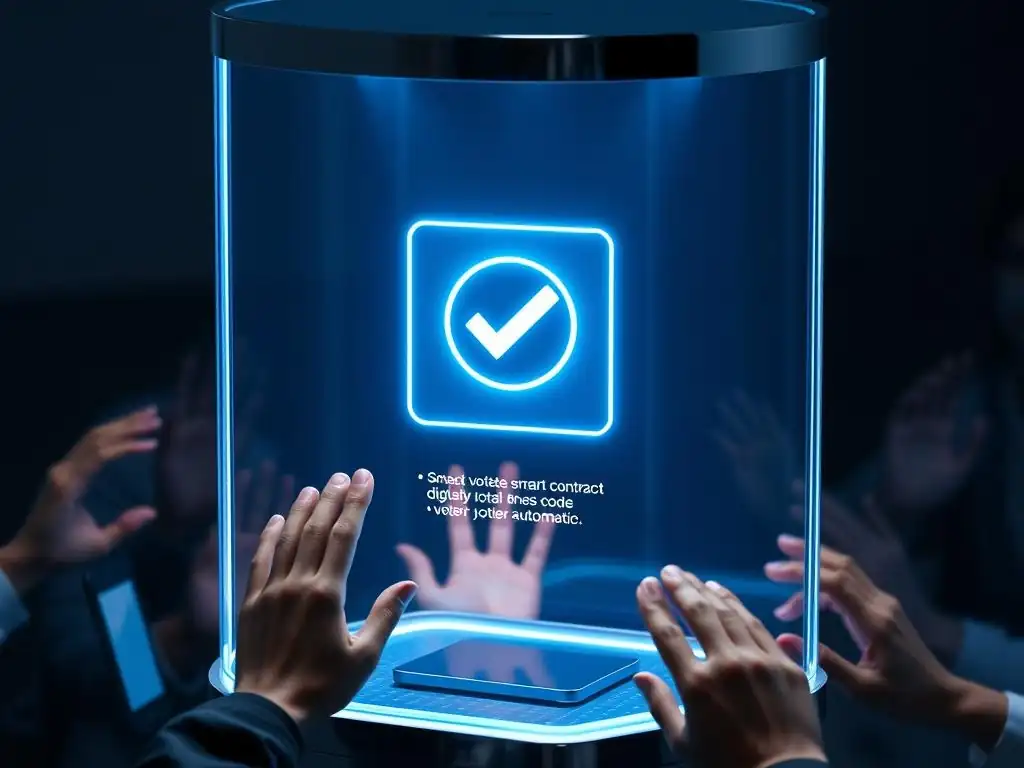
Smart contracts offer a compelling alternative for voting systems, promising increased security, transparency, and accessibility compared to traditional methods. A smart contract based voting system could record each vote as an immutable transaction on the blockchain, making it impossible to tamper with votes after they are cast. The smart contract could also be programmed to automatically tally the votes once the voting period ends, ensuring an accurate and transparent count.
While not yet widely adopted for national elections due to scalability and identity verification challenges, research and pilot projects are exploring this potential. Blockchain-based voting platforms have been used for shareholder meetings or internal organizational polls, demonstrating the ability of smart contracts to automate the voting process securely and transparently, building trust in the integrity of the result.
Smart Contracts in Digital Identity Management: Secure and Self-Sovereign Identities
Smart contracts are foundational to the concept of self-sovereign identity (SSI), where individuals control their digital identities and personal data. Instead of relying on centralized authorities (like governments or corporations) to manage identity, users can store verified credentials cryptographically and use smart contracts to selectively share proof of attributes without revealing the underlying data.
For example, a smart contract could verify that a user is over 18 without needing to see their date of birth, simply by interacting with a trusted issuer's contract that attests to that fact. This empowers individuals, improves privacy, and reduces the risk of large-scale data breaches associated with centralized identity databases. Smart contracts facilitate the secure interaction and verification of these credentials, automating trust in digital identity assertions.
Challenges and Limitations of Smart Contracts
Smart Contract Security Vulnerabilities and Auditing Best Practices
Despite their inherent security features, smart contracts are susceptible to vulnerabilities in their code. Bugs can lead to significant financial losses, as demonstrated by historical incidents like the 2016 DAO hack, where a reentrancy bug allowed an attacker to drain over $60 million worth of Ether, or the 2017 Parity wallet bug that locked up hundreds of millions of dollars. Once deployed, buggy smart contracts are often difficult or impossible to fix due to immutability.
Therefore, rigorous security auditing is a critical best practice. This involves expert review of the contract code for common vulnerabilities (reentrancy, integer overflow/underflow, access control issues) and formal verification techniques. While audits can be costly, ranging from a few thousand to tens of thousands of dollars depending on complexity, they are essential for minimizing risk when deploying smart contracts intended for handling significant value or sensitive data. Building blockchain smart contracts automation trust requires robust security measures.
Legal and Regulatory Considerations for Smart Contract Implementation
The intersection of smart contracts and traditional legal systems presents significant challenges. While smart contracts automate execution based on code, their legal enforceability in courts is often unclear. Questions arise about jurisdiction, contract interpretation (code vs. natural language), and liability in case of errors or unforeseen circumstances. Who is liable if a bug in the code causes a loss? The developer? The deployer? The network?
Regulatory frameworks worldwide are still evolving to address blockchain technology and smart contracts. Lack of clear guidance can create uncertainty for businesses seeking to implement smart contract solutions. For instance, determining if a smart contract constitutes a security, a derivative, or another regulated instrument can impact compliance requirements. Navigating this complex legal and regulatory landscape is crucial for the successful and lawful adoption of smart contracts.
Scalability Issues and Potential Solutions for Smart Contract Performance
Many public blockchains, particularly those that host complex smart contracts (like Ethereum's mainnet before recent upgrades), have faced scalability limitations. The number of transactions per second (TPS) they can process is relatively low compared to traditional payment systems, leading to network congestion, high transaction fees (gas costs), and slow confirmation times when demand is high. This can hinder the performance and user experience of dApps relying on smart contracts.
Solutions to these scalability issues include Layer 2 scaling techniques such as rollups (optimistic and zero-knowledge), state channels, and sidechains. These technologies process smart contract computations and transactions off the main blockchain, periodically submitting compressed proofs or summaries back to the main chain for final settlement and security. Networks specifically designed for higher throughput also offer alternative platforms for deploying smart contracts requiring greater performance.
The "Oracle Problem" and Data Accuracy in Smart Contracts
Smart contracts often need access to real-world data to execute their logic. For example, an insurance smart contract might need to know the weather conditions at a specific location to pay out a claim, or a DeFi lending contract might need the current market price of collateral assets. This external data cannot be directly accessed by the blockchain itself; it must be fed into the contract. This is known as the "oracle problem."
If the data provided by an oracle is inaccurate, manipulated, or unavailable, the smart contract will execute based on faulty information, potentially leading to incorrect or unfair outcomes. Relying on a single, centralized data feed reintroduces a point of failure and counteracts the decentralized nature of the smart contract. Decentralized oracle networks, such as Chainlink, address this by using multiple independent data sources and nodes to provide more reliable and tamper-resistant data feeds to smart contracts, helping maintain the integrity of blockchain smart contracts automation trust.
The Future of Smart Contracts and Blockchain Automation
Emerging Trends in Smart Contract Development and Deployment
The field of smart contract development is rapidly evolving, with several key trends shaping its future. Formal verification, a method of mathematically proving that code behaves as intended, is gaining traction as a way to enhance smart contract security beyond traditional auditing. Cross-chain smart contracts, enabled by interoperability protocols, aim to allow contracts on one blockchain to interact seamlessly with assets and data on other chains, breaking down existing silos.
Furthermore, new programming languages and development frameworks are emerging, promising improved security features, easier development, and greater performance. The focus is increasingly on creating upgradeable smart contracts (while carefully managing the risks) and developing standardized interfaces and libraries to foster greater composability and innovation within decentralized ecosystems.
The Impact of Smart Contracts on Traditional Industries
The transformative potential of blockchain smart contracts automation trust extends deeply into traditional industries. In real estate, smart contracts could automate property transfers, escrow services, and lease agreements. The insurance sector could see claims processing automated based on verified data feeds. Legal industries are exploring "legally binding smart contracts" that bridge the gap between code-based execution and traditional legal frameworks.
Supply chains will become more efficient and transparent, as discussed earlier. Financial services will continue to be disrupted by DeFi applications, offering alternatives to traditional banking, lending, and trading. While full-scale disruption will take time due to regulatory and adoption hurdles, smart contracts are poised to streamline processes, reduce costs, and introduce new business models across numerous sectors.
The Role of Smart Contracts in Building a More Decentralized Future
Smart contracts are instrumental in building a more decentralized future across various domains. They are the operational engine for Decentralized Autonomous Organizations (DAOs), where governance rules and operational logic are encoded in smart contracts, allowing communities to manage resources and make decisions collectively without central authority.
In the broader Web3 vision, smart contracts are foundational for creating decentralized internet services, social networks, and marketplaces where users have greater control over their data and interactions are peer-to-peer. By automating agreements and logic on decentralized infrastructure, smart contracts enable the shift from platforms owned and controlled by single entities to protocols owned and governed by their users, fostering greater trust and autonomy.
The Convergence of Smart Contracts and AI: Enabling Autonomous Agents
An exciting future trend is the convergence of smart contracts with Artificial Intelligence (AI). AI models could potentially be integrated with smart contracts to create autonomous agents capable of making complex decisions and executing actions on the blockchain based on sophisticated analysis. For instance, an AI could manage a diversified investment portfolio via smart contracts, automatically rebalancing based on market conditions.
This convergence could lead to highly sophisticated, self-managing decentralized systems. However, it also introduces new challenges related to the explainability and auditability of AI decisions embedded within immutable smart contracts. Research is ongoing into creating secure and reliable interfaces between off-chain AI computations and on-chain smart contract execution, exploring how AI can enhance the capabilities of blockchain smart contracts automation trust in novel ways.
Conclusion: Embracing the Power of Smart Contracts for Trust and Automation
Smart contracts represent a significant evolution in how agreements are made and executed. By embedding logic directly into code on a blockchain, they enable the automation of trust, moving away from reliance on intermediaries towards verifiable, transparent, and immutable execution. This fundamental shift unlocks unprecedented levels of efficiency, security, and transparency across a wide range of applications, from finance and supply chains to healthcare and digital identity.
While challenges related to security, regulation, scalability, and data accuracy remain, ongoing development and innovation are continuously addressing these issues. As the technology matures and best practices become more established, smart contracts are set to play an increasingly vital role in automating processes, reducing costs, and fostering a more decentralized and trustworthy digital world. Embracing the power of blockchain smart contracts automation trust is key to unlocking the full potential of decentralized technologies.
Frequently Asked Questions
How do smart contracts automate trust on the blockchain?
Smart contracts automate trust by executing predefined rules when specified conditions are met. This eliminates the need for intermediaries and relies on the immutable nature of the blockchain.
What are some practical applications of smart contracts beyond cryptocurrencies?
Beyond crypto, smart contracts are used in DeFi for lending and borrowing, supply chain management for tracking goods, and enterprise applications for automating workflows. They offer increased efficiency and transparency.
What role does regulation play in the adoption of smart contracts?
Regulation aims to provide a legal framework for smart contracts. It addresses issues like liability and enforceability, which are crucial for widespread adoption and building user confidence.
How do smart contracts contribute to the future of decentralized systems?
Smart contracts are fundamental to building decentralized applications (dApps) and organizations (DAOs). They enable autonomous and transparent governance, fostering a more trustless and collaborative environment.
What are the key considerations when designing and deploying secure smart contracts?
Security is paramount. Developers must consider issues like code vulnerabilities, gas optimization, and potential attacks. Thorough auditing and testing are crucial to prevent exploitation and loss of funds.
Final Reflection: Embracing Trustless Automation
The exploration of smart contracts reveals a powerful paradigm shift, where code becomes law and trust is algorithmically enforced. Today, as we grapple with issues of transparency and accountability in various sectors, the potential of blockchain smart contracts to automate trust becomes not just a technological advancement, but a societal imperative.
The influence of smart contracts extends far beyond the realm of cryptocurrency, subtly reshaping how we perceive agreements and interactions. This technology offers a glimpse into a future where intermediaries are minimized and verifiable execution is the norm, fostering a more equitable and efficient world. The beauty of smart contracts is that they eliminate the need for trust. Not just in the sense of not needing to trust the other party, but also in the sense of not needing to trust the system itself.
- Vitalik Buterin
As you consider the implications of blockchain smart contracts and their ability to automate trust, I invite you to reflect on the systems you interact with daily. How might these systems be improved through greater transparency and automated execution? Embrace the potential of this technology to build a future where trust is not a commodity, but a fundamental building block of our digital world.
Unveil Your Smart Contract Potential!
Thank you for exploring the world of smart contracts with us! We hope you've gained valuable insights into how these powerful tools are automating trust and revolutionizing various industries. Now, it's time to put that knowledge into action.
- Dive Deeper: Explore a real-world smart contract on a platform like Ethereum's Etherscan to see its code and transactions.: This hands-on experience is invaluable.
- Consider experimenting with a user-friendly smart contract development environment, like Remix, to get a feel for writing your own basic contract.
- Share this article with a colleague or friend interested in blockchain technology and spark a conversation about its potential applications.
What's one specific industry where you envision smart contracts making the biggest impact, and why? Share your thoughts in the comments below!
Leave a Reply