
Demystifying DeFi Smart Contracts for Beginners: Code You Should Know?


Welcome to Blockchain Trends, your gateway to understanding the revolutionary world beyond Bitcoin! Intrigued by the potential of decentralized finance? We delve deep into the transformative applications of blockchain, from enterprise solutions to regulatory landscapes. Ready to unlock the secrets? This article explores the vital DeFi smart contract basics every investor should know. Discover the fundamental code that governs this exciting space, and see how it shapes the future of finance! Keep reading to demystify the complexities and empower your DeFi journey.
Demystifying DeFi Smart Contracts for Beginners: Code You Should Know?
- Introduction to DeFi Smart Contracts Basics
- Key Features of DeFi Smart Contracts
- Understanding the Coding Languages for DeFi Smart Contracts
-
Frequently Asked Questions
- What exactly are DeFi smart contracts and why are they important?
- What programming languages are commonly used to create DeFi smart contracts?
- What are some potential risks associated with DeFi smart contracts?
- How do DeFi smart contracts differ from traditional financial agreements?
- How can I get started learning about DeFi smart contract development?
- Final Reflection: Embracing the Decentralized Future
- Unlock Your DeFi Potential: Start Building Today!
Introduction to DeFi Smart Contracts Basics
What Are Smart Contracts in DeFi?
At their core, smart contracts are self-executing pieces of code stored on a blockchain network. They automatically carry out predefined actions when specific conditions are met, eliminating the need for intermediaries. In the realm of Decentralized Finance (DeFi), these smart contracts form the foundational building blocks. They automate financial operations that traditionally require banks, brokers, or lawyers, such as lending, borrowing, trading, and asset management. Understanding DeFi smart contract basics is crucial for anyone looking to engage with or build on decentralized platforms.
These digital agreements are transparent, immutable, and distributed across the network, meaning their execution is verifiable by anyone and cannot be altered once deployed. For instance, a lending protocol like Aave or Compound utilizes complex smart contracts to manage loan pools, calculate interest rates algorithmically, and automatically execute liquidations if collateral falls below a certain threshold. Similarly, decentralized exchanges (DEXs) like Uniswap use smart contracts to enable peer-to-peer token swaps directly on the blockchain, without requiring a central order book or custodian.
Importance of DeFi Smart Contracts in Blockchain Technology
Smart contracts are not just an interesting application of blockchain; they are the engine driving the innovation within the DeFi sector. Their ability to automate complex transactions and agreements without trusted third parties is revolutionary for finance.
They enable true peer-to-peer interactions at scale, significantly reducing costs, increasing speed, and providing greater accessibility to financial services for a global audience. This shift is evident in the rapid growth of DeFi; while volatile, the Total Value Locked (TVL) in DeFi protocols has surged from under $1 billion in early 2020 to often exceeding $50-100 billion across various chains, demonstrating significant adoption and trust in these automated systems.
The importance of understanding DeFi smart contract basics extends beyond just using DeFi applications; it's about comprehending the underlying mechanisms that provide transparency and potential security. While not infallible, the open nature of smart contract code allows for public scrutiny and verification of logic, a stark contrast to the opaque systems of traditional finance. This transparency, combined with the inherent security features of blockchain like immutability, fosters a trustless environment where participants rely on code and cryptography rather than institutions.
Key Features of DeFi Smart Contracts
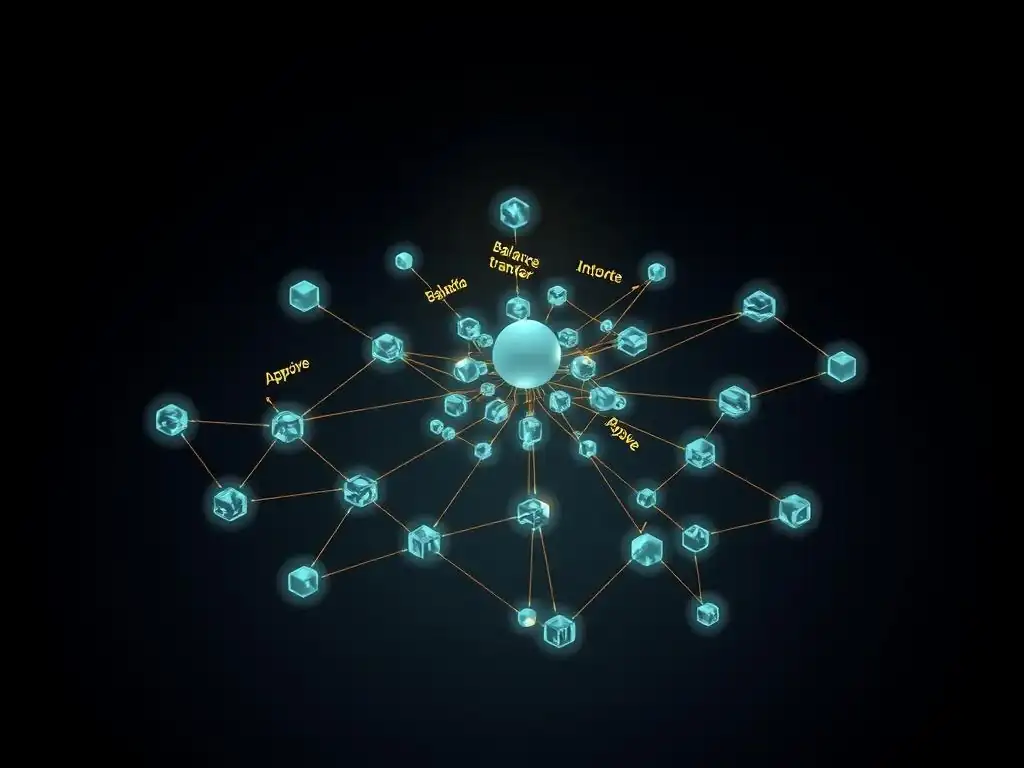
Automated Processes: How Smart Contracts Work
The fundamental principle behind smart contracts is automation based on logic: "if X happens, then execute Y." This logic is coded into the contract and deployed onto the blockchain. Once deployed, the contract resides at a specific address and waits for predefined conditions to be met, often triggered by transactions or data feeds (like price oracles).
For example, a simple smart contract for a token swap might state: "If User A sends 1 ETH to this contract, then send User A 1500 USDC from the contract's balance." The contract holds the assets and automatically executes the exchange when the condition (receiving 1 ETH) is fulfilled.
In more complex DeFi scenarios, such as liquidity pools on an Automated Market Maker (AMM) like Uniswap, smart contracts manage vast reserves of different token pairs. They use algorithms, like the constant product formula (x * y = k), to determine exchange rates and automatically execute swaps based on user interactions.
When a user wants to swap Token A for Token B, they send Token A to the contract, which then calculates the amount of Token B to send back based on the current pool ratio and the formula, executing the trade instantly and autonomously. This automation removes the need for order books and market makers, enabling continuous trading.
Transparency and Security: The Backbone of DeFi
One of the most lauded features of DeFi smart contracts is their transparency. The code of most public smart contracts is open-source and verifiable on the blockchain explorer. Anyone can read the code and understand exactly how the contract is supposed to function. Furthermore, all transactions interacting with the smart contract are recorded on the public ledger, providing a complete and immutable history of its operations. This level of openness is a significant departure from traditional financial systems, where internal processes are often proprietary and opaque. This transparency is a key element in building trust in decentralized systems.
Security in DeFi smart contracts is derived from the underlying blockchain technology itself, particularly its cryptographic principles and distributed nature. Transactions are cryptographically secured, and the distributed ledger makes it incredibly difficult for any single entity to tamper with the contract's execution or data retroactively. However, while the blockchain infrastructure provides security, the smart contract code itself is susceptible to vulnerabilities if not written correctly. This is why code audits by security experts are a critical step in the development lifecycle, aiming to identify and fix potential bugs before deployment.
Immutability: Why Code Cannot Be Changed
A defining characteristic of smart contracts, once deployed on a blockchain like Ethereum, is their immutability. This means that the code cannot be changed or updated after it has been written to the blockchain. This feature is a double-edged sword: it provides a high level of trust and predictability, as users can be certain the contract will execute exactly as coded, without fear of malicious alterations after deployment. For instance, a lending contract's interest rate calculation logic, once deployed, cannot be secretly tweaked by the protocol's administrators. This immutability is central to the trustless nature of DeFi.
However, immutability also presents challenges, particularly if bugs or vulnerabilities are discovered in the code after deployment. Since the original contract cannot be fixed, developers often employ strategies like deploying new, corrected versions of contracts and migrating users or assets, or using upgradeable proxy patterns. These patterns involve a simple, immutable proxy contract that delegates calls to an implementation contract, which can be updated. While this offers flexibility, it also introduces additional complexity and potential points of failure, and some purists argue it slightly compromises the ideal of pure immutability.
Understanding the Coding Languages for DeFi Smart Contracts
Solidity: The Primary Language for Ethereum Smart Contracts
Solidity is currently the most popular and widely used programming language for writing smart contracts on the Ethereum Virtual Machine (EVM). Since the vast majority of DeFi activity initially took place on Ethereum and EVM-compatible chains (like Binance Smart Chain, Polygon, Avalanche, etc. ), Solidity became the de facto standard for developing DeFi smart contracts. It is a high-level, object-oriented language heavily influenced by C++, Python, and JavaScript, designed specifically for creating and implementing smart contracts. Its structure allows developers to define state variables, functions, events, and modifiers, essential components for building complex decentralized applications.
Learning Solidity is often the first step for developers entering the DeFi space. Resources like documentation, tutorials, and interactive coding platforms are readily available. A simple Solidity contract might define state variables to store balances and functions to transfer tokens. For example, a basic token contract written in Solidity would include functions like transfer(address recipient, uint256 amount) and state variables like mapping(address => uint256) balances; to track token ownership. While powerful, Solidity's complexity also means it can be prone to errors if not used carefully, underscoring the need for rigorous testing and auditing.
Vyper: An Alternative for Secure Smart Contracts
Vyper is another programming language designed for the EVM, intended as an alternative to Solidity with a focus on security and simplicity. Unlike Solidity, which aims for flexibility, Vyper is deliberately designed with fewer features (no modifiers, limited inheritance, etc.) to make it easier to audit and less prone to common vulnerabilities. Its syntax is heavily influenced by Python, making it potentially more accessible to developers familiar with that language. The core philosophy of Vyper is to be more auditable and secure by design, even if it sacrifices some flexibility found in Solidity.
While not as widely adopted as Solidity, Vyper has been used for critical components in significant DeFi protocols, most notably parts of Curve Finance's smart contracts, which manage billions in assets. The language enforces strict type checking and aims to prevent common pitfalls like reentrancy attacks through language-level restrictions rather than requiring specific coding patterns. For instance, Vyper does not allow looping over dynamically sized arrays, a constraint designed to prevent certain types of denial-of-service attacks. Its adoption represents a segment of the DeFi community prioritizing maximum security and code clarity.
Other Languages Influencing DeFi Development
While Solidity and Vyper dominate the EVM-based DeFi landscape, the broader decentralized finance ecosystem exists across multiple blockchains, each potentially supporting different smart contract languages. Understanding DeFi smart contract basics increasingly involves recognizing this diversity. For instance, chains like Solana use Rust for developing smart contracts (often referred to as "programs"), leveraging its performance and memory safety features. Cardano utilizes Plutus, a Haskell-based platform for writing smart contracts, emphasizing formal verification and security.
Furthermore, languages like JavaScript and Python are crucial for interacting with deployed smart contracts from the frontend (e.g., using Web3.js or Ethers.js libraries) or for backend automation and data analysis. While not used to write the on-chain smart contract logic itself, these languages are integral to building the decentralized applications (dApps) that users interact with. As DeFi expands beyond the EVM, proficiency or familiarity with languages like Rust or Haskell becomes relevant for developers targeting those specific ecosystems, contributing to the rich tapestry of technologies underpinning decentralized finance.
Frequently Asked Questions
What exactly are DeFi smart contracts and why are they important?
DeFi smart contracts are self-executing agreements written in code and deployed on a blockchain. They automate financial processes without intermediaries, enabling services like lending and borrowing. Their importance lies in their transparency and efficiency.
What programming languages are commonly used to create DeFi smart contracts?
The most popular language is Solidity, used primarily for Ethereum-based smart contracts. Other languages, like Vyper, are also gaining traction. Choosing the right language is crucial for security and functionality.
What are some potential risks associated with DeFi smart contracts?
Smart contracts are vulnerable to coding errors and exploits. These vulnerabilities can lead to financial losses for users. Security audits are essential to mitigate these risks.
How do DeFi smart contracts differ from traditional financial agreements?
Unlike traditional agreements, DeFi smart contracts are immutable and transparent. They execute automatically based on predefined conditions, eliminating the need for centralized enforcement. This offers increased trust and efficiency.
How can I get started learning about DeFi smart contract development?
Begin with online courses and tutorials focused on Solidity or Vyper. Experiment with small projects to gain practical experience. Joining DeFi communities can provide valuable support and guidance.
Final Reflection: Embracing the Decentralized Future
The journey into DeFi smart contract basics reveals a world of immense potential, but also one that demands careful understanding. As we've explored the fundamental code structures and principles, it becomes clear that these contracts are not just lines of code; they are the building blocks of a new financial paradigm, reshaping how we interact with value and trust in the digital age. The accessibility of this technology, even at a basic level, empowers individuals to participate in a financial revolution previously confined to centralized institutions.
The impact of DeFi smart contracts extends far beyond mere technological innovation. They represent a shift in power, placing control back into the hands of individuals and fostering a more transparent and equitable financial system. This democratization of finance resonates deeply, offering a glimpse into a future where financial services are accessible to all, regardless of their background or location. The future of finance is decentralized, and smart contracts are the key to unlocking its potential.
This quote encapsulates the transformative power of these contracts and their ability to reshape our financial landscape.
Now, armed with a foundational understanding of DeFi smart contract basics, I encourage you to reflect on the possibilities that lie ahead. Consider how you can leverage this knowledge to participate in the decentralized revolution, whether it's through building your own applications, contributing to open-source projects, or simply becoming a more informed participant in the DeFi ecosystem. The future of finance is being written today, and your understanding of these fundamental concepts empowers you to be a part of it.
Unlock Your DeFi Potential: Start Building Today!
Thanks for diving into the world of DeFi smart contracts with us! We hope you now feel more confident navigating this exciting space and understand the fundamental code elements that power it all. Ready to take the next step?
Here are a few actionable ways to deepen your understanding and begin building your DeFi future:
- Dive Deep into Remix IDE: Experiment with writing and deploying basic smart contracts using Remix IDE. It's a user-friendly environment perfect for beginners.
- Explore Open-Source DeFi Projects: Analyze the code of established DeFi protocols on platforms like GitHub. Learning from real-world examples is invaluable.
- Share Your Insights: Discuss your learnings and challenges with other DeFi enthusiasts on forums or social media. Collaboration is key in this rapidly evolving field.
What's the first smart contract function you're excited to explore and build in Remix? Let's hear your ideas!
Leave a Reply