
The Future of Smart Contract Languages: Beyond Solidity's Limitations


Welcome to Blockchain Trends, your definitive guide to the evolving landscape of blockchain technology. Are you ready to delve into the future of decentralized applications? Discover the exciting possibilities beyond Solidity and explore innovative smart contract alternatives that are reshaping the development landscape. Join us as we uncover cutting-edge solutions and discuss how these advancements are driving efficiency, security, and accessibility in the world of blockchain. What possibilities await beyond Solidity's limitations? Let's find out.
The Future of Smart Contract Languages: Beyond Solidity's Limitations
- Introduction: Solidity's Dominance and Emerging Challenges in Smart Contract Development
- Exploring Next-Generation Smart Contract Languages
- Functional Programming Languages for Smart Contracts: Enhancing Security and Predictability
- Domain-Specific Languages (DSLs) for Specialized Smart Contract Applications
- Comparative Analysis: Solidity Smart Contract Alternatives - Features and Use Cases
- The Transition from Solidity: Adoption and Integration Strategies
- The Future Landscape: Predictions and Trends in Smart Contract Languages
- Conclusion: Embracing Diversity in Smart Contract Languages for a More Secure and Scalable Blockchain Future
-
Frequently Asked Questions
- What are some Solidity smart contract alternatives being explored in the blockchain space?
- Why is there a need for alternatives to Solidity for smart contract development?
- How do Solidity smart contract alternatives like Vyper differ from Solidity in terms of security?
- What kind of enterprise applications might benefit the most from using Solidity smart contract alternatives?
- How does the emergence of Solidity smart contract alternatives influence the future of decentralized systems and blockchain technology?
- Final Reflection: Embracing the Evolution of Smart Contracts
- Unveil Your Blockchain Future: Go Beyond Solidity!
Introduction: Solidity's Dominance and Emerging Challenges in Smart Contract Development
A Brief History of Solidity and its Impact on Blockchain Development
Solidity emerged as the primary programming language for writing smart contracts on the Ethereum blockchain, which launched in 2015. Developed by the Ethereum team, it was designed to be a relatively accessible, high-level language with syntax similar to C++, Python, and JavaScript. This design philosophy contributed significantly to Ethereum's early success and the rapid proliferation of decentralized applications (dApps).
Solidity became the de facto standard for smart contract development, powering the initial waves of ICOs, DeFi protocols, and NFT marketplaces. Its ease of learning compared to lower-level languages and its close integration with the Ethereum Virtual Machine (EVM) made it the go-to choice for a vast number of developers entering the blockchain space.
The impact of Solidity on blockchain development is undeniable. It enabled developers to create complex, self-executing agreements on a decentralized ledger, fundamentally changing how value and logic could be exchanged digitally. Libraries, frameworks, and development tools specifically tailored for Solidity, such as Truffle, Hardhat, and OpenZeppelin, further solidified its position.
This robust ecosystem lowered the barrier to entry for developers, fostering innovation across various sectors, from finance and gaming to supply chain management and digital identity. The sheer volume of smart contracts written in Solidity on Ethereum and compatible chains like Binance Smart Chain (now BNB Chain) or Polygon underscores its foundational role in the current blockchain landscape.
Limitations of Solidity: Security Vulnerabilities, Gas Costs, and Scalability Issues
Despite its widespread adoption, Solidity has faced significant criticism and challenges, particularly concerning security. The language's flexibility and statefulness can lead to complex code that is prone to subtle bugs and vulnerabilities. Infamous incidents like the 2016 DAO hack, which resulted in the loss of Ether worth approximately $150 million at the time, highlighted the critical security risks associated with smart contract errors.
Other common vulnerabilities in Solidity include reentrancy attacks, integer overflows/underflows, and access control issues, which have led to substantial financial losses across numerous projects. While tooling and best practices have improved, the inherent complexity and expressiveness of Solidity still pose security risks.
Furthermore, running Solidity smart contracts on the Ethereum network is subject to fluctuating and often high gas costs, especially during periods of high network congestion. Gas is the unit of computational effort required to execute operations on the EVM, and its price in Ether can make simple interactions prohibitively expensive.
During peak times, a single complex transaction or smart contract deployment could cost hundreds or even thousands of dollars in gas fees. This economic barrier limits the types of applications that are feasible on Ethereum and hinders mass adoption.
While Layer 2 scaling solutions address execution costs, the underlying cost structure of the EVM and the nature of Solidity execution remain a challenge, prompting interest in Solidity smart contract alternatives on different architectures or with different language designs. Scalability is also a concern; the sequential execution model of the EVM and the global state can become bottlenecks for applications requiring high transaction throughput, although this is more a limitation of the execution environment than Solidity itself, alternative languages often target more scalable platforms.
Why Explore Solidity Smart Contract Alternatives? Addressing the Need for Innovation
The limitations of Solidity, particularly regarding security and efficiency, have driven significant interest in exploring alternative programming languages for smart contracts. Developers and blockchain platforms are seeking languages that offer stronger security guarantees, potentially through features like built-in formal verification capabilities or resource-oriented type systems that prevent common errors by design. The goal is to reduce the likelihood of catastrophic bugs and exploits that have plagued the industry.
Moreover, the demand for more performant and cost-effective smart contracts has spurred the development of languages optimized for different virtual machines or execution environments. Languages targeting WebAssembly (Wasm), for instance, promise faster execution speeds and potentially lower costs on compatible blockchains.
The need for greater expressiveness for certain tasks, better developer tooling, and the desire to leverage existing developer communities (like Python or Rust developers) also contribute to the exploration of Solidity smart contract alternatives. This pursuit is not just about finding a "better" language, but about diversifying the smart contract development landscape to meet the evolving demands of decentralized applications and enterprise blockchain solutions, pushing the boundaries of what's possible on a distributed ledger.
Exploring Next-Generation Smart Contract Languages
Vyper: A Pythonic Approach to Smart Contract Security and Simplicity
Vyper is a contract-oriented, pythonic programming language that specifically targets the Ethereum Virtual Machine (EVM). It was designed with security and simplicity as its core principles, aiming to be more auditable and less prone to security vulnerabilities than Solidity. Vyper achieves this by intentionally limiting its features, omitting complex object-oriented programming concepts, modifiers, and infinite loops, which are often sources of bugs in Solidity. This constrained design makes Vyper code easier to read, understand, and formally verify, significantly reducing the attack surface for malicious actors.
The language's philosophy prioritizes clarity and safety over Turing completeness, meaning it avoids constructs that could lead to unpredictable behavior or make formal verification difficult. This makes Vyper particularly well-suited for implementing crucial components like token standards (e.g., ERC-20, ERC-721) and basic financial logic where security is paramount. While its feature set is smaller than Solidity's, Vyper's focus on auditability and secure-by-design principles presents a compelling alternative for developers prioritizing robustness and safety in their smart contracts.
Key Features of Vyper: Security Focus, Audibility, and Formal Verification
Vyper's design is heavily weighted towards enhancing security. It explicitly disallows common Solidity patterns that have historically led to vulnerabilities, such as unlimited loops and recursive calls (preventing reentrancy attacks by design in many cases). State variables must have explicit visibility (public or private), and functions are designed to be simple and atomic. The language also incorporates features aimed at improving audibility, making it easier for security researchers and developers to reason about the contract's logic and identify potential flaws. The syntax is more restrictive and predictable than Solidity's, reducing ambiguity.
A significant advantage of Vyper is its compatibility with formal verification tools. Because of its simplified syntax and limited feature set, it is easier to build mathematical proofs about the correctness of Vyper code. Formal verification allows developers to prove that certain properties of their smart contract hold true under all possible execution paths, offering a much higher degree of assurance than traditional testing alone.
While formal verification is possible for Solidity, the complexity of the language makes it significantly more challenging and resource-intensive. Vyper's design facilitates this process, making it a more practical option for developers seeking the highest level of security guarantees for critical applications, positioning it as a strong contender among Solidity smart contract alternatives focused on safety.
Vyper vs. Solidity: A Comparison of Syntax, Gas Efficiency, and Development Experience
Comparing Vyper and Solidity reveals distinct trade-offs. Syntactically, Vyper is inspired by Python, using indentation for code blocks and explicit function definitions, which many developers find more readable than Solidity's C-like curly braces. This Pythonic syntax can lower the learning curve for developers already familiar with Python. Solidity, with its resemblance to JavaScript and C++, might be more intuitive for web developers.
In terms of gas efficiency, Vyper contracts often compile to slightly more efficient bytecode for certain operations compared to Solidity, although this is not a universal rule and depends heavily on the specific contract logic. Vyper's limitations mean developers might need to write more verbose code or structure their logic differently to achieve the same functionality as a more concise Solidity contract. The development experience also differs; Solidity has a much larger ecosystem of tools, libraries, and community support built over many years.
Vyper's tooling is maturing but is not yet as extensive. However, for projects where security and auditability are paramount and the required functionality fits within Vyper's constraints, the trade-off in tooling might be acceptable for the enhanced safety provided by this Solidity smart contract alternative.
Rust for Smart Contracts: Performance and Safety in Blockchain Applications
Rust is a multi-paradigm, general-purpose programming language designed for performance and safety, especially safe concurrency. Its strong focus on memory safety without garbage collection makes it highly suitable for systems programming and increasingly, for writing smart contracts on various blockchain platforms. Unlike Solidity which compiles to EVM bytecode, Rust is often used to compile smart contracts to WebAssembly (Wasm), an instruction format designed for a portable, size- and load-time efficient binary format. Wasm is gaining traction as a target for smart contract execution environments on newer blockchains due to its performance characteristics and language-agnostic nature.
The appeal of Rust for smart contract development lies in its ability to prevent common programming errors at compile time, such as null pointer dereferences, data races, and buffer overflows, which are frequent sources of vulnerabilities in languages like C++ and can manifest in smart contracts written in less memory-safe languages. Rust's ownership system and borrow checker enforce strict rules about how memory is managed and accessed, providing strong safety guarantees without the runtime overhead of a garbage collector.
This makes Rust a powerful option for building high-performance, secure smart contracts, positioning it as a significant player among Solidity smart contract alternatives on non-EVM chains.
Advantages of Rust: Memory Safety, Concurrency, and WebAssembly (Wasm) Compatibility
Rust's primary advantage is its unparalleled memory safety guarantees. The language's ownership system ensures that memory is managed efficiently and safely, preventing common bugs that lead to crashes or security exploits in other languages. This is particularly critical in smart contracts where errors can have immutable and financially devastating consequences. Rust also provides strong support for safe concurrency, allowing developers to write parallel code without fear of data races, which can be crucial for performance in complex smart contract logic or blockchain node software.
Furthermore, Rust's ability to compile to WebAssembly (Wasm) is a major benefit. Wasm provides a sandboxed execution environment that is fast, efficient, and portable. Many newer blockchain platforms, including Polkadot, Cosmos (via CosmWasm), and Near Protocol, use Wasm as their smart contract execution engine. Writing smart contracts in Rust allows developers to leverage the performance and security benefits of Rust while targeting these high-performance Wasm runtimes. This combination offers a compelling alternative to the EVM/Solidity stack, enabling the creation of more complex and efficient decentralized applications.
Using Rust with Frameworks like Substrate and CosmWasm for Interoperable Smart Contracts
Rust has become the language of choice for building blockchain runtimes and smart contracts on platforms that utilize WebAssembly. Frameworks like Parity Substrate, which powers the Polkadot and Kusama networks, are built using Rust and provide a framework for developing custom blockchain runtimes and smart contracts (often called "pallets" in Substrate or standard Wasm contracts). Substrate's design emphasizes modularity and allows developers to write complex, low-level blockchain logic and smart contracts in Rust, benefiting from its performance and safety features.
Similarly, CosmWasm is a specification for smart contracts that run on the Cosmos SDK, enabling developers to write Wasm-compatible smart contracts, with Rust being the most popular language for this purpose. CosmWasm contracts can be deployed on any blockchain built with the Cosmos SDK that integrates the CosmWasm module, fostering interoperability within the Cosmos ecosystem. These frameworks demonstrate Rust's versatility and growing importance in the blockchain space beyond Ethereum, establishing it as a powerful option among Solidity smart contract alternatives, particularly for building application-specific blockchains and interoperable decentralized applications.
Move: A Resource-Oriented Programming Language for Secure and Flexible Smart Contracts
Move is a new programming language developed by Facebook (now Meta) for writing safe and secure smart contracts. Initially designed for the Diem blockchain project, it is now being adopted by independent blockchain platforms like Aptos and Sui. Move is specifically designed to address the shortcomings of existing smart contract languages, particularly concerning the handling of digital assets. Its core innovation is the "resource-oriented" type system, which treats digital assets (like tokens or NFTs) as resources that can be moved from one location to another but cannot be copied, duplicated, or implicitly discarded.
This resource-oriented paradigm provides strong static guarantees that assets are not double-spent or lost. Move contracts are designed to be highly secure and formally verifiable, making it easier to reason about the behavior of code that handles valuable assets. The language's design aims for flexibility and expressiveness while maintaining a focus on safety, offering a novel approach to smart contract development that stands apart from traditional account-based models and Solidity's approach to asset management.
The Resource-Oriented Paradigm: Preventing Double-Spending and Asset Manipulation
The resource-oriented paradigm is the cornerstone of Move's security model for digital assets. In Move, resources are first-class citizens that are stored in a module's or account's persistent storage. The type system enforces that resources can only be copied or dropped if the resource type definition explicitly allows it (marked with copy or drop abilities). By default, resources cannot be duplicated or discarded. When a resource is passed as an argument to a function or returned, it is literally moved, changing its location in the global storage.
This strict enforcement at the language level makes it inherently difficult to accidentally or maliciously duplicate, lose, or double-spend assets. For example, representing a coin or a token as a Move resource means that transferring it from one account to another involves moving the resource struct, guaranteeing that the coin exists in only one place at any given time. This contrasts with languages like Solidity, where tokens are typically represented as entries in a mapping ( address => uint256), and preventing double-spending relies entirely on correct arithmetic and access control logic within the contract code. Move's resource types offer a more fundamental, type-system-level guarantee against common asset-related vulnerabilities, presenting a compelling security advantage among Solidity smart contract alternatives.
Move's Integration with the Aptos and Sui Blockchains: A New Era for Smart Contract Security
Following the discontinuation of the Diem project, the Move language and its associated technology have found new life in independent blockchain initiatives, most notably Aptos and Sui. Both platforms are built around the Move language and its virtual machine (MoveVM), leveraging its resource-oriented programming model to offer high-performance and secure blockchain networks. Aptos, founded by former Meta employees, is designed for scalability and reliability, with transactions executed in parallel thanks to its Block-STM engine. Smart contracts on Aptos are written in Move, benefiting from its built-in security features for asset management.
Sui, also developed by former Meta engineers, takes a slightly different approach to its data model, organizing data into "objects" which can be owned or shared, and transactions operate directly on these objects. Smart contracts on Sui are also written in Move, utilizing its resource capabilities to manage these objects securely.
The adoption of Move by these high-profile, next-generation blockchains signals a potential shift in smart contract development, offering developers a robust and secure alternative to the EVM and Solidity. These platforms aim to address the scalability and security challenges faced by older blockchains, with Move playing a central role in their value proposition as viable Solidity smart contract alternatives.
Functional Programming Languages for Smart Contracts: Enhancing Security and Predictability
The principles of functional programming, such as immutability, pure functions, and avoidance of shared state, align well with the requirements for writing secure and predictable smart contracts. Functional languages can make it easier to reason about program behavior and formally verify correctness.
Haskell and Formal Verification of Smart Contracts
Haskell, a purely functional programming language, is known for its strong type system and features that facilitate formal verification. While not designed specifically for smart contracts, its principles and associated tools have influenced blockchain development. Platforms like Cardano use components influenced by functional programming ideas, and languages like Plutus, used on Cardano, are based on Haskell. Plutus allows developers to write smart contracts using Haskell, which are then compiled to a low-level language for execution on the Cardano blockchain.
Using a language like Haskell or a Haskell-derived language for smart contracts offers benefits in terms of correctness and security. The immutability of data and the focus on pure functions reduce side effects, making contract logic easier to test and reason about.
Tools developed for formal verification in the Haskell ecosystem can potentially be adapted or leveraged to prove properties about smart contracts written in Plutus or similar functional languages. This approach leverages decades of research in functional programming and verification, providing a powerful methodology for building highly reliable decentralized applications, presenting a different paradigm among Solidity smart contract alternatives.
Lisp-Based Smart Contract Languages: Clarity and Expressiveness
Lisp is one of the oldest high-level programming languages and is known for its simple syntax based on S-expressions and its powerful meta-programming capabilities. While not widely used for general-purpose smart contract development today, the principles and structure of Lisp have inspired some blockchain languages. The clarity and expressiveness of Lisp, particularly its homoiconicity (where code and data share the same structure), can make it easier to analyze and manipulate code programmatically, which is beneficial for static analysis and formal verification of smart contracts.
Some experimental or specialized blockchain platforms have explored Lisp-like languages for their smart contracts. The simplicity and power of Lisp's core concepts can lead to concise and auditable code for specific types of smart contract logic. While not as mainstream as Solidity, Vyper, or Rust in the smart contract space, the exploration of Lisp-based languages highlights the ongoing search for languages that prioritize clarity, verifiability, and safety, contributing to the diverse ecosystem of Solidity smart contract alternatives.
Domain-Specific Languages (DSLs) for Specialized Smart Contract Applications
Domain-Specific Languages (DSLs) are programming languages tailored for a particular application domain. In the context of smart contracts, DSLs are designed with built-in features and constraints that make writing safe and efficient contracts for specific use cases (like financial applications or asset management) easier and less error-prone than using general-purpose languages.
Scilla: A Smart Contract Intermediate-Level Language for Enhanced Security
Scilla (Smart Contract Intermediate-Level LAnguage) is the smart contract language developed for the Zilliqa blockchain. Unlike Solidity which is a high-level language compiled directly to bytecode, Scilla is designed as an intermediate-level language with a focus on security and formal verification. Scilla separates the computational aspect of a smart contract from its communication aspect, using a state-transition model. This separation makes the contract's behavior easier to reason about and verify.
Scilla's design incorporates principles from functional programming and formal verification research. It provides a more structured and less error-prone environment for writing smart contracts compared to general-purpose languages. The language is designed to be amenable to static analysis and formal verification techniques, allowing developers to prove the absence of certain types of bugs. This focus on security at the language design level makes Scilla a strong alternative for building reliable decentralized applications on the Zilliqa platform, positioning it as a security-focused option among Solidity smart contract alternatives.
Pact: Designed for Readability, Security, and Database-Like Functionality
Pact is the smart contract language used on the Kadena blockchain. It is a Turing-incomplete, open-source language designed with specific goals: making blockchain transactions safer, clearer, and faster. Pact is known for its human-readable syntax, which resembles SQL and Lisp, making it relatively easy for developers and even non-developers to understand contract logic. This focus on readability is a key security feature, as it facilitates code audits and reduces the likelihood of hidden bugs.
Pact includes powerful features specifically designed for blockchain environments, such as built-in support for multi-signature transactions, upgradeability of contracts without requiring hard forks, and ACID (Atomicity, Consistency, Isolation, Durability) properties for database-like transactions within the smart contract. Its transactional nature and ability to handle complex data structures make it well-suited for enterprise use cases and complex financial applications. Pact also incorporates formal verification capabilities. Its combination of readability, built-in safety features, and database-like functionality makes it a distinct and powerful option among Solidity smart contract alternatives, particularly for business-oriented applications.
Comparative Analysis: Solidity Smart Contract Alternatives - Features and Use Cases
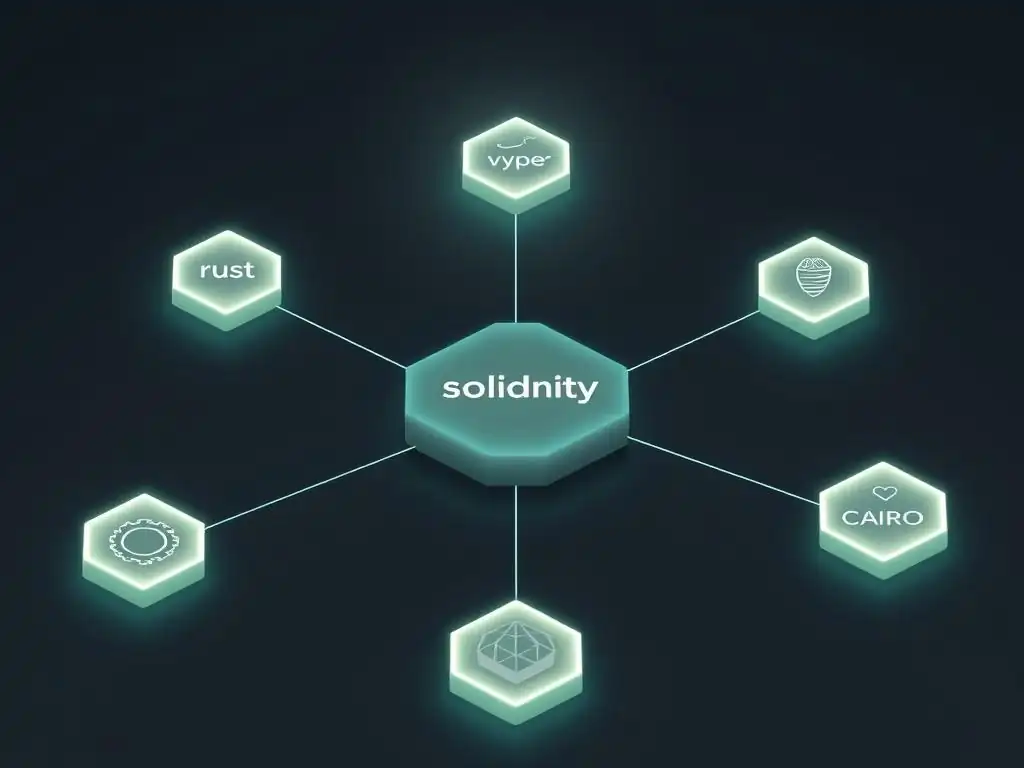
Evaluating the various Solidity smart contract alternatives requires considering several factors: security features, performance and scalability, developer experience, and suitability for different use cases. Each language and platform offers a unique set of trade-offs.
Security Features: Formal Verification, Static Analysis, and Vulnerability Prevention
Security is paramount for smart contracts, and alternative languages often prioritize it more explicitly than Solidity's initial design did. Languages like Vyper and Scilla are designed to be highly auditable and amenable to formal verification due to their restricted feature sets and structured paradigms. Move's resource-oriented type system offers a unique, language-level guarantee against asset manipulation vulnerabilities like double-spending.
Rust's memory safety features prevent a class of bugs common in systems programming that could also manifest in smart contracts. Pact includes features like upgradeability and multi-sig support directly in the language, enhancing security for certain operations. While tooling for static analysis and formal verification exists for Solidity, it can be more complex to apply comprehensively compared to languages designed with verification in mind.
Performance and Scalability: Gas Optimization and Transaction Throughput
Performance and scalability are often tied to the underlying blockchain platform and its execution environment, but the smart contract language can also play a role. Languages compiling to WebAssembly (Wasm), such as Rust (used on Substrate, CosmWasm, Near) and potentially others in the future, often promise better execution speed and efficiency compared to the EVM, which was designed in an earlier era.
The efficiency of gas usage (or equivalent cost metric) is also a factor; Vyper is sometimes lauded for gas efficiency in simple cases, while Rust/Wasm and Move platforms aim for higher transaction throughput through parallelization or optimized execution environments. The choice of a Solidity smart contract alternative often goes hand-in-hand with choosing a blockchain platform designed for better performance and scalability than Ethereum's base layer.
Developer Experience: Learning Curve, Tooling, and Community Support
Developer experience is a crucial factor in adoption. Solidity benefits from a massive head start, boasting the largest community, most extensive documentation, and widest array of development tools (IDEs, debuggers, testing frameworks, libraries like OpenZeppelin). Languages like Vyper leverage familiarity with Python syntax, potentially lowering the barrier for Python developers. Rust has a rapidly growing and enthusiastic developer community, excellent tooling for general programming, which is extending into the blockchain space.
Move is newer but is backed by significant resources on platforms like Aptos and Sui. Scilla and Pact have smaller, more specialized communities tied to their respective blockchains. The learning curve for each language varies, from Vyper's intentional simplicity to Rust's initial steep learning curve due to its ownership system. When considering Solidity smart contract alternatives, developers weigh the benefits of security and performance against the maturity of the ecosystem and ease of development.
Use Cases: DeFi, NFTs, Supply Chain, and Enterprise Applications
Different Solidity smart contract alternatives are better suited for specific use cases. Solidity's flexibility has made it dominant across virtually all categories, from complex DeFi protocols (like Uniswap, Aave) to NFTs (ERC-721, ERC-1155 standards) and supply chain tracking. Vyper's security focus makes it ideal for high-value, simpler logic like token contracts and core DeFi components where auditability is critical.
Rust's performance and safety make it suitable for complex logic, blockchain runtimes, and applications requiring high throughput on Wasm-based chains. Move's resource-oriented model is particularly strong for applications heavily involving digital assets, such as advanced tokenomics, gaming assets, and financial instruments on platforms like Aptos and Sui.
Pact's readability and database features are well-aligned with enterprise use cases, supply chain management, and regulated financial applications on Kadena. Exploring Solidity smart contract alternatives allows platforms and developers to choose tools best tailored to the specific requirements and security needs of their target applications.
The Transition from Solidity: Adoption and Integration Strategies
Transitioning from Solidity to alternative smart contract languages involves significant technical and strategic considerations. It's not simply a matter of rewriting code; it requires understanding new paradigms, tools, and blockchain platforms.
Bridging the Gap: Solidity Interoperability and Migration Strategies
Recognizing Solidity's current dominance, many alternative platforms and languages are exploring ways to bridge the gap. Some platforms that support Solidity smart contract alternatives also offer compatibility layers or bridges to interact with the Ethereum ecosystem. For example, some Wasm-based chains might implement bridges to allow assets or information to flow between their chain and Ethereum.
Another strategy involves supporting multiple languages on a single platform, allowing developers to choose the best tool for a specific task or gradually migrate components. For instance, some chains might support both Solidity (perhaps via EVM compatibility layers) and a Wasm-based language like Rust. Migration strategies for existing Solidity projects often involve auditing the current codebase, identifying components that would benefit from a different language (e.g., security-critical parts in Vyper, performance-sensitive parts in Rust), and planning a phased transition, potentially utilizing proxy patterns or upgradeable contracts where possible.
Training and Education: Empowering Developers with New Smart Contract Languages
A major hurdle for adopting Solidity smart contract alternatives is the existing developer skill set. The vast majority of current blockchain developers are proficient in Solidity. Therefore, widespread adoption of new languages requires significant investment in training and education.
This includes creating comprehensive documentation, tutorials, coding bootcamps, and online courses specifically for these new languages and their associated platforms. Blockchain companies and foundations supporting these languages need to actively engage with the developer community, providing resources and support to help developers learn the new paradigms (like Rust's ownership or Move's resources) and tools. Empowering developers with the knowledge and skills to work with these alternatives is critical for expanding the ecosystem beyond Solidity.
Community Building: Fostering Innovation and Collaboration in the Blockchain Ecosystem
Building a vibrant and supportive community is essential for the long-term success of any smart contract language. This involves fostering open-source development, encouraging contributions to compilers, tools, and libraries, and creating forums for developers to share knowledge and collaborate. Hackathons, workshops, and conferences focused on Solidity smart contract alternatives can help attract developers and showcase the capabilities of these new languages.
A strong community contributes to better tooling, shared best practices, and a more robust ecosystem, which in turn attracts more developers and projects, creating a positive feedback loop. Collaboration between different blockchain platforms and language communities can also accelerate innovation and potentially lead to industry standards that benefit the entire ecosystem.
The Future Landscape: Predictions and Trends in Smart Contract Languages
The smart contract landscape is rapidly evolving. While Solidity currently holds the dominant position, several trends suggest increasing diversity and specialization in programming languages for decentralized applications.
The Rise of Multi-Language Smart Contract Platforms
One significant trend is the emergence of blockchain platforms designed to support multiple smart contract languages and virtual machines. Rather than forcing developers into a single language, these platforms offer flexibility, allowing developers to choose the best language based on their project's requirements, team expertise, and desired security/performance characteristics. For example, some platforms might offer both EVM compatibility (for Solidity) and a Wasm execution environment (for Rust, C++, etc.).
This approach caters to a broader developer base and encourages innovation by not being tied to a single language's limitations. This trend validates the importance of exploring Solidity smart contract alternatives, as platforms are actively enabling their use.
Increased Focus on Formal Verification and Security Audits
Given the high stakes involved in smart contracts, there will be an increasing emphasis on formal methods and rigorous security audits. Languages and tools that facilitate formal verification, like Vyper, Scilla, and those based on functional programming principles (e.g., Plutus), are likely to gain traction, especially for high-value or critical applications. The industry is maturing, and there is a growing recognition that traditional testing is insufficient to guarantee the security of complex smart contracts. Future language development will likely incorporate security features and verifiability from the outset, making it easier and more cost-effective to ensure contract correctness.
The Impact of WebAssembly (Wasm) on Smart Contract Development
WebAssembly (Wasm) is poised to have a transformative impact on smart contract development. Its efficiency, portability, and language-agnostic nature make it an attractive target for blockchain virtual machines. As more blockchain platforms adopt Wasm, the ability to write smart contracts in a variety of languages that compile to Wasm (including Rust, C++, C#, and potentially others) will become more widespread.
This opens up smart contract development to a much larger pool of developers outside the traditional Solidity ecosystem and enables the creation of more performant and complex on-chain logic. Wasm-based execution environments represent a major catalyst for the adoption of diverse Solidity smart contract alternatives.
Conclusion: Embracing Diversity in Smart Contract Languages for a More Secure and Scalable Blockchain Future
Key Takeaways: The Importance of Exploring Solidity Smart Contract Alternatives
Solidity has been instrumental in the growth of the blockchain ecosystem, but its limitations regarding security vulnerabilities, gas costs, and potential scalability bottlenecks necessitate the exploration of alternative solutions. Languages like Vyper, Rust, Move, Scilla, and Pact, among others, each offer distinct advantages aimed at addressing these challenges. Vyper prioritizes security and simplicity through a restricted, auditable design. Rust provides memory safety and performance, often targeting Wasm execution.
Move introduces a novel resource-oriented type system for secure asset handling. DSLs like Scilla and Pact offer domain-specific features and enhanced security/readability for particular use cases. The future of smart contract development is likely multi-lingual, with different languages serving different needs and running on various high-performance, secure blockchain platforms.
Call to Action: Experimenting with New Languages and Contributing to the Blockchain Ecosystem
For developers, blockchain platforms, and businesses involved in the decentralized space, it is crucial to look beyond Solidity and explore the capabilities of these emerging smart contract languages. Experimenting with Solidity smart contract alternatives on platforms like Aptos, Sui, Polkadot, Cosmos (via CosmWasm), Zilliqa, or Kadena provides valuable insights into their potential benefits and trade-offs. Learning a new smart contract language can unlock opportunities on next-generation blockchains and equip developers with the skills needed for the evolving decentralized landscape.
Contributing to the open-source development of these languages, their tooling, and documentation is also vital for fostering a more secure, scalable, and diverse blockchain ecosystem for the future. The journey beyond Solidity is not just about finding a replacement, but about expanding the possibilities of smart contract technology through innovation and collaboration.
Frequently Asked Questions
What are some Solidity smart contract alternatives being explored in the blockchain space?
Several alternatives exist, including Vyper, Rust, and Go. These languages aim to address Solidity's limitations such as security vulnerabilities and complex syntax.
Why is there a need for alternatives to Solidity for smart contract development?
Solidity, while popular, has known security flaws and a steep learning curve. Alternative languages offer improved security, performance, and developer experience, making them attractive options.
How do Solidity smart contract alternatives like Vyper differ from Solidity in terms of security?
Vyper emphasizes security by design, restricting certain functionalities present in Solidity. This helps to prevent common vulnerabilities like reentrancy attacks and promotes more secure smart contract development.
What kind of enterprise applications might benefit the most from using Solidity smart contract alternatives?
Enterprises requiring high security and reliability, such as supply chain management or healthcare, could benefit. The enhanced security and performance of alternatives make them suitable for mission-critical applications.
How does the emergence of Solidity smart contract alternatives influence the future of decentralized systems and blockchain technology?
The development of diverse languages fosters innovation and resilience within the ecosystem. By offering choices and improved security, these alternatives contribute to the broader adoption and evolution of blockchain technology.
Final Reflection: Embracing the Evolution of Smart Contracts
The exploration of Solidity smart contract alternatives underscores a crucial truth: innovation thrives on acknowledging limitations. While Solidity has undeniably paved the way for decentralized applications, its inherent constraints necessitate a broader perspective and a willingness to embrace emerging languages and frameworks. The future of smart contracts hinges on this very adaptability, pushing us beyond the familiar and towards more secure, efficient, and accessible blockchain solutions.
The ongoing quest for "Solidity smart contract alternatives" isn't merely a technical exercise; it's a reflection of our collective desire for a more robust and inclusive digital future. This pursuit resonates deeply because it speaks to the fundamental principle of continuous improvement, a principle that underpins all meaningful progress. The only constant is change.
- Heraclitus. This ancient wisdom reminds us that stagnation is the antithesis of growth, and that embracing new approaches is essential for realizing the full potential of blockchain technology.
As we stand at the cusp of this evolution, let us not be bound by the comfort of the known. Instead, let us actively seek out and explore the diverse landscape of smart contract languages, contributing our expertise and insights to shape a more resilient and versatile ecosystem. Consider how you can contribute to this evolution, whether through learning a new language, contributing to open-source projects, or simply advocating for a more diverse and inclusive blockchain community. The future of smart contracts is not predetermined; it is a future we build together, brick by brick, line by line.
Unveil Your Blockchain Future: Go Beyond Solidity!
Thank you for diving into the evolving world of smart contract languages. We hope you've gained valuable insights into the limitations of Solidity and the exciting alternatives emerging in the blockchain space. Now, it's time to put that knowledge into action!
Here's how you can continue your journey:
- Dive into a hands-on tutorial of a next-generation smart contract language like Vyper or Scilla. Experience the difference firsthand!
- Share this article with a blockchain developer friend or colleague to ignite a discussion about the future of smart contract development.
- Consider contributing to an open-source project focused on building more secure and efficient smart contract languages. Contribute to the future!
What new smart contract language are you most excited to explore and why?
Leave a Reply