
Remix IDE for Smart Contract Testing and Quick Deployments: A HandsOn Guide


Welcome to Blockchain Trends, your guide to navigating the ever-evolving world of blockchain beyond the hype. Ever wondered how to ensure your smart contracts are rock-solid before deploying them to the blockchain? This article dives deep into Remix IDE smart contract testing, offering a hands-on approach to building secure and reliable decentralized applications. Discover how Remix IDE can streamline your development process and empower you to create innovative solutions. Intrigued? Let's explore the power of Remix!
- Smart Contract Testing with Remix IDE: A Practical Guide
-
Frequently Asked Questions
- What is the Remix IDE and why is it useful for smart contract development?
- How does Remix IDE aid in the process of smart contract testing?
- Can Remix IDE be used to deploy smart contracts to different blockchain networks?
- What are some key features within Remix IDE that assist with smart contract debugging?
- Is Remix IDE suitable for developing complex, large-scale blockchain applications, or is it better suited for smaller projects?
- Final Reflection: Empowering Smart Contract Development
- Unleash Your Inner Blockchain Builder!
Smart Contract Testing with Remix IDE: A Practical Guide
Understanding the Remix IDE Testing Environment
The "Deploy & Run Transactions" tab within Remix IDE serves as the primary hub for Remix IDE smart contract testing and deployment. This environment provides developers with a powerful interface to interact with their compiled contracts on various simulated or real blockchain networks. The layout is intuitive, featuring sections for selecting the environment, choosing accounts, setting gas limits and value, selecting the contract to deploy or interact with, and viewing transaction logs. This central panel streamlines the testing workflow significantly, allowing rapid iteration during the development cycle.
Crucially, this tab offers different "Environments," with the most common for initial Remix IDE smart contract testing being the "JavaScript VM" (Virtual Machine). This in-browser simulation of the Ethereum blockchain is incredibly fast and requires no external setup or real Ether. It's ideal for quick, isolated tests of contract logic.
The JavaScript VM typically provides several pre-funded accounts, each starting with a significant amount of simulated Ether, such as 100 ETH, enabling extensive testing without worrying about funding test accounts. The transaction log at the bottom provides immediate feedback on all interactions, including deployment and function calls, displaying details like transaction status, gas used, and return values.
Deploying Your Smart Contract to a Test Blockchain (JavaScript VM)
Once your smart contract is successfully compiled in Remix IDE, the next step for Remix IDE smart contract testing is deployment. Navigate to the "Deploy & Run Transactions" tab. Ensure the "Environment" is set to "JavaScript VM" and select one of the provided accounts. Choose your compiled contract from the dropdown list under "Contract". If your contract's constructor requires arguments, input them in the field next to the "Deploy" button. Clicking "Deploy" initiates the process, simulating the deployment of your contract onto the JavaScript VM blockchain.
Upon successful deployment, a new entry will appear in the transaction log, indicating the transaction hash, status (usually green for success), gas used, and other relevant details. More importantly, the deployed contract instance will appear below in the "Deployed Contracts" section. This section lists all contracts currently deployed in the simulated environment, each represented by its address. This instance is now ready for interaction, allowing you to call its functions and test its behavior directly within the Remix IDE interface, a core component of effective Remix IDE smart contract testing.
Using Remix IDE's Debugger for Smart Contract Analysis
Debugging is an indispensable part of Remix IDE smart contract testing, especially when transactions fail or produce unexpected results. Remix IDE includes a robust debugger accessible directly from the transaction log. By clicking on a transaction entry (whether a deployment or a function call), a debug button appears, opening the debugger panel. This panel allows developers to step through the execution of the transaction instruction by instruction (opcode by opcode), providing deep insight into the contract's runtime behavior.
The debugger interface displays various crucial pieces of information, including the current opcode being executed, the call stack, local variables, and, most importantly, the state changes occurring within the contract. By using the step-over, step-into, and step-out controls, developers can trace the flow of execution, observe how variables change, and pinpoint the exact line of Solidity code where an issue, such as a transaction revert or an incorrect state update, originates.
This granular analysis is vital for diagnosing complex bugs that might not be obvious from the transaction output alone, significantly enhancing the quality of Remix IDE smart contract testing.
Testing Smart Contract Functions with Remix IDE
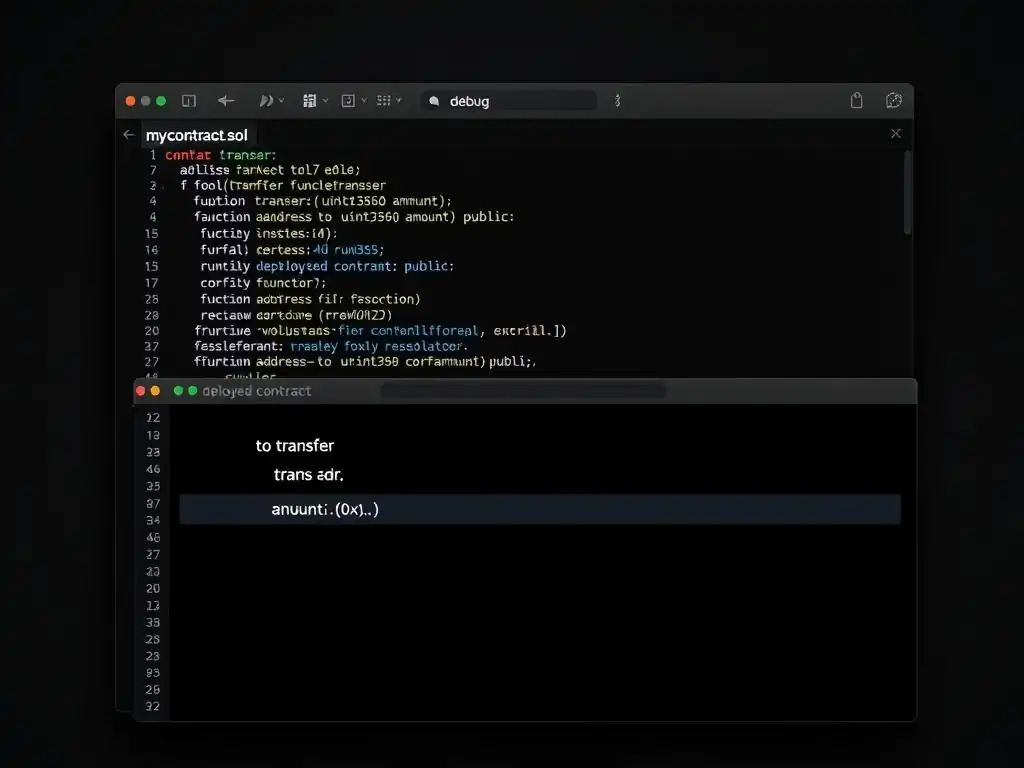
Interacting with your deployed smart contract is the most hands-on way to perform Remix IDE smart contract testing. In the "Deployed Contracts" section of the "Deploy & Run Transactions" tab, each deployed instance is listed, displaying its address and all its public/external functions and state variables. Functions are represented by colored buttons: blue buttons signify view or pure functions (read-only, do not change state), and orange or red buttons signify state-changing functions (which require a transaction).
To test a function, simply locate its button. If the function requires input parameters, input fields will appear next to the button; enter the required values. Clicking a blue button executes the function immediately in the browser, and the return value is displayed below the button.
Clicking an orange or red button simulates sending a transaction to the network (in this case, the JavaScript VM). The details of this simulated transaction appear in the transaction log, showing its status, gas used, and any events emitted. This direct interaction allows developers to test various scenarios, inputs, and function sequences to ensure the contract behaves as expected under different conditions during Remix IDE smart contract testing.
Analyzing Gas Consumption in Remix IDE
Gas consumption is a critical metric in smart contract development, directly impacting the cost of interactions on live networks. Remix IDE provides immediate feedback on gas usage during Remix IDE smart contract testing within the JavaScript VM environment. Every deployment and transaction simulation recorded in the transaction log includes a "gas used" field. This value represents the total computational cost of executing that specific operation on the simulated blockchain, measured in gas units.
Observing the "gas used" value for different transactions and function calls is essential for optimizing contract efficiency. While the JavaScript VM doesn't use real Ether, the gas costs it reports are generally indicative of costs on actual networks. Developers can perform various operations and note their gas footprints. For instance, operations that modify storage variables ( SSTORE) are significantly more expensive than simple arithmetic operations ( ADD). By analyzing these costs within Remix IDE, developers can identify gas-heavy functions or code patterns and refactor them to reduce transaction costs before deploying to a live network, making gas analysis a vital part of comprehensive Remix IDE smart contract testing.
Frequently Asked Questions
What is the Remix IDE and why is it useful for smart contract development?
The Remix IDE is a browser-based IDE that's invaluable for smart contract development because it allows for quick prototyping and testing without needing a local development environment. It supports Solidity and other smart contract languages.
How does Remix IDE aid in the process of smart contract testing?
Remix IDE provides a built-in testing environment where you can easily deploy contracts, call functions, and inspect state. This allows for thorough testing of your smart contract's logic before deploying to a live network.
Can Remix IDE be used to deploy smart contracts to different blockchain networks?
Yes, Remix IDE supports deploying to various networks, including local testnets, public testnets (like Goerli or Sepolia), and even the mainnet (though caution is advised). You can configure the deployment environment directly within the IDE.
What are some key features within Remix IDE that assist with smart contract debugging?
Remix offers powerful debugging tools like a debugger, step-by-step execution, and the ability to inspect variables and memory. These features are essential for identifying and fixing bugs in your smart contracts.
Is Remix IDE suitable for developing complex, large-scale blockchain applications, or is it better suited for smaller projects?
While Remix IDE is excellent for prototyping and small to medium-sized projects, for very complex applications, developers often transition to more robust IDEs like VS Code with extensions. However, it's a great starting point for learning and experimenting.
Final Reflection: Empowering Smart Contract Development
The ability to rapidly prototype and test smart contracts is more crucial than ever in today's rapidly evolving blockchain landscape. Remix IDE's accessibility and ease of use have democratized smart contract development, allowing developers of all skill levels to contribute to the decentralized future. This hands-on guide has hopefully illuminated how Remix IDE can be a powerful tool in your arsenal, enabling you to iterate quickly and confidently deploy secure and functional smart contracts.
The impact of tools like Remix IDE extends beyond mere code execution; they shape the very fabric of decentralized innovation. The ability to experiment freely and validate ideas without significant overhead is essential for fostering creativity and driving progress in the blockchain space. The best way to predict the future is to create it.
- Peter Drucker. This quote resonates deeply with the spirit of Remix IDE, empowering developers to actively shape the future of decentralized applications.
Now, armed with this knowledge, I encourage you to explore the vast possibilities that Remix IDE unlocks. Don't be afraid to experiment, to break things, and to learn from your mistakes. The future of blockchain technology is being written one smart contract at a time, and with tools like Remix IDE, you have the power to contribute to that narrative. Embrace the challenge, and build something amazing.
Unleash Your Inner Blockchain Builder!
Thanks for exploring the power of Remix IDE with us! You've gained the skills to quickly create and deploy smart contracts. Now is the perfect time to put your knowledge into practice.
Ready to take the next step?
- Try deploying a simple "Hello, World!" smart contract on a test network using Remix IDE. Experience the full process firsthand!
- Experiment with different Solidity compiler versions and optimization settings within Remix. See how these options affect your contract's performance and gas costs.
- Share your Remix IDE projects and contract addresses with the Blockchain Trends community. Help others and learn from their experiences!
What innovative smart contract idea will you prototype first in Remix IDE?
Leave a Reply