
State Channels Deep Dive: Scaling Smart Contracts Beyond the Limits


Welcome to Blockchain Trends, your compass in the rapidly evolving world of decentralized technology. Beyond the buzzwords and market fluctuations, we delve into the real-world applications of blockchain, from revolutionizing finance to reshaping industries. Ever wondered how to overcome the inherent limitations of blockchain and unlock its true potential for smart contracts? Dive in as we explore the fascinating world of blockchain scaling state channels, offering a glimpse into a future where transactions are faster, cheaper, and more efficient. Discover how this innovative approach is paving the way for truly scalable decentralized applications and smart contracts. Let's begin!
- Lightning Network Architecture: A Technical Overview
-
Frequently Asked Questions
- What are state channels and how do they relate to blockchain scaling?
- How do state channels differ from other blockchain scaling solutions like sidechains?
- What are the primary advantages of using state channels for blockchain scaling?
- What are some limitations or challenges associated with implementing state channels for blockchain scaling?
- How do state channels contribute to the future of decentralized systems beyond just faster transactions?
- Final Reflection: Embracing the Scalable Future of Blockchain
- Unleash the Power of Scalable Smart Contracts!
Lightning Network Architecture: A Technical Overview
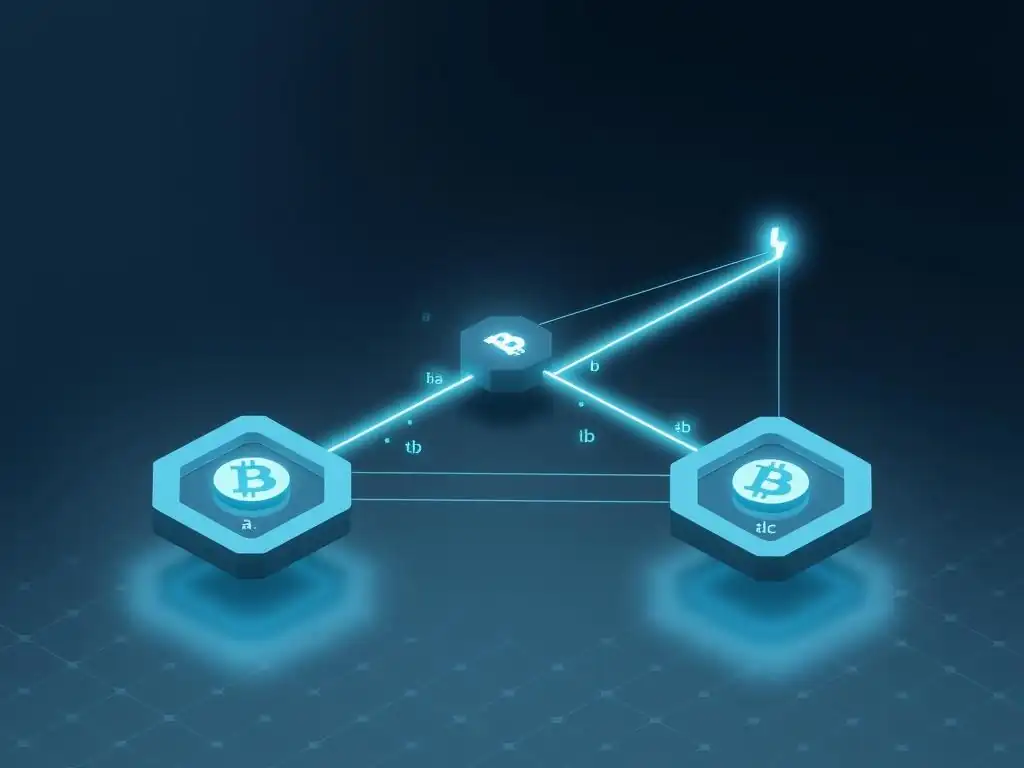
Payment Channels and HTLCs (Hashed Time-Locked Contracts)
At the core of the Lightning Network's architecture lies the concept of a payment channel. A payment channel is a peer-to-peer connection established between two participants on the network, secured by a multi-signature Bitcoin address. This channel allows the two parties to conduct an unlimited number of transactions off-chain, without needing to broadcast each one to the main Bitcoin blockchain.
These off-chain transactions are recorded in a series of commitment transactions, each one effectively updating the balance distribution within the channel. Only the initial funding of the channel and the final settlement (or dispute) require an on-chain transaction, drastically reducing the load on the base layer. This mechanism is fundamental to achieving high-frequency, low-cost transactions necessary for effective Bitcoin scaling layer 2 solutions.
To facilitate multi-hop payments across the network and ensure trustless routing, the Lightning Network utilizes Hashed Time-Locked Contracts (HTLCs). HTLCs are smart contracts that secure payments by requiring the recipient to provide proof of a secret (the hash pre-image) within a specified time limit. If the secret is not revealed or the time limit expires, the funds can be reclaimed by the sender.
This cryptographic primitive allows payments to be routed through intermediate nodes without requiring any node in the path to trust the next node. Each intermediate node in a payment path receives an HTLC and creates a new one for the next hop, effectively chaining the payment across the network. A typical payment path might involve several hops, each secured by an HTLC, ensuring that the payment either arrives at the destination or safely returns to the sender if any part of the path fails.
The Role of the Bitcoin Blockchain in Channel Initialization and Settlement
The Bitcoin blockchain serves as the foundational security layer for the Lightning Network. Every payment channel begins with an on-chain funding transaction. This transaction locks a specific amount of Bitcoin into a 2-of-2 multi-signature address controlled by the two channel participants.
This initial step is the only time funds are directly moved on the base layer to establish a channel. Once the funding transaction is confirmed on the blockchain (typically requiring several block confirmations to ensure finality), the channel is open and the two parties can begin exchanging off-chain commitment transactions, updating the balance within the channel without interacting further with the main chain. This reliance on the underlying blockchain's security is paramount; without it, the off-chain transactions would have no final settlement mechanism or dispute resolution layer.
The Bitcoin blockchain also acts as the ultimate arbiter for settling or closing a Lightning channel. When participants decide to close a channel cooperatively, they broadcast the latest agreed-upon commitment transaction to the blockchain, which distributes the final balance according to the last state. In non-cooperative scenarios, where one party goes offline or attempts to broadcast an outdated state, the other party can broadcast their latest valid commitment transaction to the chain to force a channel closure. The blockchain's consensus rules and scripting capabilities (specifically, OP_CHECKSEQUENCEVERIFY and OP_CHECKLOCKTIMEVERIFY used in HTLCs and commitment transactions) ensure that disputes are resolved correctly and malicious attempts to steal funds by broadcasting old states are penalized. This robust on-chain safety net is what makes the off-chain Lightning transactions trustless and secure, leveraging the full security of the Bitcoin network.
Lightning Network Nodes and Routing
The Lightning Network is composed of numerous nodes operated by individuals, businesses, and exchanges around the world. Each node runs Lightning Network software (such as LND, c-lightning, or Eclair) and maintains a series of open payment channels with other nodes. These connections form a decentralized graph, where nodes act as hubs and spokes, facilitating payments between participants who may not have a direct channel open with each other.
Nodes announce their channel information and liquidity to the network, allowing other nodes to discover potential payment paths. As of late 2023, the network consists of tens of thousands of public nodes and over 60,000 active public channels, representing a significant distributed infrastructure for Bitcoin scaling.
Routing is the process by which a payment finds a path through this network graph from the sender to the recipient. When a user initiates a payment, their node attempts to find a sequence of connected channels with sufficient liquidity to carry the payment. This involves querying the network graph and calculating potential routes.
Payments are sent hop-by-hop using the HTLC mechanism; each intermediate node receives the payment, verifies the HTLC conditions, and forwards it to the next node in the path, contingent on the next node also accepting the HTLC. Advanced routing algorithms, like pathfinding based on the network graph and channel liquidity information, are constantly being developed and refined to improve the success rate and efficiency of payments, ensuring that transactions traverse the network quickly and reliably, contributing significantly to Bitcoin's scalability goals.
Frequently Asked Questions
What are state channels and how do they relate to blockchain scaling?
State channels are a layer-two scaling solution that allow parties to transact off-chain, only interacting with the main blockchain to open and close the channel. This dramatically reduces the load on the main chain and improves transaction speed.
How do state channels differ from other blockchain scaling solutions like sidechains?
Unlike sidechains which have their own independent consensus mechanisms, state channels operate directly on the main blockchain. They rely on smart contracts on the main chain to enforce the agreed-upon rules of the channel.
What are the primary advantages of using state channels for blockchain scaling?
The main advantages are increased transaction speed, lower transaction fees (due to off-chain activity), and improved privacy as only the opening and closing transactions are recorded on the main chain.
What are some limitations or challenges associated with implementing state channels for blockchain scaling?
State channels typically require pre-defined participants and are best suited for scenarios with frequent, predictable interactions. They can also be complex to implement and require careful security considerations.
How do state channels contribute to the future of decentralized systems beyond just faster transactions?
By enabling efficient and scalable off-chain interactions, state channels pave the way for more complex and resource-intensive decentralized applications. They also foster greater user adoption by providing a more seamless and cost-effective user experience.
Final Reflection: Embracing the Scalable Future of Blockchain
The exploration of state channels has illuminated a crucial pathway towards overcoming the inherent limitations of blockchain scalability. The promise of near-instantaneous transactions and drastically reduced fees, achieved without compromising security, positions state channels as a pivotal technology for the widespread adoption of decentralized applications. This isn't just about faster blockchains; it's about unlocking the true potential of smart contracts and decentralized finance for everyday use.
The impact of state channels extends far beyond mere technical improvements. It represents a shift in how we perceive and interact with blockchain technology, moving from a world of congested networks to one of fluid and efficient interactions. This potential for transformation is deeply compelling, reminding us that innovation is not just about building new things, but about reimagining the possibilities of existing technologies. The future of blockchain is not just about building bigger blocks, but about building smarter channels.
- Anonymous Blockchain Developer
Now, as you reflect on the potential of blockchain scaling state channels, consider how this technology might impact your own interactions with the digital world. How could faster, cheaper, and more private transactions empower you to participate more fully in the decentralized economy? Embrace the opportunity to learn, experiment, and contribute to the development of this transformative technology, and together, we can build a more scalable and accessible future for blockchain.
Unleash the Power of Scalable Smart Contracts!
Thank you for exploring the potential of State Channels with us. You've now gained a deeper understanding of how these innovative solutions can revolutionize smart contract scalability. Now, it's time to put that knowledge into action.
Here are a few steps you can take right now:
- Start experimenting with a simple State Channel implementation using readily available libraries. Don't be afraid to get your hands dirty!
- Dive deeper into the research: Explore cutting-edge State Channel projects on platforms like GitHub and identify how they're addressing specific scalability challenges.
- Share this article with a fellow developer or blockchain enthusiast. Let's spark a conversation and explore practical applications together!
What innovative application of State Channels are you most excited to explore building? Share your thoughts in the comments below!
Leave a Reply