
Data Sharding vs. Network Sharding: Different Approaches to Scalable Blockchains


Welcome to Blockchain Trends, your trusted source for understanding the revolutionary impact of blockchain technology. Beyond the headlines of cryptocurrencies, we delve into the real-world applications shaping industries and redefining trust.
Are you ready to navigate the complexities of achieving truly scalable blockchains? This article explores a crucial aspect of blockchain's future: Blockchain scalability solutions comparison. Discover the nuanced differences between data sharding and network sharding, and how these approaches pave the way for a decentralized future. But which method truly unlocks the potential for mass adoption? Let's dive in and explore the cutting-edge solutions driving the next generation of blockchain innovation.
Data Sharding vs. State Sharding: Different Approaches to Scalable Blockchains
- Introduction: Addressing Blockchain Scalability Challenges
- Data Sharding: Scaling Through Transaction Partitioning
- State Sharding: Dividing the Blockchain State for Parallel Processing
- Data Sharding vs. State Sharding: A Detailed Comparison
- Case Studies: Real-World Examples of Data and State Sharding
- Future Trends in Blockchain Sharding Technologies
- Conclusion: Choosing the Right Sharding Approach for Blockchain Scalability
-
Frequently Asked Questions
- How does data sharding improve blockchain scalability?
- What is network sharding, and how does it differ from data sharding?
- What are some of the key benefits of using sharding techniques in blockchain?
- What are the potential challenges associated with implementing sharding in blockchains?
- How do data sharding and network sharding contribute to the future of decentralized systems?
- Final Reflection: Embracing the Scalable Future of Blockchain
- Unlock the Future of Blockchain Scalability!
Introduction: Addressing Blockchain Scalability Challenges
The Need for Blockchain Scalability Solutions
Blockchain technology, while revolutionary in its ability to create decentralized and immutable ledgers, faces a significant hurdle known as the "scalability trilemma." This concept suggests that a decentralized system can only effectively achieve two out of three properties: decentralization, security, and scalability. Early blockchain networks, designed with strong emphasis on decentralization and security, often struggle to process a high volume of transactions quickly and cheaply, leading to network congestion and high fees during peak times. This limitation hinders widespread adoption for applications requiring high throughput, such as global payment systems or complex decentralized applications (dApps).
To overcome these limitations and enable blockchains to compete with or surpass traditional centralized systems in terms of transaction volume, various blockchain scalability solutions have emerged. These solutions aim to increase the number of transactions a network can process per second (throughput) without compromising its core principles. Understanding and implementing effective blockchain scalability solutions is crucial for the future growth and utility of decentralized technologies, moving beyond niche applications to mainstream adoption across various industries. This article provides a blockchain scalability solutions comparison focusing on sharding techniques.
Exploring Data Sharding and State Sharding for Enhanced Throughput
Sharding is a database partitioning technique that has been adapted for blockchain networks to improve scalability. The core idea behind sharding is to divide the overall network or data into smaller, more manageable pieces called "shards." Instead of every node processing every transaction and storing the entire state of the blockchain, nodes are assigned to specific shards and only need to process transactions and store the state relevant to their assigned shard. This parallelization of work across multiple shards significantly increases the network's capacity.
Within the realm of blockchain scalability solutions, two primary approaches to sharding have gained prominence: data sharding and state sharding. While both leverage the concept of partitioning, they differ fundamentally in what they partition and how they achieve scalability. Data sharding primarily focuses on distributing the transaction data load, allowing different shards to process distinct sets of transactions concurrently.
State sharding, on the other hand, divides the blockchain's overall state (the collective balance of accounts, smart contract storage, etc.) across shards, enabling parallel processing of transactions that affect different parts of the state. This blockchain scalability solutions comparison will delve into the specifics of each approach.
Comparing Data Sharding and State Sharding: A High-Level Overview
At a high level, the distinction between data sharding and state sharding lies in their primary target for partitioning. Data sharding, sometimes referred to as transaction sharding, partitions the flow of transactions. Each shard processes a specific subset of incoming transactions, and while the entire state might theoretically still be accessible or reconstructed by a full node, the immediate processing burden is distributed. This approach simplifies the initial implementation but can face challenges related to cross-shard communication and the need for some level of global state awareness or consensus.
State sharding, conversely, partitions the state of the blockchain itself. Each shard maintains and processes transactions related only to its specific portion of the state. This allows for a more radical form of parallelization, as nodes within a shard only need to store and validate a fraction of the total blockchain state.
However, managing interactions between different state shards (e.g., a transaction transferring value from an account in one shard to an account in another) introduces significant complexity, often requiring sophisticated cross-shard communication protocols and atomic transaction mechanisms to maintain consistency and security across the network. Understanding this fundamental difference is key to evaluating these blockchain scalability solutions.
Data Sharding: Scaling Through Transaction Partitioning
What is Data Sharding in Blockchain?
Data sharding, in the context of blockchain technology, is a method designed to increase transaction throughput by partitioning the incoming stream of transactions into smaller groups. These groups are then processed in parallel by different subsets of network nodes, or "shards." The core idea is that not every node needs to validate every single transaction occurring on the network. Instead, nodes are assigned to specific shards and are responsible for validating transactions only within their allocated shard. This significantly reduces the processing load on individual nodes.
In a data-sharded architecture, while the transaction processing is distributed, the underlying blockchain state might still be considered global or accessible, albeit potentially requiring coordination to fully reconstruct or verify. The emphasis is on parallelizing the validation and inclusion of transactions into blocks within their respective shards. Blocks produced by different shards are then typically combined or linked together, often through a main chain or beacon chain, to form a cohesive and secure overall ledger. This approach is one of the prominent blockchain scalability solutions being explored.
How Data Sharding Improves Blockchain Performance
Data sharding enhances performance primarily by enabling parallel transaction processing. If a blockchain network can process N transactions per second without sharding, dividing the transaction load across M shards, where each shard can process N/M transactions (or more, depending on optimization), the theoretical maximum network throughput can approach N * M transactions per second. This multiplicative effect on throughput is the main benefit. For example, a network originally capable of 100 transactions per second could potentially achieve 1000 TPS with 10 effective shards.
Furthermore, by reducing the number of transactions that each node must process, data sharding can also decrease the latency of transaction confirmation. Nodes within a shard can reach consensus on the validity of transactions within their shard more quickly than if they had to process the entire network's transaction volume. This lower processing burden per node also makes it easier for less powerful hardware to participate in the network as validator nodes within a shard, potentially enhancing decentralization compared to monolithic chains requiring high-end hardware. This constitutes a crucial aspect of blockchain scalability solutions comparison.
Data Sharding Techniques: Account-Based Sharding, UTXO-Based Sharding
Data sharding techniques can be broadly categorized based on how they assign transactions or state information to specific shards. One common approach is account-based sharding, where transactions are assigned to a shard based on the address of one of the participants, typically the sender's address or a designated contract address. For instance, all transactions originating from or interacting with accounts starting with '0xabc...' might be routed to Shard A, while those starting with '0xdef...' go to Shard B. This method requires careful handling of transactions involving multiple accounts residing in different shards.
Another technique, more aligned with the Unspent Transaction Output (UTXO) model used by Bitcoin, is UTXO-based sharding. In this model, transactions are assigned to shards based on the location of the UTXO being spent. If a UTXO resides in Shard X, the transaction spending it would be processed in Shard X. This simplifies intra-shard processing but presents challenges when a single transaction needs to consume UTXOs located in multiple different shards, requiring complex cross-shard coordination. Both techniques aim to distribute the transaction load, contributing to the overall goal of enhanced blockchain scalability solutions.
Benefits of Data Sharding for Blockchain Scalability
The primary benefit of data sharding is its potential to significantly increase transaction throughput. By dividing the workload across multiple shards, the network can process a much larger volume of transactions concurrently compared to a single, non-sharded chain. This is essential for supporting a greater number of users and applications. A blockchain scalability solutions comparison often highlights throughput as a key metric.
Data sharding can also improve transaction latency and reduce fees. With a smaller set of transactions to validate within a shard, blocks can potentially be produced and confirmed faster, leading to quicker transaction finality. The increased capacity also alleviates network congestion, which is a major driver of high transaction fees on popular blockchains. Furthermore, by reducing the processing requirements for nodes, data sharding can make it more accessible for a wider range of participants to run validator nodes, potentially enhancing the decentralization of the network.
Challenges and Limitations of Data Sharding
One significant challenge with data sharding is ensuring the security of individual shards and the overall network. If a shard is small, it might be vulnerable to a "single-shard attack" where a malicious actor controls a sufficient portion of the validation power within that shard to compromise its integrity (e.g., perform double-spending). While techniques like random node assignment to shards or frequent re-shuffling can mitigate this, they add complexity.
Another limitation is handling cross-shard transactions. When a transaction involves assets or smart contracts located in different shards, coordinating atomic execution becomes difficult. Simple approaches might require multi-step processes or lock-ups, increasing latency and complexity. More sophisticated methods require complex communication protocols and consensus mechanisms across shards to ensure operations are atomic (either both parts succeed or both fail), which adds significant development overhead and potential points of failure. Evaluating these complexities is vital in any blockchain scalability solutions comparison.
State Sharding: Dividing the Blockchain State for Parallel Processing
Understanding State Sharding in Blockchain
State sharding is a more advanced form of sharding that partitions not just the transaction flow but also the blockchain's state itself. The state includes all the account balances, contract storage, and other information that defines the current condition of the blockchain. In a state-sharded network, different shards are responsible for managing and storing only a specific subset of the total state. For example, Shard A might manage accounts starting with '0x0...' and their associated contract data, while Shard B handles accounts starting with '0x1...'.
This means that nodes within a particular shard only need to store and process transactions that affect the state managed by that shard. They do not need to store the entire global state of the blockchain, nor do they need to validate transactions occurring in other shards unless they are involved in a cross-shard interaction. This drastically reduces the storage and processing requirements for individual nodes, making it feasible for a larger number of nodes to participate and potentially supporting a much higher overall transaction throughput. State sharding is often considered a more ambitious approach among blockchain scalability solutions.
How State Sharding Enhances Transaction Processing Speed
State sharding enhances transaction processing speed by enabling true parallelization of operations across different parts of the blockchain state. Since each shard manages a distinct portion of the state, transactions affecting different state partitions can be processed concurrently in their respective shards without interference. For instance, a transaction sending funds between two accounts in Shard A can be processed at the same time as a smart contract interaction occurring entirely within Shard B.
This parallel processing capability allows the network to handle a significantly higher volume of transactions simultaneously. The theoretical maximum throughput of a state-sharded network can scale roughly linearly with the number of shards. If a shard can handle T transactions per second, a network with S shards could potentially process up to T * S transactions per second. This multiplicative scaling potential is a key advantage highlighted in a blockchain scalability solutions comparison.
State Sharding Architectures: Beacon Chain, Shard Chains
A common architecture for implementing state sharding involves a central coordination layer, often called a "beacon chain" or main chain, and multiple "shard chains." The beacon chain is responsible for managing the overall network, including coordinating the shard chains, handling consensus across shards, registering validators, and facilitating cross-shard communication. It typically does not process user transactions directly but provides the backbone for the sharded ecosystem.
The shard chains are where the actual transaction processing and state management occur. Each shard chain operates relatively independently, processing transactions and maintaining its portion of the blockchain state with its own set of validators. Periodically, the state of each shard chain is finalized and recorded on the beacon chain, providing a global point of reference and security guarantee. This architectural model, exemplified by Ethereum 2.0's design, represents a complex but powerful approach to achieving scalable blockchain solutions.
Advantages of State Sharding for Scalable Blockchains
One of the most significant advantages of state sharding is its potential for massive scalability. By dividing the blockchain state, the network can theoretically scale its transaction throughput almost linearly with the number of shards. This makes it possible to achieve transaction volumes that can rival or surpass traditional payment systems, enabling a much wider range of applications for blockchain technology. This high scalability potential is a major point in favor of state sharding in blockchain scalability solutions comparison.
State sharding also offers benefits in terms of node requirements. Since nodes only need to store and process the state relevant to their assigned shard, the hardware and storage requirements for running a node are significantly reduced compared to storing the entire global state of a high-throughput, non-sharded chain. This lower barrier to entry can encourage greater participation from individuals and smaller entities, potentially leading to a more decentralized and robust network.
Potential Drawbacks and Security Considerations of State Sharding
State sharding introduces considerable complexity, particularly in managing cross-shard interactions. Transactions involving assets or contracts located in different shards require sophisticated mechanisms to ensure atomicity and consistency across shard boundaries. Implementing secure and efficient cross-shard communication protocols is a major technical challenge and a potential source of vulnerabilities if not done correctly.
Security is another critical consideration. Similar to data sharding, individual shards could be vulnerable to attacks if they have a small number of validators, potentially allowing a malicious actor to gain control of a shard and manipulate its state. Ensuring the security of the overall network requires robust mechanisms on the beacon chain or coordinating layer to detect and penalize malicious behavior across shards, as well as potentially using techniques like random assignment and rotation of validators among shards to prevent concentration of power. These security challenges add layers of complexity to state-sharded blockchain scalability solutions.
Data Sharding vs. State Sharding: A Detailed Comparison
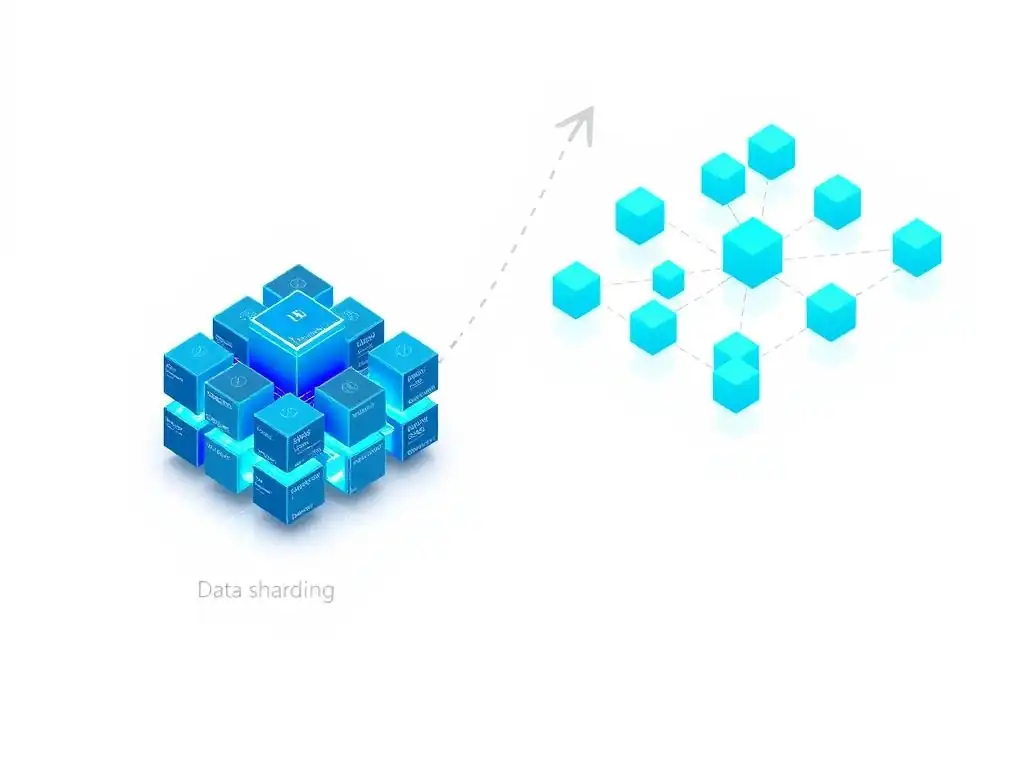
Key Differences in Approach: Transaction vs. State Partitioning
The fundamental difference between data sharding and state sharding lies in what aspect of the blockchain they partition. Data sharding primarily partitions the transaction load and the processing of these transactions. Nodes within a shard validate and include a specific subset of transactions into blocks. While the state might implicitly be affected by these transactions, the primary division is of the input stream and processing tasks. The full state might still conceptually exist globally or be reconstructible.
State sharding, on the other hand, partitions the blockchain state itself. Each shard is responsible for a distinct portion of the state (e.g., a range of addresses, a set of smart contracts). Nodes within a shard only need to store and process transactions that modify their specific part of the state. This leads to a more profound reduction in the data and computation required by individual nodes, enabling higher theoretical scalability but also introducing significant challenges in managing dependencies and interactions between different state partitions. This distinction is central to any blockchain scalability solutions comparison.
Scalability Trade-offs: Data Sharding vs. State Sharding
In terms of theoretical scalability, state sharding generally offers a higher potential ceiling than data sharding. By dividing the state, state sharding allows for a more complete parallelization of computation and storage, where the throughput can potentially scale linearly with the number of shards. This makes it suitable for achieving very high transaction volumes needed for global-scale applications.
Data sharding also improves scalability by parallelizing transaction processing, but it may face bottlenecks related to the eventual need to consolidate or interact with a more global view of the state, or limitations imposed by cross-shard communication complexity if state is not truly partitioned. While simpler to implement initially, its scalability might be capped below that of a fully realized state sharded system, particularly for complex dApps that interact with many parts of the state. Evaluating these trade-offs is crucial when considering different blockchain scalability solutions.
Security Implications: Comparing the Security Models
Security is a critical aspect where both sharding approaches face unique challenges. In data sharding, a key concern is the "single-shard attack," where a small number of validators in a specific shard could potentially collude to validate fraudulent transactions or prevent valid ones. Mitigating this often involves complex mechanisms like random sampling of validators for each shard or frequent re-shuffling to prevent attackers from concentrating resources in one shard.
State sharding shares the single-shard attack vulnerability, but the consequences can be more severe as the attacker could potentially compromise a portion of the blockchain's state. State sharding architectures often rely heavily on a secure beacon chain or main chain to coordinate security across shards, finalize shard states, and punish malicious behavior. The security of the entire system becomes highly dependent on the robustness and security of this central coordinating layer and the protocols for inter-shard communication and state finalization. A thorough blockchain scalability solutions comparison must weigh these security models.
Implementation Complexity: Which Sharding Method is Easier to Implement?
Data sharding is generally considered less complex to implement initially compared to state sharding. Partitioning the transaction processing flow is a more straightforward task than fundamentally restructuring how the blockchain state is managed and accessed across multiple, independent partitions. Many early sharding proposals and implementations focused on data sharding due to this lower barrier to entry.
State sharding, with its requirement to divide and manage the state, handle complex cross-shard state dependencies, and build robust cross-shard communication and consensus protocols, represents a significantly higher level of technical complexity. The engineering effort required for a secure and efficient state-sharded system is substantial. Projects undertaking state sharding, like Ethereum 2.0, have faced lengthy development timelines due to these complexities, highlighting the technical hurdles involved in building such advanced blockchain scalability solutions.
Use Cases: Where Does Each Sharding Method Excel?
Data sharding might be well-suited for simpler use cases that primarily involve high volumes of straightforward transactions, such as payments or simple token transfers, where interactions between different parts of the state are less frequent or complex. Its relative ease of implementation can make it a quicker path to improved throughput for certain types of networks.
State sharding is necessary for use cases requiring very high throughput and complex interactions involving decentralized applications (dApps) that modify various parts of the blockchain state. Applications like decentralized exchanges (DEXs), complex DeFi protocols, or large-scale gaming applications can benefit immensely from the radical parallelization offered by state sharding, allowing for a much larger user base and more complex operations than possible on non-sharded or data-sharded chains. Choosing the right approach depends heavily on the intended use case and required level of blockchain scalability solutions.
Case Studies: Real-World Examples of Data and State Sharding
Data Sharding in Action: Zilliqa
Zilliqa is often cited as one of the pioneering blockchain platforms to implement a form of sharding, specifically focusing on transaction sharding, which aligns closely with the concept of data sharding. Zilliqa's architecture divides the network into shards, and transactions are processed in parallel within these shards. For example, in periods of high network activity, Zilliqa's sharding mechanism allows it to process thousands of transactions per second, a significant improvement over monolithic blockchains like Bitcoin or early Ethereum.
Zilliqa's sharding implementation involves assigning nodes to shards and processing transactions within those shards. Consensus within each shard is achieved using a Practical Byzantine Fault Tolerance (PBFT) mechanism, while a Proof-of-Work (PoW) mechanism is used periodically to establish node identities and prevent Sybil attacks across the network. While Zilliqa's approach primarily shards transaction processing and network nodes, the overall state is still conceptually managed, making it a strong example of a data-sharded system in practice and a notable case in a blockchain scalability solutions comparison.
State Sharding in Practice: Ethereum 2.0
Ethereum's transition to Ethereum 2.0 (now often referred to as the Beacon Chain and Shard Chains) represents the most prominent example of a large-scale blockchain network moving towards state sharding. The core of this architecture is the Beacon Chain, which manages validators and coordinates the network. Initially, Ethereum introduced the Beacon Chain and has been working towards implementing shard chains that will handle parallel transaction processing and state storage.
The plan for Ethereum's sharding involves dividing the blockchain state across multiple shard chains (initially targeted at 64, though this number is flexible). Each shard chain will manage a portion of the total Ethereum state. This will allow for significant parallelization, enabling the network to potentially handle tens of thousands or even hundreds of thousands of transactions per second, a massive leap from its previous capacity of roughly 15-30 TPS. This ambitious state sharding implementation is a key development in the landscape of blockchain scalability solutions.
Analyzing the Performance of Sharded Blockchains
Analyzing the performance of sharded blockchains involves looking at key metrics such as transactions per second (TPS), transaction latency, and the cost of transactions. Projects like Zilliqa have demonstrated significantly higher TPS compared to non-sharded chains, showcasing the immediate benefits of parallel transaction processing. While specific numbers can fluctuate based on network load and configuration, Zilliqa has reported achieving throughputs well over 1,000 TPS in testing and under load.
For state-sharded networks like the future Ethereum, the expected performance gains are even more substantial. The design goal is to achieve orders of magnitude improvement in TPS by leveraging extensive parallelization of state access and computation. While the full state sharding implementation is still evolving, the theoretical potential suggests that such architectures are essential for blockchain technology to support mainstream global applications at scale. This performance analysis is vital for any blockchain scalability solutions comparison.
Future Trends in Blockchain Sharding Technologies
Advancements in Data Sharding Techniques
Future advancements in data sharding techniques are likely to focus on improving cross-shard communication and coordination mechanisms while maintaining the relative simplicity of the data partitioning approach. Research is ongoing into more efficient ways for transactions or smart contract calls to interact across different shards without sacrificing atomicity or increasing latency excessively. This could involve developing more sophisticated routing protocols or utilizing a coordination layer more effectively.
Another area of potential advancement is dynamic sharding, where the number of shards or the distribution of nodes among shards can adjust automatically based on network load. This would allow data-sharded networks to scale their capacity up or down in response to demand, optimizing resource utilization and maintaining consistent performance. These improvements aim to make data sharding a more robust and adaptable blockchain scalability solution.
Innovations in State Sharding Architectures
Innovations in state sharding architectures are expected to refine the coordination between the beacon chain and shard chains, particularly in enhancing the efficiency and security of cross-shard transactions. Developing light clients that can easily verify the state of any shard without storing the entire state is also a crucial area for enabling broader accessibility and participation in state-sharded networks.
Further research is exploring alternative state sharding models, potentially deviating from the beacon chain/shard chain model or introducing new ways to handle state dependencies and inter-shard communication. Techniques like optimistic execution across shards or more advanced cryptographic proofs to verify cross-shard interactions are being investigated to improve performance and reduce complexity. These innovations are pushing the boundaries of blockchain scalability solutions.
The Role of Sharding in Next-Generation Blockchains
Sharding is poised to play a fundamental role in the design of next-generation blockchains that aim for mass adoption. As the demand for decentralized applications grows and transaction volumes increase, monolithic blockchain architectures will become increasingly unsustainable. Sharding, in its various forms, offers a proven pathway to scaling throughput while striving to maintain decentralization and security.
Many new blockchain projects are incorporating sharding from their inception, learning from the experiences of pioneers like Zilliqa and Ethereum. The lessons learned from both data and state sharding implementations will inform the development of even more efficient, secure, and scalable sharding techniques. Ultimately, sharding is expected to be a cornerstone technology enabling blockchains to move beyond niche use cases and power global, high-throughput decentralized systems. This highlights the importance of a comprehensive blockchain scalability solutions comparison.
Conclusion: Choosing the Right Sharding Approach for Blockchain Scalability
Summarizing the Key Differences and Trade-offs
Data sharding partitions transaction processing, offering a relatively simpler path to increased throughput but facing challenges with cross-shard interactions and potential single-shard security risks. It's suitable for networks focused on high volumes of simpler transactions. Key trade-offs include potentially lower theoretical scalability compared to state sharding and complexities in managing global state awareness.
State sharding partitions the blockchain state, enabling massive parallelization and significantly higher theoretical throughput. However, it introduces substantial complexity in implementation, particularly concerning cross-shard communication and state management, and relies heavily on the security of a coordination layer. It's essential for complex dApps and use cases requiring very high transaction volumes and state access. This blockchain scalability solutions comparison underscores that each method has distinct advantages and disadvantages.
Optimizing Blockchain Scalability: Data Sharding or State Sharding?
Choosing between data sharding and state sharding, or even a hybrid approach, depends heavily on the specific requirements of the blockchain network and its intended use cases. For projects prioritizing faster time-to-market and focusing on simpler transaction types, data sharding might offer a more achievable path to improved scalability in the short term.
For networks aiming to support complex decentralized applications and achieve the highest possible transaction throughput for future growth, state sharding represents a more powerful, albeit more challenging, long-term solution. The decision involves weighing implementation complexity, security considerations, and the desired level of scalability against the technical resources available. A careful blockchain scalability solutions comparison based on project goals is necessary.
The Future of Scalable Blockchains: A Sharded Ecosystem
The future of blockchain scalability likely involves a sharded ecosystem, where various networks employ different sharding techniques or even combinations thereof to optimize performance for their specific needs. As research and development continue, we can expect to see refinements in both data and state sharding methods, potentially leading to hybrid models that combine the benefits of each approach.
Ultimately, sharding, alongside other layer-2 solutions and architectural improvements, is a critical component in the evolution of blockchain technology. It is enabling the transition from early, less scalable versions to powerful, high-throughput networks capable of supporting a wide range of applications and facilitating mainstream adoption of decentralized systems. Mastering blockchain scalability solutions comparison will be vital for developers and users navigating this evolving landscape.
Frequently Asked Questions
How does data sharding improve blockchain scalability?
Data sharding divides the blockchain's data into smaller, manageable pieces called shards. Each shard is processed independently, allowing parallel processing and reducing the burden on individual nodes, thus improving transaction throughput.
What is network sharding, and how does it differ from data sharding?
Network sharding involves dividing the blockchain network into smaller sub-networks. Each sub-network handles a subset of transactions and validates blocks independently, unlike data sharding, which primarily focuses on partitioning the data itself.
What are some of the key benefits of using sharding techniques in blockchain?
Sharding significantly enhances blockchain scalability by enabling parallel processing of transactions. This leads to faster transaction speeds, reduced transaction fees, and improved overall network performance, handling a greater volume of data.
What are the potential challenges associated with implementing sharding in blockchains?
Implementing sharding introduces complexities such as cross-shard communication, data consistency issues, and the need for robust security mechanisms to prevent attacks that target individual shards, requiring careful design and implementation.
How do data sharding and network sharding contribute to the future of decentralized systems?
Both data and network sharding offer promising solutions for building highly scalable and efficient decentralized systems. They enable blockchains to handle increasing transaction volumes and support a wider range of applications beyond cryptocurrencies, fostering greater adoption and innovation.
Final Reflection: Embracing the Scalable Future of Blockchain
The exploration of data sharding and network sharding reveals that blockchain scalability is not a monolithic problem, but a multifaceted challenge demanding diverse solutions. The nuances between these approaches, from their impact on data integrity to their influence on network consensus, highlight the ongoing innovation within the blockchain space and its commitment to overcoming inherent limitations.
The quest for true scalability is more than just a technical pursuit; it's about shaping the future of decentralized systems and their potential to revolutionize industries. The ability to process transactions efficiently and securely, without compromising decentralization, is paramount to realizing the full promise of blockchain technology. The future of finance is decentralized, and blockchain technology is the key to unlocking it.
- Vitalik Buterin. This quote underscores the urgency and importance of finding viable scalability solutions.
As we stand at the cusp of a new era in blockchain technology, let us not only appreciate the ingenuity behind these solutions but also actively participate in their evolution. Consider how these advancements can be applied to your own fields, and contribute to the ongoing dialogue that will shape the future of decentralized systems. The potential for innovation is limitless, and your engagement is crucial to unlocking the transformative power of blockchain for all.
Unlock the Future of Blockchain Scalability!
Thank you for exploring the concepts of data and network sharding. You've gained valuable insights into how these different strategies can transform blockchain scalability. Now, it's time to apply that knowledge to help develop a more efficient and accessible blockchain ecosystem. What are your next steps?
Here are some ways you can contribute:
- Deepen your understanding by researching ongoing projects that are implementing sharding techniques. Move beyond theory by analyzing practical challenges and successes.
- Share this article with your network to spark discussion and raise awareness about the importance of scalability solutions. Let’s encourage more minds to work on this critical issue!
- Explore innovative consensus mechanisms that can complement sharding methods for improved security. Think beyond traditional approaches like proof-of-work and proof-of-stake.
Which sharding approach do you believe has the greatest potential for the future of decentralized applications, and why? Share your thoughts in the comments below!
Leave a Reply