
NextGeneration Scalability Solutions: What's on the Horizon?


Welcome to Blockchain Trends, your gateway to understanding the profound impact of blockchain technology beyond the hype.
Delve into the transformative potential shaping industries worldwide, from decentralized finance to enterprise applications. Are you ready to unravel the complexities of blockchain scalability solutions and glimpse into the future? Our in-depth analysis begins now, exploring the innovations poised to redefine what's possible. Join us as we uncover the next generation of decentralized systems.
Scaling Ethereum: Solutions Driving Decentralized Innovation
- Introduction: The Evolving Landscape of Ethereum Scalability
- Layer-2 Scaling Solutions: Enhancing Ethereum Through Off-Chain Processing
- Sharding: Dividing and Conquering the Ethereum Blockchain Scalability Challenge
- Consensus Mechanism Innovations: Proof-of-Stake (PoS) and Ethereum's Transition
- Interoperability Solutions: Bridging Ethereum to Other Blockchains
- Hardware Acceleration: Improving Ethereum Client Performance
- Future Trends in Ethereum Scalability Solutions
- Evaluating the Effectiveness of Ethereum Scaling Solutions
- Conclusion: The Future of Ethereum Scalability and its Impact on the Blockchain Ecosystem
-
Frequently Asked Questions
- What are the primary limitations of current blockchain technology that necessitate scalability solutions?
- What are some examples of "Next-Generation" scalability solutions being developed for blockchain technology?
- How do Layer-2 solutions like rollups contribute to improved blockchain scalability?
- How might the regulatory landscape impact the development and adoption of blockchain scalability solutions?
- What is the potential future of blockchain technology if effective scalability solutions are successfully implemented?
- Final Reflection: Embracing the Future of Blockchain Scalability
- Unleash the Future: Dive Deeper into Blockchain Scalability!
Introduction: The Evolving Landscape of Ethereum Scalability
Why Ethereum Scalability Matters for Decentralized Applications (dApps)
Ethereum's promise lies in its ability to host a global, decentralized computing platform powered by smart contracts. This vision is primarily realized through decentralized applications (dApps) spanning finance (DeFi), non-fungible tokens (NFTs), gaming, supply chain, and more. However, the success and widespread adoption of these dApps are heavily reliant on the underlying network's capacity to handle a high volume of transactions quickly and affordably.
When the network becomes congested, as Ethereum's Layer 1 (L1) often has during periods of high demand, transaction fees (gas costs) can skyrocket, making even simple interactions prohibitively expensive for average users. This directly hinders user adoption, stifles innovation in cost-sensitive dApp categories like gaming or micropayments, and centralizes usage towards only high-value transactions or wealthier participants.
Furthermore, slow transaction confirmation times, another consequence of L1 congestion, degrade the user experience significantly. Imagine waiting minutes or even hours for a transaction to confirm in a fast-paced DeFi trading scenario or a real-time blockchain game. This latency makes dApps feel sluggish and unreliable compared to their centralized counterparts. Therefore, achieving robust Blockchain scalability solutions future is not just a technical challenge; it's a fundamental requirement for Ethereum to evolve from a niche platform into a mainstream engine for decentralized innovation, enabling a new generation of dApps that are fast, cheap, and accessible to everyone.
Current Ethereum Limitations and the Need for Scaling Solutions
Ethereum's original design, while groundbreaking, was not built for the immense transaction volume it has experienced. Operating primarily as a single, global computer where every node processes every transaction, its throughput is inherently limited. On its base layer (Layer 1), Ethereum can process approximately 15 to 30 transactions per second (TPS). While this was adequate in its early days, it pales in comparison to traditional payment systems like Visa, which can handle thousands of transactions per second. This bottleneck becomes acutely apparent during peak demand periods, such as NFT mints or DeFi yield farming surges, leading to network congestion.
This congestion translates directly into high gas fees, sometimes reaching hundreds of dollars for a single transaction, effectively pricing out many users and use cases. The network's limited capacity also restricts the complexity and types of dApps that can be built and economically operated on L1.
While the transition to Proof-of-Stake (PoS) via The Merge significantly improved energy efficiency and laid the groundwork for future upgrades, it did not substantially increase L1 transaction throughput on its own. This persistent limitation underscores the critical need for ongoing and future Blockchain scalability solutions, exploring approaches both on and off the main chain to unlock Ethereum's full potential and support the growth of its ecosystem.
Layer-2 Scaling Solutions: Enhancing Ethereum Through Off-Chain Processing
Understanding Layer-2: Rollups
Layer-2 (L2) scaling solutions represent a major paradigm shift in addressing Ethereum's throughput limitations without compromising its security or decentralization. The core idea behind L2 is to move the bulk of transaction processing off the main Ethereum chain (Layer 1) onto a separate, dedicated L2 chain or network. These L2 networks execute transactions much faster and cheaper than L1. However, they inherit the security guarantees of Ethereum L1 by posting transaction data or proofs back to the mainnet.
Rollups, in particular, have emerged as the leading L2 scaling technology. They work by "rolling up" hundreds or thousands of off-chain transactions into a single batch. This batch is then compressed and posted as a single transaction onto Ethereum L1.
By processing transactions off-chain and only committing minimal data or validity proofs to L1, rollups drastically reduce the load on the main chain. This allows for significantly higher transaction throughput compared to L1. For instance, while L1 Ethereum handles ~15-30 TPS, L2 rollups like Arbitrum or Optimism can theoretically handle hundreds or even thousands of TPS, with ZK-rollups promising even higher future capacities.
The transaction costs on L2s are also dramatically lower, often fractions of a cent or a few dollars compared to potentially hundreds on L1 during peak times. This efficiency gain is crucial for enabling economically viable dApps that were previously too expensive to run on the base layer, showcasing a key avenue for the Blockchain scalability solutions future.
Optimistic Rollups vs. ZK-Rollups: Security, Efficiency, and Use Cases
Within the rollup category, two primary types dominate: Optimistic Rollups and Zero-Knowledge Rollups (ZK-Rollups). Optimistic Rollups, used by platforms like Arbitrum and Optimism, operate under the assumption that all transactions within a rolled-up batch are valid by default. They post the transaction data to L1. To ensure correctness, there is a "challenge period" (typically 7 days) during which anyone can submit a "fraud proof" to L1 if they detect an invalid transaction in the batch.
If a fraud is proven, the invalid batch is reverted, and the sequencer who posted it is penalized. This optimistic approach simplifies computation but results in long withdrawal times from the L2 back to L1 (the duration of the challenge period). They are generally EVM-compatible, making it easier for existing Ethereum dApps to migrate.
ZK-Rollups, employed by projects such as zkSync, StarkNet, and Polygon zkEVM, take a different approach. Instead of assuming validity, they generate a cryptographic validity proof (using technologies like zk-SNARKs or zk-STARKs) for each batch of transactions. This proof, which cryptographically guarantees the correctness of all transactions in the batch, is then posted to L1 along with the compressed transaction data.
Because validity is proven upfront, there is no need for a challenge period, resulting in much faster withdrawals back to L1 (often minutes). ZK-Rollups are generally more computationally intensive to generate the proofs and achieving full EVM compatibility has historically been more challenging, although significant progress is being made with zkEVMs. While Optimistic Rollups currently have a larger share of the L2 market and dApp ecosystem, ZK-Rollups are often seen as the long-term future for Blockchain scalability solutions future due to their superior withdrawal times and cryptographic security guarantees.
Plasma: A Historical Perspective on Layer-2 Scaling
Plasma was one of the early proposed Layer-2 scaling frameworks for Ethereum, initially conceptualized by Vitalik Buterin and Joseph Poon in 2017. It proposed building a framework of nested blockchains or tree-like structures, with the root chain anchored to the main Ethereum L1. Each child chain (Plasma chain) could process transactions off-chain, inheriting security from its parent chain through a commitment posted periodically to the parent. The idea was that only state roots would be committed to L1, dramatically reducing the data load on the main chain and theoretically enabling very high throughput.
Despite its innovative concept, Plasma faced significant implementation challenges, particularly regarding data availability and safe exits. Users needed to monitor the Plasma chain to ensure their funds weren't being transacted maliciously and initiate a complex "exit" procedure to withdraw assets back to L1, which could be challenging if the Plasma operator was malicious or went offline.
These complexities and risks, especially the difficulty of handling mass exits and ensuring data availability, made Plasma implementations less practical and user-friendly compared to the rollup architecture that emerged later. While some projects explored Plasma variants, the focus of the Ethereum scaling community largely shifted towards rollups, which provide better data availability guarantees (by posting data on-chain) and simpler exit mechanisms, cementing rollups' position as the dominant L2 solution for the immediate and future Blockchain scalability solutions future landscape.
Validium: Data Availability Considerations
Validium is a type of Layer-2 scaling solution that is closely related to ZK-Rollups but with a key difference concerning data availability. Like ZK-Rollups, Validium chains use zero-knowledge proofs (zk-SNARKs or zk-STARKs) to verify the correctness of off-chain transaction computations. A validity proof is posted to Ethereum L1, ensuring that the state transitions are valid. However, unlike ZK-Rollups, Validium does not post the transaction data itself onto Ethereum L1. The data is instead stored off-chain, typically by a committee of data operators or a centralized entity.
This off-chain data storage allows Validiums to achieve significantly higher throughput than ZK-Rollups and Optimistic Rollups because the bottleneck of L1 data bandwidth is removed. Validium networks can theoretically handle thousands or even tens of thousands of transactions per second. However, this comes at the cost of different trust assumptions regarding data availability.
Users rely on the data operators to keep the data available. If the data operators collude or go offline, users might not be able to access the data needed to reconstruct the state or exit the Validium chain safely. This makes Validiums suitable for specific use cases, such as exchanges (e.g., Immutable X for NFTs) or gaming platforms, where users might accept a slightly different trust model in exchange for extremely high performance and low costs, contributing to the diverse set of Blockchain scalability solutions future being explored.
What is Sharding and How Does it Improve Ethereum's Throughput?
Sharding is a database scaling technique adapted for blockchains. In the context of Ethereum, sharding involves splitting the blockchain's state (account balances, contract storage, etc.) and the processing load across multiple, smaller partitions called "shards." Instead of every node processing every transaction, nodes would specialize in processing transactions and maintaining the state for only a specific shard. This allows the network to process multiple transactions in parallel across different shards simultaneously.
By dividing the workload, sharding dramatically increases the overall transaction throughput of the network. If Ethereum were split into, say, 64 shards, the theoretical capacity could increase by a factor approaching 64 (accounting for coordination overhead).
This parallelization is a fundamental way to scale the base layer itself, moving beyond the limitations of a single chain. While the original vision for Ethereum 2.0 sharding focused on execution shards (where transactions are processed directly on the shards), the roadmap has evolved to prioritize data sharding, which is designed to provide massive data capacity for Layer-2 rollups, demonstrating a key strategy in the long-term Blockchain scalability solutions future.
Ethereum 2.0's Sharding Implementation
Ethereum's sharding implementation is part of its broader upgrade path, often referred to historically as Ethereum 2.0 or Serenity, now integrated into the post-Merge roadmap. The foundation for sharding was laid with the launch of the Beacon Chain in December 2020, which coordinates the network's validators and prepares the ground for sharded chains. Initially, the plan involved 64 execution shards that would eventually merge with the mainnet. However, with the rise and success of Layer-2 rollups, the strategy shifted.
The current focus is on implementing "data sharding" first. This involves creating 64 or more "data shards" that won't execute transactions directly but will provide a vast amount of data space accessible to L2 rollups. Rollups will post their compressed transaction data to these data shards, which is significantly cheaper and more abundant than posting it directly to L1 call data.
This approach allows L2s to inherit L1's security for data availability more efficiently, unlocking their full potential. The implementation is progressing through phases, starting with "Proto-Danksharding" (EIP-4844), which introduces "blobs" for cheaper L2 data posting without full sharding, leading towards full "Danksharding" in the future. This phased approach reflects the evolving understanding of the most effective Blockchain scalability solutions future for Ethereum.
Challenges and Current Status of Ethereum's Sharding Roadmap
Implementing sharding is a complex undertaking involving significant engineering challenges. One major challenge is ensuring secure and efficient cross-shard communication. Users and dApps often need to interact with assets or contracts located on different shards, requiring mechanisms for transferring value or calling contracts across these partitions without compromising security or introducing bottlenecks. Another challenge is state management; splitting the blockchain state while allowing for seamless interaction is technically difficult.
The current status of Ethereum's sharding roadmap is focused on enabling Layer-2 scalability via data sharding. Proto-Danksharding (EIP-4844), which introduces a new, cheaper transaction type for data blobs specifically for rollups, is a significant step towards full data sharding and is expected to be implemented relatively soon.
Full Danksharding, which will provide even greater data capacity through a more sophisticated sharding design, is a more long-term goal. While the original plan for L1 execution sharding has been deprioritized in favor of scaling via L2s leveraging sharded data space, the concept of dividing the network load remains central to Ethereum's long-term Blockchain scalability solutions future.
Consensus Mechanism Innovations: Proof-of-Stake (PoS) and Ethereum's Transition
Proof-of-Stake (PoS): Energy Efficiency and Scalability on Ethereum
Proof-of-Stake (PoS) is a consensus mechanism that replaced Proof-of-Work (PoW) on Ethereum. In PoS, validators propose and attest to blocks based on the amount of cryptocurrency they have "staked" (locked up) as collateral, rather than competing to solve complex computational puzzles as in PoW. This fundamental difference has profound implications, notably for energy consumption. While PoW networks like Bitcoin consume vast amounts of electricity (comparable to medium-sized countries), Ethereum's PoS network uses drastically less energy. Estimates from the Ethereum Foundation suggest a reduction of over 99.95% in energy consumption after the transition, addressing a major environmental concern.
While PoS itself does not inherently increase the maximum number of transactions Ethereum L1 can process per second compared to PoW, it is a crucial prerequisite for implementing future scalability upgrades like sharding. PoS makes sharding technically feasible because coordinating validators staking ETH is far more efficient than coordinating energy-intensive miners across multiple shards.
Furthermore, the economic incentives in PoS (validators are rewarded for good behavior and penalized for bad) align better with the needs of a sharded network. Thus, the move to PoS was a necessary foundational step towards achieving the long-term vision for Blockchain scalability solutions future on Ethereum.
The Merge: Ethereum's Transition to Proof-of-Stake
The Merge was a landmark event in the history of Ethereum, successfully executed in September 2022. It represented the fusion of the original Proof-of-Work execution layer (the network we used pre-Merge) with the Proof-of-Stake Beacon Chain, which had been running in parallel since December 2020. After The Merge, block production on Ethereum is solely handled by validators staking ETH on the Beacon Chain, rather than by PoW miners.
It is important to clarify what The Merge did not do regarding immediate scalability. It did not directly lower gas fees, nor did it significantly increase L1 transaction speed or throughput right away. These improvements are part of future planned upgrades.
What The Merge did achieve was transitioning Ethereum's consensus mechanism from PoW to PoS, drastically reducing its energy footprint, improving its economic security model, and most importantly, enabling the subsequent implementation of critical scalability upgrades like sharding. This event was a complex technical feat that solidified the path towards a more sustainable and scalable Ethereum, essential for the Blockchain scalability solutions future.
Staking and Validator Roles in Ethereum's PoS System
In Ethereum's Proof-of-Stake system, individuals or entities can participate in securing the network by becoming validators. This involves "staking" a minimum of 32 Ether (ETH) by depositing it into a deposit contract on the L1 chain. Staked ETH acts as collateral; validators are rewarded for performing their duties correctly (proposing and attesting to blocks) and can be penalized (slashed) for malicious behavior or extended downtime.
Validators play a critical role in the network's operation. They are responsible for proposing new blocks and attesting to the validity of blocks proposed by other validators. This collective attestation process is how the network reaches consensus on the state of the blockchain.
The rewards earned by validators come from transaction fees (which are partially burned) and new ETH issuance. Staking can be done individually (requiring 32 ETH and running validator software), through staking pools (allowing participation with less than 32 ETH), or via centralized services. The health and participation rate of validators are key to the security and performance of the PoS network, forming the backbone for future Blockchain scalability solutions.
Interoperability Solutions: Bridging Ethereum to Other Blockchains
The Importance of Cross-Chain Communication for Ethereum's Ecosystem
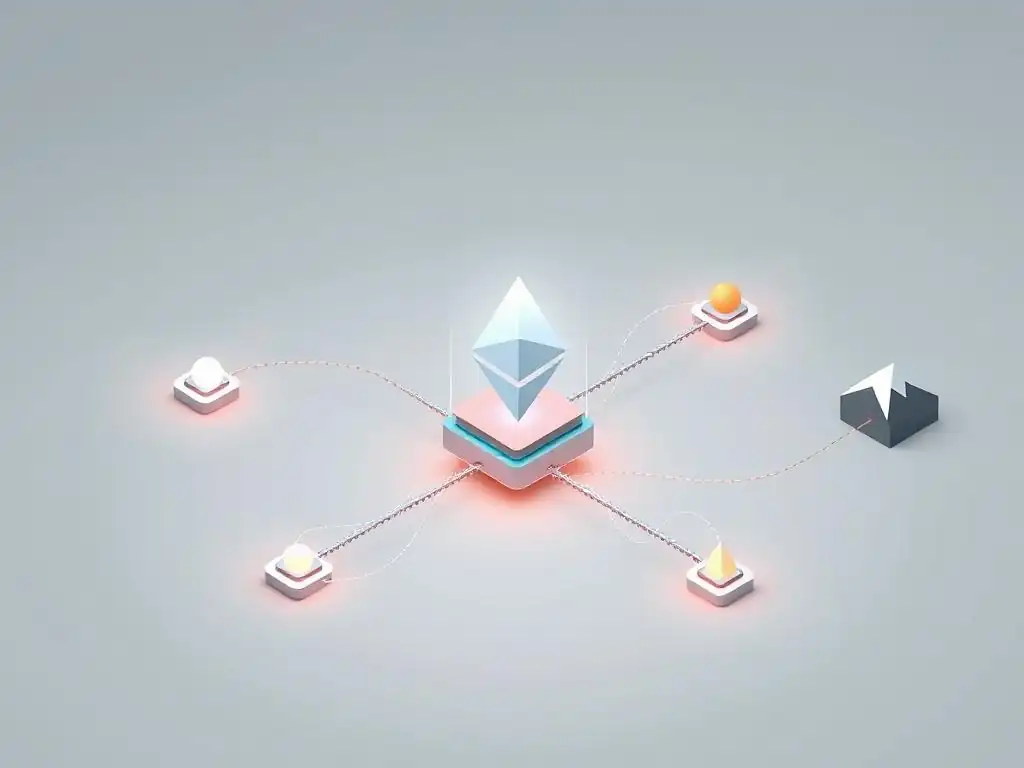
As the blockchain ecosystem matures, it is becoming increasingly fragmented across various Layer-1 chains (like Bitcoin, Solana, Polkadot) and Ethereum Layer-2 networks. While Ethereum and its L2s host a vast amount of activity and value, users and dApps often need to interact with assets or data residing on other chains.
For example, someone might want to use Bitcoin in an Ethereum DeFi protocol, or move assets from an Ethereum L2 back to L1, or interact with a dApp deployed on a different L2 or even a non-Ethereum chain. Without effective cross-chain communication, these networks exist in isolated silos, limiting liquidity, fragmenting user bases, and hindering the overall growth and potential of decentralized applications.
Enabling seamless interoperability allows for the free flow of assets, data, and even smart contract calls between different blockchain environments. This creates a more connected and efficient ecosystem, where users aren't locked into a single chain and dApps can leverage the unique strengths of multiple networks.
For instance, a dApp might use a high-throughput L2 for most operations but settle final state changes on Ethereum L1, while also needing to access data from another chain. Robust cross-chain solutions are therefore essential for the future of decentralized finance, gaming, and all applications that benefit from connectivity, complementing the internal Blockchain scalability solutions future of Ethereum itself.
Ethereum Bridges: Enabling Asset Transfers and Data Sharing
Blockchain bridges are protocols designed to connect different blockchain networks, allowing users to transfer assets and potentially data between them. For Ethereum, bridges are crucial for moving value not only between Ethereum L1 and other L1s but also between L1 and its various L2s, and between different L2s themselves.
The most common use case is transferring tokens: a user deposits tokens on the source chain, which are then locked, and an equivalent number of wrapped or native tokens are minted on the destination chain. To move back, the wrapped tokens are burned on the destination chain, and the original tokens are unlocked on the source chain.
Bridges vary significantly in their architecture and security models. Some rely on a trusted set of validators or multi-signature wallets to custody locked assets and relay information, introducing centralization risks. Others use more decentralized approaches, like light client verification or zero-knowledge proofs, to verify state transitions on the source chain more trustlessly.
The security of bridges is paramount, as they represent honey pots of locked assets and have been the target of major hacks, resulting in losses exceeding a billion dollars across various incidents (e.g., the Ronin Bridge hack in March 2022 lost over $600 million). Developing secure and reliable bridging technology is a critical component of the broader Blockchain scalability solutions future, enabling a more connected decentralized world.
LayerZero and IBC: Cross-Chain Communication Protocols
Beyond simple asset bridges, protocols are being developed to enable more general-purpose cross-chain communication. LayerZero is an example of an "omnichain" interoperability protocol designed to connect various blockchains. It uses a novel architecture involving endpoints deployed on each chain, a relayer, and an oracle (like Chainlink). When a message is sent from Chain A to Chain B, the LayerZero endpoint on A sends the transaction header to the oracle and the transaction proof to the relayer.
The oracle forwards the header to the endpoint on B, and the relayer forwards the proof. The endpoint on B then validates the proof against the header, confirming the transaction's validity on Chain A without needing to run a full light client for A on chain B. This approach aims for efficiency and low cost.
The Inter-Blockchain Communication (IBC) protocol, primarily associated with the Cosmos ecosystem, is another prominent example of a cross-chain standard. IBC uses a light client verification model, where each connected chain runs a light client of the other chain to verify the validity of messages passed between them. This provides a high degree of trustless security but can be more complex and resource-intensive to set up.
While IBC is native to Cosmos SDK chains, efforts are underway to make it compatible with other ecosystems, including Ethereum. These protocols represent different philosophies and technical approaches to solving the hard problem of trustless cross-chain messaging, which is crucial for realizing a truly interconnected Blockchain scalability solutions future.
Hardware Acceleration: Improving Ethereum Client Performance
The Role of Specialized Hardware in Optimizing Ethereum Node Operations
While software and protocol-level changes are key to scaling Ethereum's transaction throughput, the performance of the underlying network infrastructure – the nodes that run the Ethereum client software – is also vital. Running a full Ethereum node requires significant computational resources. Nodes must download and verify the entire transaction history (which is terabytes of data), process new blocks in real-time, execute smart contract code, and respond to network requests. As the network grows and activity increases, the demands on node hardware escalate.
Specialized hardware, particularly high-performance Solid State Drives (SSDs), powerful multi-core CPUs, and ample RAM, plays a crucial role in optimizing node operations. Fast SSDs are essential for quickly accessing and writing blockchain data. Powerful CPUs are needed to efficiently execute smart contract code and verify cryptographic proofs.
Sufficient RAM helps cache frequently accessed data, reducing reliance on slower disk reads. While consumer-grade hardware can run a node, professional node operators or infrastructure providers often use datacenter-grade equipment to ensure maximum uptime, fastest sync times, and the ability to handle high query loads. This hardware foundation is necessary to keep the decentralized network running smoothly and effectively support the increased load from Layer-2 solutions and other Blockchain scalability solutions future developments.
Client Diversity and Optimization Strategies
Ethereum's resilience and health are significantly bolstered by having multiple independent client software implementations (e.g., Geth, Nethermind, Erigon, Besu). Client diversity means that if there is a bug or vulnerability in one client, the majority of the network running other clients remains unaffected, preventing a single point of failure. Each client implementation also employs different optimization strategies tailored to specific performance goals.
For instance, clients like Erigon are specifically optimized for efficient disk usage and faster syncing times, making it easier for new nodes to join the network and reducing the hardware requirements slightly for archival nodes. Other clients focus on execution speed or memory management.
Developers continuously work on optimizing these clients to reduce resource consumption, improve block processing speed, and enhance peer-to-peer networking capabilities. While not a direct increase in protocol throughput, these hardware and software optimizations at the node level are essential for maintaining the operational efficiency and decentralization of the network, ensuring that the infrastructure can keep pace with the demands placed upon it by the evolving Blockchain scalability solutions future.
Future Trends in Ethereum Scalability Solutions
Data Availability Sampling (DAS)
Data Availability Sampling (DAS) is a critical technique planned for future Ethereum upgrades, particularly full Danksharding. In a sharded network, a validator in one shard needs to be able to verify that the data posted by validators in other shards is actually available to the network, even if they don't download the entire data of those other shards. This is the "data availability problem." Full nodes can download all data, but this is resource-intensive. Light clients, which are resource-constrained (like mobile phones), cannot.
DAS allows light clients (and even full nodes more efficiently) to probabilistically verify data availability by downloading and checking only small random samples of data from a block or shard. If enough random samples are available, there's a high statistical probability that the entire data set is available.
This technique is fundamental for enabling the massive data capacity promised by Danksharding, as it allows the network to verify the availability of vast amounts of L2 rollup data posted to data shards without requiring every node to download everything. DAS is a key piece of infrastructure for the future Blockchain scalability solutions future, specifically enabling the scaling of rollups.
Verkle Trees
Verkle Trees are a proposed future upgrade to the data structure Ethereum uses to represent its state (the Merkle Patricia Trie). Verkle Trees are a type of cryptographic accumulator that allows for very small proofs ("witnesses") needed to verify a piece of data within a large dataset. In Ethereum's context, this means the data needed to verify the state of an account or contract within a block (the "witness size") could be dramatically reduced.
Currently, the witness size for a block can be several megabytes, which needs to be processed and verified by nodes. Verkle Trees could potentially reduce this to kilobytes. This reduction in witness size has several significant benefits for Blockchain scalability solutions future.
It makes block processing faster and less resource-intensive for nodes. Crucially, it is essential for enabling stateless clients, which would not need to store the entire state of the blockchain, making it much easier and faster to sync and run an Ethereum node. Smaller proofs could also potentially allow for larger block sizes or more complex transactions without overwhelming the network.
Account Abstraction
Account Abstraction (as proposed in EIP-4337) is a concept aimed at unifying the two types of Ethereum accounts: Externally Owned Accounts (EOAs) controlled by private keys and Contract Accounts controlled by code. The goal is to allow smart contracts to initiate transactions and pay for gas, effectively making all accounts behave more like smart contracts. While not a direct increase in raw transaction throughput (TPS), account abstraction is a significant step towards improving user experience and enabling new functionalities that are crucial for widespread dApp adoption, which in turn relies on underlying Blockchain scalability solutions future.
With account abstraction, users could have wallets with features like social recovery (friends or guardians can help regain access if a key is lost), batching multiple transactions into one for efficiency and lower gas costs, paying transaction fees in tokens other than ETH, and setting complex spending limits or conditions via code. These features make interacting with Ethereum and dApps much more user-friendly and flexible, reducing friction points that currently hinder adoption. By enabling more efficient and user-friendly interactions, account abstraction complements throughput scaling by making the increased capacity accessible and usable for a broader audience.
Evaluating the Effectiveness of Ethereum Scaling Solutions
Key Metrics for Measuring Scalability: Transactions Per Second (TPS), Latency, and Cost
Evaluating the effectiveness of different Blockchain scalability solutions future requires focusing on key performance metrics beyond just theoretical capacity. The most commonly cited metric is Transactions Per Second (TPS), which measures the number of transactions a network can process concurrently. Higher TPS indicates greater capacity. However, TPS alone isn't sufficient. Latency, which refers to the time it takes for a transaction to be confirmed or finalized, is equally important for user experience. Low latency is crucial for interactive applications like trading or gaming.
Another critical metric is Cost, specifically transaction fees (gas costs). A scalable solution must make transactions affordable for a wide range of use cases and users. High TPS is less meaningful if the cost per transaction remains exorbitant. Other factors include security (does the scaling solution maintain the security guarantees of L1? ), decentralization (does it introduce new centralization risks? ), and composability (how easily can different dApps and protocols interact within the scaled environment?). A truly effective scaling solution optimizes across all these dimensions.
Arbitrum: Examining Scalability and Ecosystem Growth
Arbitrum is a leading Optimistic Rollup solution for Ethereum, launched by Offchain Labs. It provides a separate chain where transactions are executed, significantly increasing throughput compared to Ethereum L1. While theoretical TPS can reach into the thousands, practical throughput depends on factors like L1 data bandwidth and dApp complexity. Arbitrum has demonstrated real-world scalability improvements, consistently handling hundreds of thousands or even millions of transactions daily across its various chains (Arbitrum One, Arbitrum Nova), far exceeding L1 capacity.
The lower transaction costs on Arbitrum (often cents instead of dollars or hundreds) and faster execution times have attracted a large and vibrant ecosystem. As of late 2023/early 2024, Arbitrum hosts hundreds of dApps, including major DeFi protocols, NFT marketplaces, and gaming projects, commanding billions of dollars in total value locked (TVL). This significant migration and growth of dApps on Arbitrum serve as a strong case study demonstrating how Layer-2 solutions can effectively scale Ethereum, reduce costs, and foster substantial ecosystem development, proving the impact of Blockchain scalability solutions future.
Polygon: Analyzing the Impact of a Layer-2 Solution on dApp Development
Polygon, initially known for its PoS sidechain, has also become a significant player in the Ethereum scaling landscape, now actively developing ZK-rollup solutions like Polygon zkEVM. The Polygon PoS chain, while architecturally different from a rollup (it's a separate chain with its own validators, committing checkpoints to Ethereum L1), has achieved massive adoption due to its high speed (often processing thousands of TPS) and extremely low transaction costs (fractions of a cent).
The affordability and speed of the Polygon PoS chain have made it an attractive environment for dApp developers, particularly for use cases sensitive to high L1 gas fees, such as blockchain gaming, social applications, and certain DeFi strategies. It hosts thousands of dApps and millions of users, including large-scale projects and partnerships with major companies. Polygon's success illustrates how providing a scalable, low-cost environment can dramatically lower the barrier to entry for dApp development and user participation, showcasing a successful implementation of Blockchain scalability solutions future that has significantly impacted the broader Web3 ecosystem.
Conclusion: The Future of Ethereum Scalability and its Impact on the Blockchain Ecosystem
The Ongoing Evolution of Ethereum Scaling Solutions
The journey towards a truly scalable Ethereum is not a single event but an ongoing, multi-faceted process. The network is pursuing a layered approach, combining improvements to the base Layer 1 with innovative Layer-2 technologies and enhanced cross-chain communication. Layer-2 rollups, both Optimistic and ZK-based, have already proven their ability to dramatically increase transaction throughput and reduce costs, handling the majority of user activity for many dApps. The planned implementation of data sharding (Proto-Danksharding and Danksharding) on Layer 1 will further enhance the capacity of these rollups by providing dedicated, cheap data space.
Alongside these core scaling strategies, future protocol upgrades like Verkle Trees and Data Availability Sampling will optimize the network's efficiency and enable more decentralized participation (e.g., easier node running). Furthermore, advancements in consensus mechanisms (PoS) and the development of usability features like Account Abstraction are crucial complements. This continuous evolution, involving parallel efforts across multiple technological fronts, underscores the complexity and determination behind achieving robust Blockchain scalability solutions future capable of supporting a global decentralized network.
The Potential for Widespread dApp Adoption Driven by a Scalable Ethereum
The ultimate goal of Ethereum's scaling efforts is to create a platform that is fast, cheap, and accessible enough for mainstream adoption of decentralized applications. High transaction costs and slow confirmations on L1 have been major inhibitors, limiting dApps to primarily high-value use cases or power users. By moving the majority of activity to highly efficient Layer-2 networks, supported by a scalable Layer-1 data layer, Ethereum aims to lower the cost per transaction to fractions of a cent and confirmation times to seconds or milliseconds.
Achieving this level of scalability will unlock a vast array of potential dApp use cases that are currently economically unfeasible on L1. This includes micro-payments, high-frequency trading, seamless in-game asset transfers, decentralized social media interactions, and complex supply chain tracking.
As scalability improves and user experience is enhanced through features like account abstraction, the barrier to entry for average users decreases significantly. A truly scalable Ethereum has the potential to onboard billions of users and enable a new wave of decentralized applications across finance, culture, and everyday life, realizing the initial vision and cementing the importance of the Blockchain scalability solutions future.
Frequently Asked Questions
What are the primary limitations of current blockchain technology that necessitate scalability solutions?
Current blockchains often face limitations in transaction throughput and high gas fees, hindering widespread adoption. This leads to slower transaction times and increased costs for users.
What are some examples of "Next-Generation" scalability solutions being developed for blockchain technology?
Examples include Layer-2 solutions like rollups and sidechains, as well as sharding and state channels. These aim to increase transaction processing capacity.
How do Layer-2 solutions like rollups contribute to improved blockchain scalability?
Rollups process transactions off-chain and then batch them onto the main blockchain, significantly reducing on-chain transaction load and gas costs.
How might the regulatory landscape impact the development and adoption of blockchain scalability solutions?
Regulations can either foster innovation through clear guidelines or stifle it through overly restrictive rules, particularly regarding security token offerings and DeFi protocols.
What is the potential future of blockchain technology if effective scalability solutions are successfully implemented?
Successful scalability could unlock widespread adoption across various industries, enabling faster, cheaper, and more efficient decentralized applications and enterprise blockchain solutions.
Final Reflection: Embracing the Future of Blockchain Scalability
The exploration of next-generation scalability solutions underscores a critical juncture for blockchain technology. The ability to handle increasing transaction volumes without sacrificing security or decentralization is no longer a theoretical concern, but an immediate necessity for widespread adoption. The solutions discussed, from sharding to layer-2 protocols, represent a concerted effort to overcome the limitations that currently hinder blockchain's potential to revolutionize industries.
This relentless pursuit of scalability has profoundly shaped the blockchain landscape, fostering innovation and driving the evolution of decentralized applications. Witnessing this transformation firsthand reinforces the belief that blockchain's true potential lies in its ability to adapt and overcome challenges. The future of blockchain is not just about technology; it's about the potential to reshape our world.
This quote encapsulates the transformative power that scalable blockchain solutions promise, impacting everything from finance and supply chain management to healthcare and governance.
As we stand on the cusp of a new era in blockchain technology, let us not be passive observers. Consider how these advancements in scalability solutions can empower you, your community, and the industries you are passionate about. Embrace the future of blockchain, explore its possibilities, and contribute to building a more decentralized, efficient, and equitable world.
Unleash the Future: Dive Deeper into Blockchain Scalability!
Thank you for exploring the exciting advancements in blockchain scalability with us. You now have a glimpse into the potential solutions shaping the future of decentralized technology. Ready to put this knowledge into action?
Here's how you can continue your journey:
- Commit to exploring one of the emerging scalability solutions highlighted in this article. Download its whitepaper, try out its testnet, or join its community forum.
- Share this article with your network to spark discussions on how these technologies can solve real-world problems.
- Suggest other innovative scalability solutions you have come across.
What specific scalability challenge are you most excited to see solved, and which solution do you think holds the greatest promise? Share your thoughts in the comments below!
Leave a Reply