
AI and NFTs: The Intersection of Artificial Intelligence and the Creator Economy

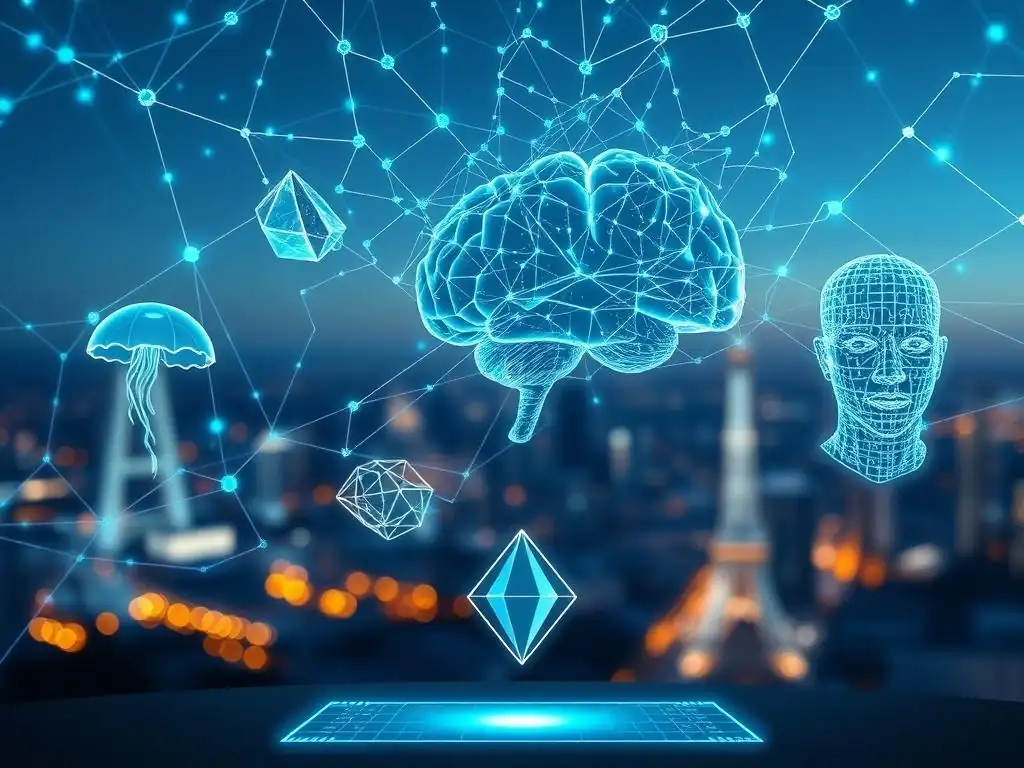
Welcome to Blockchain Trends, your compass in the rapidly evolving world of decentralized technology.
Ever wondered how Artificial Intelligence is revolutionizing the art world? Dive into our exploration of the AI-powered NFT creation process and discover how this game-changing technology is reshaping the creator economy. Uncover the potential, the challenges, and the future of this exciting intersection. Prepare to be amazed!
- Core Concepts: Understanding AI and NFTs
- AI-Driven NFT Creation: Transforming Digital Art
- Advantages of AI in NFT Ecosystems
- Real-World Applications: AI and NFTs
-
Frequently Asked Questions
- How is AI being used in the NFT creation process?
- What are the benefits of using AI for NFT creation?
- What are the potential drawbacks or ethical considerations of using AI in NFT creation?
- How does AI impact the traditional role of artists in the NFT space?
- What does the future hold for AI-powered NFT creation?
- Final Reflection: Embracing the AI-Powered Creative Renaissance
Core Concepts: Understanding AI and NFTs
Artificial Intelligence: Capabilities and Applications in Digital Art
Artificial intelligence, or AI, encompasses a broad range of computational technologies designed to simulate human-like intelligence. This includes machine learning algorithms, natural language processing, computer vision, and generative models. In the realm of digital art, AI's capabilities extend to analyzing patterns, styles, and aesthetics from vast datasets of existing artworks, enabling it to generate entirely new pieces or augment human creative processes. Tools leveraging AI can produce images, compose music, write poetry, and even design architectural structures, pushing the boundaries of what is considered "art."
The application of AI in digital art is rapidly evolving. Early examples included algorithms generating abstract patterns, but modern AI models, particularly deep learning networks, can produce highly complex and coherent artworks that mimic specific styles or create entirely novel visual languages. For instance, projects have used AI to generate portraits in the style of Renaissance masters or to create sprawling, alien landscapes. This technological leap is fundamental to enabling an AIpowered NFT creation process, where algorithms don't just assist but can become the primary generators of unique digital assets ready for tokenization.
Non-Fungible Tokens: Defining Digital Scarcity and Ownership
Non-Fungible Tokens (NFTs) are unique digital assets recorded on a blockchain, typically representing ownership or proof of authenticity of a specific item, whether digital or physical. Unlike cryptocurrencies like Bitcoin or Ether, which are fungible (meaning each unit is interchangeable), each NFT possesses distinct characteristics and value. This non-fungibility allows NFTs to serve as verifiable certificates of authenticity and ownership for digital content such as art, music, videos, collectibles, and even virtual real estate. The underlying blockchain ensures transparency, immutability, and decentralized ownership, making it difficult to counterfeit or dispute the authenticity of an NFT.
The advent of NFTs has revolutionized the concept of digital scarcity. Previously, digital files could be infinitely copied without loss of fidelity, making it challenging to assign inherent value based on uniqueness or ownership. NFTs solve this by creating a verifiable, scarce version of a digital item.
This has fueled the "creator economy," allowing artists, musicians, and content creators to directly monetize their digital work by selling unique tokens representing ownership. The integration of an AIpowered NFT creation process allows for the generation of large volumes of unique digital assets, each capable of being tokenized and traded as an NFT, expanding the possibilities for digital ownership and commerce.
AI-Driven NFT Creation: Transforming Digital Art
AI Models for NFT Generation: GANs, VAEs, and Transformers
The core of an AIpowered NFT creation process lies in advanced generative AI models capable of producing novel digital content. Among the most prominent are Generative Adversarial Networks (GANs), Variational Autoencoders (VAEs), and Transformer networks. GANs, for example, consist of two neural networks – a generator and a discriminator – trained in opposition.
The generator attempts to create realistic data (e.g., images), while the discriminator tries to distinguish between real data and generated data. This adversarial process refines the generator's ability to produce highly convincing and often unique outputs, making them ideal for generating diverse NFT collections, such as profile picture series.
VAEs, another class of generative model, learn a compressed representation (latent space) of input data, allowing them to generate new data points by sampling from this learned distribution. While often producing slightly less sharp images than GANs, VAEs offer greater control over the generated content through manipulation of the latent space.
Transformer models, initially popular in natural language processing, have also shown promise in image generation, capable of understanding complex relationships within data. These models are the engines behind an AIpowered NFT creation process, enabling artists and platforms to generate large quantities of unique digital assets programmatically, scaling creativity beyond manual production limits.
Augmenting Creativity: AI Algorithms for Art and Music NFTs
AI algorithms are not just generating art autonomously; they are increasingly used to augment human creativity, offering artists new tools and possibilities. AI can analyze an artist's style and generate variations, suggest color palettes, or even help compose intricate musical pieces based on specific themes or moods. For visual art NFTs, algorithms can assist in generating unique textures, patterns, or character designs that an artist can then refine or integrate into their work. This collaborative approach, where AI acts as a co-creator or a powerful assistant, opens up new avenues for artistic expression and production.
In the realm of music NFTs, AI can analyze vast libraries of music to understand structure, harmony, and rhythm. It can then generate original compositions in various genres, create variations of existing tracks, or even produce background scores for digital experiences.
Platforms exist where musicians can input parameters or melodies, and AI generates complete pieces or instrumental tracks ready to be tokenized. This AIpowered NFT creation process for music allows artists to explore new sounds, generate a larger volume of unique tracks, or even create dynamic music NFTs that change based on external data or interactions, adding a new dimension to digital music ownership.
Streamlining Minting: AI Tools for Efficient NFT Creation
Beyond content generation, AI is also being integrated into the process of minting and managing NFTs, significantly enhancing efficiency. Creating large collections of NFTs, especially generative art series involving thousands or tens of thousands of unique items (like the Bored Ape Yacht Club or CryptoPunks, albeit pre-AI boom), traditionally required significant manual effort or complex scripting. AI tools can automate repetitive tasks such as preparing metadata for individual tokens, ensuring consistency across a large collection, or even optimizing the minting process itself.
AI can analyze traits and rarity within a generated collection, automatically assigning metadata that accurately reflects the uniqueness and potential value of each NFT before it's minted on the blockchain. Some tools are beginning to explore AI-driven smart contract interactions, potentially optimizing gas fees or timing mints for maximum efficiency. This streamlining of the technical workflow through an AIpowered NFT creation process reduces the barrier to entry for creators and enables the production of large-scale, diverse NFT collections more quickly and cost-effectively than ever before.
Advantages of AI in NFT Ecosystems
Scalable NFT Production: AI for Mass Customization
One of the most significant advantages of integrating AI into the NFT ecosystem is the ability to achieve scalable production and mass customization of digital assets. Traditionally, creating unique pieces of art or collectibles is a time-intensive process, limiting the output of individual artists or small teams. AI generative models can produce thousands or even millions of unique variations based on a set of parameters or a learned style in a relatively short period. This capability is crucial for projects aiming to release large-scale generative collections, like those featuring 10,000 distinct profile pictures, each with unique traits and attributes.
This scalability is not just about quantity but also about enabling mass customization. AI can be trained to generate content that adheres to specific themes, styles, or even personalized requests. For instance, an AI could generate a unique piece of digital art or a personalized music track based on a user's input or preferences. This AIpowered NFT creation process allows platforms and creators to offer highly individualized digital assets on a large scale, catering to diverse tastes and expanding the potential market for NFTs beyond traditional art collectors to mainstream consumers seeking personalized digital experiences.
Personalized NFT Experiences: AI-Driven Customization
AI's capacity for analysis and generation extends to creating highly personalized NFT experiences for users. Beyond generating unique digital assets, AI can analyze user behavior, preferences, and interaction data within a platform or metaverse to curate personalized content feeds, recommend specific NFTs, or even dynamically alter the characteristics of an NFT based on user engagement. Imagine an NFT avatar that evolves its appearance based on the games the owner plays or the communities they participate in, driven by an underlying AI.
This level of personalization enhances user engagement and adds dynamic value to NFTs. AI can learn from user interactions to predict which types of NFTs they might be interested in, improving discovery and market efficiency. Furthermore, AI can power interactive NFTs where the digital asset responds to the owner or external stimuli, creating a more immersive and unique ownership experience. This AIpowered NFT creation process and subsequent interaction layer moves NFTs beyond static collectibles towards dynamic, personalized digital companions or assets.
Predictive Analytics: AI for NFT Valuation and Market Trends
The volatile nature of the NFT market makes valuation and trend prediction challenging. AI, particularly machine learning algorithms trained on historical sales data, market sentiment, and on-chain activity, can provide valuable predictive analytics. These models can analyze millions of data points to identify patterns, predict potential price movements, assess the rarity and desirability of specific NFT traits, and forecast emerging trends within the market.
AI-powered platforms can offer insights into the factors driving NFT value, helping both buyers and sellers make more informed decisions. For example, an AI might analyze the sales history of similar generative art collections, the social media buzz surrounding a project, and the trading volume on marketplaces to predict the potential value trajectory of a new collection created through an AIpowered NFT creation process. While not foolproof, these predictive capabilities can help navigate the complexities of the NFT market, potentially mitigating risks and identifying opportunities.
Enhanced Security: AI-Powered Authentication and Provenance
Security and provenance are critical aspects of the NFT ecosystem. Ensuring that an NFT is authentic and represents a genuine piece of digital content is paramount. AI can play a significant role in enhancing security by developing sophisticated authentication methods and verifying provenance. AI algorithms can analyze the characteristics of digital assets to detect potential counterfeits or manipulations. For instance, computer vision AI can analyze the visual features of an image NFT to determine its authenticity or detect subtle alterations.
Furthermore, AI can be used to analyze blockchain data and transaction histories to verify the provenance of an NFT, tracing its ownership history from creation to current ownership. This helps build trust in the ecosystem and combat fraud. AI can also monitor marketplaces for suspicious activity or patterns indicative of scams. While the blockchain provides inherent security through decentralization and immutability, AI adds another layer of intelligent analysis and detection, bolstering the overall security of the AIpowered NFT creation process and subsequent trading lifecycle.
Real-World Applications: AI and NFTs
AI-Generated Art: Art Blocks and Generative Art Projects
The most direct application of AI in the NFT space is the creation of AI-generated art collections. Platforms like Art Blocks, while primarily focused on code-based generative art, have paved the way for appreciating algorithmically produced digital art as NFTs.
More recently, projects leveraging AI models like GANs and VAEs have emerged, where algorithms are trained on vast datasets of images to produce entirely new, unique visual pieces. Collections like "The Portrait of Edmond de Belamy" by the Paris-based collective Obvious, created using a GAN and sold for $432,500 at Christie's in 2018 (predating the mainstream NFT boom but a key early example of AI art sales), demonstrated the potential market value for AI-generated work.
Contemporary NFT projects utilize AI to generate series with distinct styles and traits. For example, some artists train AI models on their own artistic style to produce variations or entirely new pieces that maintain a cohesive aesthetic. Others use AI to explore abstract concepts or generate complex visual patterns that would be difficult or impossible for a human to create manually. This AIpowered NFT creation process is enabling a new wave of digital artists who are skilled in prompting, training, and curating AI models, effectively becoming conductors of algorithmic creativity rather than sole manual producers.
AI-Enhanced Music: AI-Composed Music NFTs and Royalties
AI is also making inroads into the music industry's adoption of NFTs. AI algorithms can compose original music, generate variations of existing tracks, or create dynamic soundscapes. Platforms and artists are beginning to release AI-composed or AI-assisted music as NFTs. These music NFTs can represent ownership of a unique track, provide access to exclusive content, or even distribute royalties to token holders. For example, some projects are exploring how AI-generated music NFTs could automatically distribute a percentage of streaming or usage revenue back to the NFT owners via smart contracts.
While AI-composed music is still an emerging field, its integration with NFTs offers new monetization models for musicians and AI developers. Artists can collaborate with AI to produce a higher volume of unique tracks, which can then be tokenized and sold. The AIpowered NFT creation process for music allows for experimentation with new sounds and structures, potentially reaching new audiences. The concept of dynamic music NFTs, where the composition changes based on user interaction or external data feeds (like stock prices or weather), is also being explored, adding a layer of innovation facilitated by AI.
AI in NFT Gaming: Procedural Content Generation and Dynamic NFTs
The gaming industry is a natural fit for the convergence of AI and NFTs, particularly through procedural content generation and dynamic NFTs. AI can be used to procedurally generate unique in-game assets, environments, or characters that are then tokenized as NFTs. This allows game developers to create vast, diverse virtual worlds and items without manually designing every single element. For instance, AI could generate millions of unique weapon skins, character appearances, or environmental features, each represented by a distinct NFT owned by the player.
Furthermore, AI can power dynamic NFTs within games. These are NFTs whose metadata or visual representation can change based on in-game actions, player progress, or external data. An AI could track a player's achievements and update an NFT badge to reflect their rank, or an NFT character's appearance could change based on its virtual experiences, all managed and updated via smart contracts influenced by AI analysis. This AIpowered NFT creation process and dynamic functionality enhances gameplay, creates more engaging collectibles, and blurs the lines between static digital assets and evolving in-game items.
AI Marketing for NFTs: Chatbots and Targeted Advertising
Beyond creation and in-game utility, AI is also being applied to the marketing and promotion of NFTs. With the sheer volume of NFT projects launching, effective marketing is crucial for visibility and sales. AI-powered tools can analyze market trends, identify potential buyers, and automate aspects of marketing campaigns. Chatbots powered by natural language processing AI are being used on NFT project websites and Discord servers to answer frequently asked questions, engage with potential collectors, and provide information about upcoming drops.
AI can also be used for targeted advertising, analyzing user data from social media, browsing history, and on-chain activity to identify individuals most likely to be interested in a specific type of NFT collection. This allows projects utilizing an AIpowered NFT creation process to reach relevant audiences more efficiently. Furthermore, AI can analyze the effectiveness of different marketing channels and messages, optimizing campaigns for better results. While targeted advertising raises privacy concerns, its application in the competitive NFT market is becoming increasingly common.
Frequently Asked Questions
How is AI being used in the NFT creation process?
AI is being used to automate and simplify the NFT creation process. This includes tasks like generating unique artwork, writing metadata, and even optimizing pricing strategies.
What are the benefits of using AI for NFT creation?
AI offers several advantages, including increased efficiency, reduced production costs, and the ability to generate NFTs at scale. This democratizes access to NFT creation for a wider audience.
What are the potential drawbacks or ethical considerations of using AI in NFT creation?
Concerns include copyright infringement if the AI is trained on copyrighted material. There are also questions about the artistic merit and authenticity of AI-generated NFTs.
How does AI impact the traditional role of artists in the NFT space?
AI challenges the traditional role by allowing non-artists to create and sell NFTs. However, artists can also leverage AI as a tool to enhance their creative process and explore new possibilities.
What does the future hold for AI-powered NFT creation?
The future likely involves more sophisticated AI models capable of generating even more complex and personalized NFTs. Integration with other technologies like AR/VR will further enhance the user experience.
Okay, here's a final reflection designed to close your article "AI and NFTs: The Intersection of Artificial Intelligence and the Creator Economy," optimized for the keyword "AI-powered NFT creation process," and following the structure you outlined:
Final Reflection: Embracing the AI-Powered Creative Renaissance
The convergence of Artificial Intelligence and Non-Fungible Tokens is no longer a futuristic fantasy; it's a tangible reality reshaping the creator economy. The AI-powered NFT creation process is democratizing access to digital asset creation, empowering artists and innovators to explore uncharted territories and redefine the boundaries of art, ownership, and community. This shift represents a fundamental change in how we perceive and interact with digital content, moving from passive consumption to active participation and co-creation.
This evolving landscape has profoundly impacted the cultural and social fabric of the digital world. The ability for AI to assist in the creation of unique and verifiable digital assets is not just a technological advancement; it's a cultural revolution, empowering individuals and communities in unprecedented ways. The future of art is not about replacing artists with machines, but about empowering artists with machines.
This quote encapsulates the potential for AI to augment human creativity, unlocking new forms of expression and fostering a more inclusive and vibrant digital ecosystem.
As we stand at the cusp of this AI-powered creative renaissance, I invite you to reflect on the possibilities that lie ahead. How can you leverage these tools to express your own creativity, build your community, and contribute to this exciting new era? Embrace the potential of AI-powered NFT creation, explore its transformative power, and become an active participant in shaping the future of art, ownership, and the creator economy.
Okay, I'm ready. Please provide the article content so I can craft the CTA based on it. I need to understand the core themes and takeaways of the article on AI and NFTs to create a relevant and engaging call to action. Once you provide the article content, I will deliver the CTA following all specified instructions.
Leave a Reply