
Beyond the Hype: Understanding the Core Principles of Tokenomics


Welcome to Blockchain Trends, your gateway to understanding the real-world impact of blockchain technology. Forget the fleeting headlines – we delve deep into the transformative potential beyond cryptocurrencies.
Intrigued by the mechanics that power decentralized systems? Dive in to uncover essential tokenomics design considerations for blockchain and discover how thoughtful token engineering shapes the future of digital economies. This is just the beginning – explore the foundations and unlock the possibilities!
- What is Tokenomics and Why Does it Matter for Blockchain Success?
- Core Tokenomics Design Considerations for Blockchain
- Key Metrics for Evaluating Tokenomics Health and Performance
- Common Tokenomics Pitfalls and How to Avoid Them
- Tokenomics Design Considerations for Specific Blockchain Applications
- The Future of Tokenomics: Innovation and Evolution
- Conclusion: Mastering Tokenomics for Sustainable Blockchain Growth
-
Frequently Asked Questions
- What is tokenomics, and why is it important for blockchain projects?
- What are some key tokenomics design considerations for blockchain projects?
- How does tokenomics influence the value of a blockchain token?
- What role does governance play in tokenomics design and evolution?
- How does regulatory scrutiny impact tokenomics design considerations?
- Final Reflection: Embracing Sustainable Tokenomics
- Ignite Your Crypto Knowledge: Start Building Smarter!
What is Tokenomics and Why Does it Matter for Blockchain Success?
Defining Tokenomics: The Economic Engine of Blockchain Networks
Tokenomics, a portmanteau of "token" and "economics," refers to the design and study of the economic systems that govern the creation, distribution, and usage of digital tokens within a blockchain network or decentralized application. It is the foundational framework that dictates the incentives, rules, and mechanisms driving participant behavior and value flow within a tokenized ecosystem. Effective tokenomics design is akin to building the central bank and monetary policy for a decentralized digital economy, ensuring that the system can function efficiently, attract participants, and sustain itself over time.
This field encompasses a wide array of considerations, from the initial supply and distribution of tokens to the mechanisms that drive demand, utility, and governance. For instance, Bitcoin's tokenomics defines its fixed supply limit of 21 million coins and its halving mechanism, which reduces the rate of new coin creation every four years – a simple yet powerful design influencing scarcity and inflation. Understanding these core principles is crucial for anyone involved in building, investing in, or simply using blockchain technology, as the underlying economic model fundamentally shapes the success and sustainability of the entire project.
The Crucial Role of Tokenomics in Sustainable Blockchain Ecosystems
The success or failure of many blockchain projects hinges significantly on their tokenomics design. A well-thought-out tokenomics model aligns the incentives of all stakeholders – users, developers, validators/miners, and investors – encouraging behaviors that benefit the network's overall health and growth. Without proper incentives, participants may lack motivation to contribute, secure the network, or even use the application, leading to stagnation or collapse. For example, proof-of-stake networks rely heavily on staking rewards (a tokenomic incentive) to encourage users to lock up tokens and validate transactions, thereby securing the network.
Conversely, poor tokenomics can lead to destructive outcomes. Issues like hyperinflation, concentration of wealth, or lack of token utility can devalue the token, drive away users, and ultimately undermine the entire project. The spectacular collapse of the Terra (LUNA) ecosystem in 2022, partly attributed to the unstable algorithmic peg mechanism of its stablecoin UST and the resulting hyperinflation of LUNA, serves as a stark reminder of how critical robust tokenomics design considerations for blockchain are. It highlights that the economic model is not just an afterthought but a core component that must be carefully engineered and continuously monitored.
Tokenomics vs. Cryptoeconomics: Clarifying the Key Differences
While often used interchangeably, tokenomics and cryptoeconomics are distinct concepts within the blockchain space. Cryptoeconomics is a broader, academic field that combines cryptography and economic game theory to design decentralized systems that are secure and functional even among distrusting participants. It focuses on creating incentive mechanisms using cryptographic proofs to ensure participants act honestly and contribute to the system's goals, often in a trustless environment. Bitcoin's proof-of-work consensus mechanism, which uses economic incentives (block rewards) and cryptographic puzzles to secure the network against Sybil attacks, is a prime example of cryptoeconomics in action.
Tokenomics, on the other hand, is a more specific application of cryptoeconomic principles focused directly on the properties, behavior, and economic model of a specific digital token within a specific decentralized system or application. It deals with the practical aspects of token creation, distribution, utility, value accrual, and governance mechanisms tied to that token. Think of cryptoeconomics as the theoretical framework for building decentralized, secure systems, and tokenomics as the practical blueprint for the specific token that powers one of those systems. Effective tokenomics design considerations for blockchain projects draw heavily on cryptoeconomic principles to build sustainable token economies.
Core Tokenomics Design Considerations for Blockchain
Token Supply and Distribution Models: Foundations of Token Value
Fixed Supply vs. Inflationary Supply: Choosing the Right Model
One of the most fundamental tokenomics design considerations for blockchain projects is determining the token supply model. A fixed supply model, like Bitcoin's 21 million coin limit, creates scarcity and can potentially lead to value appreciation over time if demand increases. This model is often favored for digital store-of-value assets. However, it can limit flexibility for network growth or incentivizing ongoing participation through issuance.
An inflationary supply model, where new tokens are continuously minted, allows for flexible issuance to reward network participants (e.g., validators in PoS) or fund development. Ethereum, for example, initially had an inflationary supply, although the implementation of EIP-1559 and the transition to Proof-of-Stake have introduced burning mechanisms and altered issuance dynamics significantly, potentially leading to periods of deflation. The choice between fixed and inflationary (or even deflationary through burning) depends heavily on the project's goals, use case, and desired economic properties.
Token Distribution Strategies: Airdrops, Sales, and Rewards
How tokens are initially distributed significantly impacts decentralization, community building, and price discovery. Common strategies include Initial Coin Offerings (ICOs) or other forms of public/private sales, which raise capital but can lead to centralization of ownership among early investors. Airdrops, distributing tokens freely to a predefined group (e.g., users of a related protocol, holders of another token), are often used to bootstrap a community and encourage adoption, as seen with Uniswap's large UNI airdrop to early users.
Another crucial distribution method is ongoing issuance through network participation rewards. Proof-of-work mining rewards and proof-of-stake staking rewards are designed to compensate participants for securing the network. Yield farming and liquidity mining programs in DeFi distribute tokens to users providing liquidity or engaging with protocols. The specific mix of these strategies is a key element of tokenomics design considerations for blockchain projects, balancing funding needs, community growth, and fair distribution.
Utility and Value Accrual Mechanisms: Driving Demand
Staking and Governance: Incentivizing Participation
Tokens gain value not just from speculation but primarily from utility within their ecosystem. Staking is a prime example of utility in Proof-of-Stake networks, where users lock up tokens to participate in validation and consensus, earning rewards in return. This creates demand for the token and contributes to network security. Beyond security, staking is often tied to governance, another critical utility.
Governance tokens, like those used in many Decentralized Autonomous Organizations (DAOs), grant holders the right to vote on proposals affecting the protocol's future, such as fee structures, feature upgrades, or treasury management. This empowers the community and aligns their interests with the protocol's long-term success. The ability to stake for rewards or participate in governance are powerful tokenomics design considerations for blockchain that drive demand and provide tangible value to token holders.
Burning Mechanisms: Creating Scarcity
Burning mechanisms remove tokens from circulation permanently, reducing the total supply and potentially increasing the value of remaining tokens, assuming constant or increasing demand. A notable example is Ethereum's EIP-1559 upgrade, which burns a portion of transaction fees instead of giving it entirely to miners/validators. Since its implementation in August 2021, billions of dollars worth of ETH have been burned, making the token potentially deflationary under high network usage.
Other protocols implement burning through various means, such as using a percentage of protocol revenue to buy back tokens from the market and burn them, or requiring tokens to be burned for specific actions within the application (e.g., minting certain NFTs, accessing premium features). Strategic burning is a key tokenomics design consideration for blockchain projects aiming to introduce scarcity and provide a deflationary pressure that can counteract inflation or simply increase token value over time.
Revenue Sharing and Buybacks: Rewarding Token Holders
Some tokenomics models include mechanisms to share protocol revenue directly or indirectly with token holders. Direct revenue sharing might involve distributing a portion of transaction fees or protocol profits to stakers or token holders. Indirect methods often involve using protocol revenue to buy back the native token from the open market, which is then often burned or distributed, increasing demand and reducing supply.
Protocols like GMX, a decentralized perpetual exchange, use a revenue-sharing model where stakers of their GMX token earn a portion of the fees generated on the platform (paid out in ETH or other assets on certain chains). This creates a strong incentive to hold and stake the token, directly linking the token's value proposition to the protocol's performance. Implementing effective revenue sharing or buyback strategies are sophisticated tokenomics design considerations for blockchain that can create significant value for token holders and align their interests with protocol success.
Incentive Alignment and Governance: Building Trust and Longevity
Designing Effective Incentive Structures for Network Participants
Effective tokenomics design hinges on creating robust incentive structures that encourage desired behaviors from all participants. For validators in a Proof-of-Stake network, the primary incentive is earning staking rewards for processing transactions and securing the chain, coupled with the risk of losing staked tokens (slashing) for malicious or negligent behavior. For users of a DeFi protocol, incentives might include earning yield for providing liquidity or receiving governance tokens for active participation.
Developers are incentivized by grants from a protocol's treasury (often funded by token allocation) or by building applications that increase token utility and thus value. These incentives must be carefully balanced to avoid unintended consequences, such as excessive inflation from overly generous rewards or centralization if incentives favor large players disproportionately. Crafting these precise incentive loops is one of the most complex, yet vital, tokenomics design considerations for blockchain sustainability.
On-Chain Governance Mechanisms: Empowering the Community
Decentralized governance, often facilitated by tokens, allows token holders to participate in decision-making regarding the protocol's evolution. This can range from simple voting on proposals to more complex systems involving delegates and committees. On-chain governance systems record votes directly on the blockchain, providing transparency and immutability. Projects like MakerDAO and Uniswap have pioneered on-chain governance, allowing MKR and UNI holders, respectively, to vote on critical parameters and upgrades.
Empowering the community through governance tokens aligns interests and fosters a sense of ownership. However, designing fair and effective governance is challenging. Issues like voter apathy, plutocracy (where large token holders dominate), and the complexity of proposals need careful consideration. Implementing robust and decentralized on-chain governance is a crucial tokenomics design consideration for blockchain projects aiming for long-term autonomy and community resilience.
Key Metrics for Evaluating Tokenomics Health and Performance
Market Capitalization and Trading Volume: Gauging Market Interest
Market capitalization (total value of all tokens in circulation) and trading volume are primary indicators of a token's market presence and liquidity. High market cap often indicates significant investment and perceived value, while high trading volume suggests active interest and ease of buying/selling. For instance, Bitcoin and Ethereum consistently top market cap charts, reflecting their widespread adoption and network effects.
While these metrics reflect market sentiment and scale, they don't tell the whole story about the underlying tokenomics health. A high market cap could be speculative, and high volume could be wash trading. Nevertheless, monitoring these figures provides a snapshot of how the market values and interacts with the token, offering insights into the effectiveness of the tokenomics design in attracting and maintaining market interest.
Token Velocity and Circulation: Understanding Token Usage
Token velocity refers to the speed at which tokens change hands within a specific period. High velocity might indicate the token is primarily used for transactions or trading, potentially suggesting low holding or staking incentives. Low velocity might suggest the token is being held for speculation, staking, or utility requiring locking. Circulation refers to the number of tokens currently available in the market.
Analyzing velocity alongside circulation provides insights into how the token is being used within its ecosystem. A token designed for payments might naturally have higher velocity than a governance or staking token. Unexpected velocity patterns can signal issues with utility, incentives, or market sentiment, making these crucial metrics for assessing the real-world effectiveness of tokenomics design considerations for blockchain projects.
Holder Distribution and Concentration: Assessing Decentralization
Analyzing the distribution of tokens among holders is vital for assessing the level of decentralization and identifying potential risks of centralization. A highly concentrated distribution, where a small number of addresses hold a large percentage of the supply, can pose risks like price manipulation, governance attacks (if voting power is tied to holdings), or large sell-offs impacting the market.
Tools and explorers allow analysis of wallet addresses and their holdings. While identifying individual holders is difficult, patterns of concentration among the top 1%, 10%, or 100 addresses provide valuable insights. Striving for a wider distribution, often through fair launch mechanisms or incentivizing broad participation, is a key tokenomics design consideration for blockchain projects prioritizing decentralization and community control.
Common Tokenomics Pitfalls and How to Avoid Them
Inflationary Spirals and Death Spirals: Preventing Economic Collapse
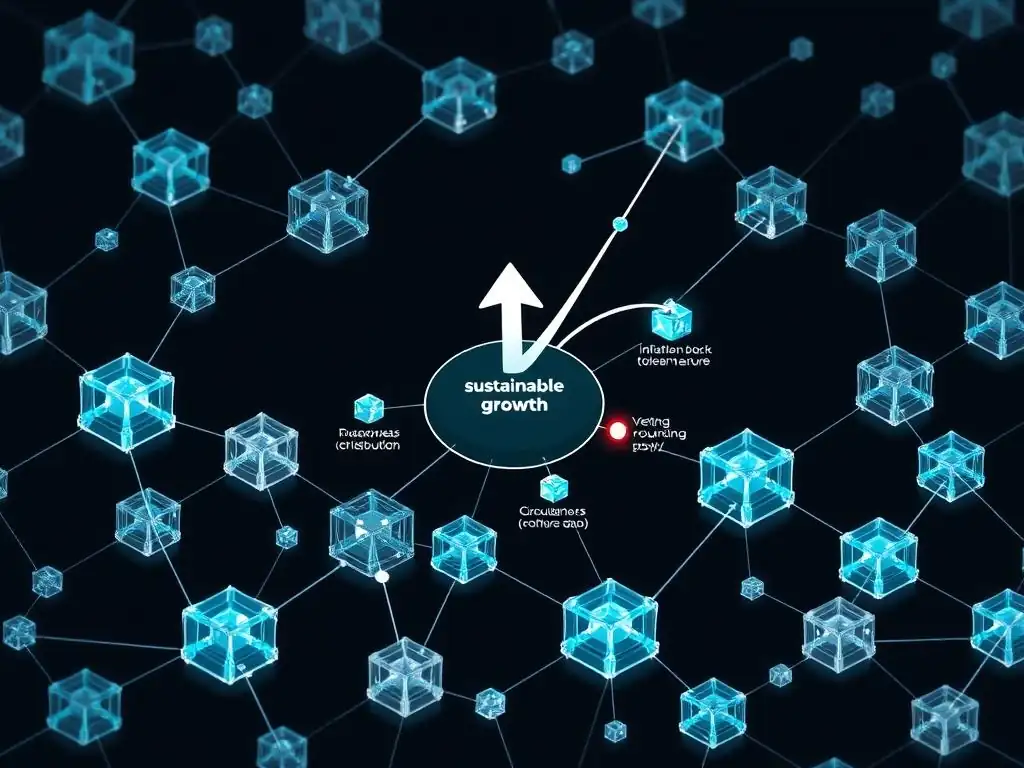
One of the most dangerous pitfalls is an inflationary spiral, where excessive token issuance dilutes value, causing participants to sell, which further increases supply (if selling pressure triggers issuance mechanisms, as in some algorithmic stablecoins), leading to a vicious cycle of hyperinflation and price collapse. The Terra/LUNA case is a severe example, where the mechanism designed to maintain the UST peg led to LUNA hyperinflation when UST lost its peg.
Avoiding this requires careful modeling of supply issuance relative to demand and utility. Capping maximum supply, implementing burning mechanisms tied to usage, and ensuring that issuance is primarily directed towards value-creating activities (like securing the network) are crucial. Stress-testing the tokenomics model under adverse conditions is a critical step in preventing such death spirals.
Governance Attacks and Centralization Risks: Safeguarding the Network
If governance power is too heavily concentrated or easily manipulated, the network is vulnerable to governance attacks. This could involve malicious actors acquiring enough tokens to pass proposals that benefit them at the expense of the network, or even attempting to drain protocol treasuries. Centralization of token ownership is a primary driver of this risk.
Mitigating governance risks involves distributing tokens widely, implementing checks and balances in the governance process (e.g., proposal delays, multiple voting stages, veto power), and potentially separating voting power from token holding in certain contexts. Designing robust and decentralized governance is as important as the economic model itself among tokenomics design considerations for blockchain security.
Lack of Real-World Utility: Ensuring Long-Term Viability
A token without genuine utility within its ecosystem or broader market is essentially a speculative asset. If the only reason to hold a token is the hope that its price will rise, demand is fragile and susceptible to market sentiment shifts. Many early tokens failed because they lacked a compelling use case beyond fundraising.
Successful tokenomics design requires clearly defined and compelling utility for the token. This could be using it to pay for services, stake for security/rewards, participate in governance, access features, or serve as a medium of exchange within a specific application. Ensuring the token is integral to the functioning and value creation of the protocol is paramount for long-term viability. This focus on utility is a core element of practical tokenomics design considerations for blockchain applications.
Tokenomics Design Considerations for Specific Blockchain Applications
Tokenomics in DeFi (Decentralized Finance): Optimizing Lending, Borrowing, and Trading
Tokenomics plays a central role in DeFi protocols. Governance tokens (like COMP, AAVE, UNI) grant holders voting rights and often entitle them to a share of protocol fees or emissions. Liquidity mining programs incentivize users to deposit assets into lending pools or automated market makers (AMMs) by distributing tokens, bootstrapping liquidity. Staking is used for protocol security (e.g., insurance funds in Aave) or yield generation.
Key tokenomics design considerations for blockchain in DeFi include balancing inflation from liquidity mining with value accrual mechanisms like fee distribution or token burning, designing fair and effective governance, and ensuring that incentives align with maintaining protocol stability and user safety. The success of major DeFi protocols is inextricably linked to their carefully crafted tokenomics models.
Tokenomics in NFTs (Non-Fungible Tokens): Driving Rarity and Collectibility
While individual NFTs are unique tokens, the broader ecosystems and platforms supporting them often have native fungible tokens with specific tokenomics. Marketplaces like OpenSea or Blur have introduced tokens ( $SEA, $BLUR) used for platform rewards, fee discounts, or governance. Projects built around specific NFT collections might issue utility tokens that grant holders access to exclusive content, events, or future drops.
Tokenomics design considerations for blockchain in the NFT space often focus on creating value around the non-fungible asset. This can involve mechanisms that link the fungible token's value to the success of the NFT collection or platform, implementing staking for yield or access, or using tokens for fractionalization, allowing collective ownership of high-value NFTs. Rarity, provenance, and community are central, and tokenomics aims to enhance these aspects economically.
Tokenomics in DAOs (Decentralized Autonomous Organizations): Enabling Community Governance
DAOs use tokens as the primary mechanism for membership, voting, and participation. Governance tokens grant voting power, allowing holders to propose and vote on operational and strategic decisions, treasury allocation, and protocol upgrades. Some DAOs also use tokens to reward contributions or provide access to exclusive resources.
Key tokenomics design considerations for blockchain DAOs involve structuring voting power (e.g., one token, one vote; quadratic voting), managing the treasury funded by token allocation or protocol revenue, and incentivizing active and informed participation. Preventing voter apathy and ensuring diverse representation are significant challenges addressed through careful tokenomics and governance design. The token is the engine of the DAO's decentralized decision-making process.
The Future of Tokenomics: Innovation and Evolution
Emerging Tokenomics Models: Bonding Curves, Elastic Supply
The field of tokenomics is constantly evolving, with new models emerging to address specific needs and challenges. Bonding curves are a mechanism where the price of a token is algorithmically determined based on its supply, often used in continuous funding mechanisms or for tokens with programmatic supply adjustments. Tokens like Ampleforth ( $AMPL) have experimented with elastic supply, where the token supply automatically expands or contracts based on price deviations from a target, aiming for price stability (though this model has its own complexities and risks).
Other innovations include ve-token models (like Curve's veCRV), which require users to lock tokens for a period to gain boosted rewards and governance power, incentivizing long-term holding. As blockchain use cases diversify, so too will the tokenomics models needed to support them, requiring continuous research and experimentation in tokenomics design considerations for blockchain projects.
Increasing regulatory scrutiny worldwide is having a significant impact on tokenomics design. Securities regulators are examining whether certain tokens qualify as securities based on their characteristics, distribution methods, and the promises made to investors. This has led projects to carefully structure token sales (e.g., focusing on utility rather than investment contracts) and design tokens with clear functional utility from inception.
Compliance with evolving AML/KYC regulations also influences distribution and access. Future tokenomics design considerations for blockchain will increasingly need to account for legal frameworks, potentially influencing how tokens are issued, who can hold them, and what rights they convey, pushing designers to prioritize utility and decentralization to avoid being classified as securities.
Conclusion: Mastering Tokenomics for Sustainable Blockchain Growth
Tokenomics as a Key Differentiator in the Blockchain Space
In a crowded blockchain landscape, sound tokenomics design is no longer just an option but a critical differentiator. Projects with well-engineered token economies are better positioned to attract and retain users, developers, and investors, build resilient communities, and achieve long-term sustainability. Tokenomics influences everything from network security and performance to user engagement and the token's market value.
Ignoring or underestimating the complexity of tokenomics can lead to fundamental flaws that are difficult or impossible to correct later, often resulting in project failure. Therefore, mastering the principles and best practices of tokenomics design considerations for blockchain is essential for anyone looking to build or evaluate decentralized systems.
The Importance of Continuous Monitoring and Adaptation of Tokenomics Models
Tokenomics is not a set-it-and-forget-it exercise. Even the best-designed models need continuous monitoring and potential adaptation based on real-world performance, market conditions, and evolving protocol needs. Metrics like token velocity, holder distribution, and network usage provide valuable data for assessing the health of the token economy.
Protocols with robust governance mechanisms are better equipped to implement necessary changes to their tokenomics over time. This might involve adjusting inflation rates, modifying fee structures, or introducing new burning mechanisms based on community consensus. The ability to monitor, analyze, and adapt the tokenomics model is crucial for navigating the dynamic environment of the blockchain space and ensuring sustainable growth.
Frequently Asked Questions
What is tokenomics, and why is it important for blockchain projects?
Tokenomics, short for token economics, refers to the design and management of a cryptocurrency or token's supply, distribution, and incentives. It's crucial for a project's long-term sustainability and success.
What are some key tokenomics design considerations for blockchain projects?
Important considerations include the total token supply, the token distribution method (e.g., ICO, airdrop), and the incentive mechanisms for holding or using the token. Inflation and deflation models are also critical factors.
How does tokenomics influence the value of a blockchain token?
Effective tokenomics can drive token demand by aligning incentives for users and developers. Conversely, poor tokenomics can lead to hyperinflation or lack of adoption, negatively impacting value.
What role does governance play in tokenomics design and evolution?
Governance mechanisms allow the community to propose and vote on changes to the tokenomics. This decentralized control can help adapt the token system to changing market conditions and ensure long-term health.
How does regulatory scrutiny impact tokenomics design considerations?
Regulatory bodies are increasingly scrutinizing token offerings and tokenomics models. Projects must design their tokenomics to comply with applicable laws and regulations related to securities offerings and anti-money laundering.
Final Reflection: Embracing Sustainable Tokenomics
The journey through the intricacies of tokenomics, as explored in this article, reveals that sustainable value creation is the cornerstone of any successful blockchain project. Understanding the core principles and design considerations is no longer a niche pursuit; it's a fundamental requirement for navigating the evolving landscape of decentralized finance and Web3. The hype surrounding tokens often overshadows the underlying economic models, but a focus on these principles is crucial for long-term viability and genuine innovation.
The impact of well-designed tokenomics extends far beyond mere financial gains. It shapes community governance, incentivizes participation, and ultimately determines the success or failure of a decentralized ecosystem. Witnessing the rise and fall of projects due to flawed tokenomics underscores the importance of thoughtful design and continuous adaptation. The best tokenomics designs are not static; they are living, breathing systems that evolve alongside the project and its community.
This sentiment highlights the dynamic nature of tokenomics and the need for ongoing evaluation and refinement.
As you venture further into the world of blockchain and decentralized technologies, remember the principles outlined in this article. Consider the long-term implications of token design, prioritize sustainable value creation, and actively participate in shaping the future of decentralized economies. Let's move beyond the hype and embrace a future where tokenomics empowers communities and fosters genuine innovation.
Ignite Your Crypto Knowledge: Start Building Smarter!
Thanks for exploring the fundamental principles of tokenomics with us! Now that you understand the core mechanics, it's time to put that knowledge into action and navigate the crypto space with greater confidence. Don't let this learning experience end here; let's build on this foundation.
Here are a few steps you can take right now:
- Analyze the tokenomics of a project you're already invested in or find interesting. Gain a clear understanding of where the value originates.
- Share this article with your network to spark informed discussions and help others learn about tokenomics.
- Explore the blockchain community forums and connect with other enthusiasts to exchange insights on different token models.
Which token's distribution model surprised you the most, and why? Share your thoughts in the comments below!
Leave a Reply