
How Smart Contracts Facilitate PeertoPeer IoT Networks


Welcome to Blockchain Trends, your go-to source for unraveling the real-world applications of blockchain technology. Beyond the hype of cryptocurrencies, discover how this revolutionary technology is transforming industries. Ever wondered how smart contract IoT networks can create seamless, secure, and autonomous systems? Dive in to explore the fascinating intersection of blockchain and the Internet of Things, and unlock the potential of decentralized innovation. What if your devices could transact directly, securely, and autonomously? Let's explore how that's becoming a reality!
How Smart Contracts Facilitate Peer-to-Peer IoT Networks
- Introduction: The Convergence of Smart Contracts and IoT
- What are Smart Contracts and How Do They Work?
- Benefits of Using Smart Contracts in IoT Networks
- Peer-to-Peer IoT Networks: A New Paradigm for Device Communication
- Smart Contracts: The Key Enabler for P2P IoT
- Use Cases of Smart Contract-Enabled P2P IoT Networks
- Challenges and Considerations for Implementing Smart Contract IoT Networks
- The Future of Smart Contract IoT Networks
- Conclusion: Empowering a Decentralized IoT Future with Smart Contracts
-
Frequently Asked Questions
- How do smart contracts enable peer-to-peer IoT networks?
- What are the key benefits of using smart contracts in IoT networks?
- What are the main challenges in implementing smart contracts for IoT devices?
- How can smart contracts improve data integrity in IoT networks?
- What role does blockchain regulation play in the future of smart contract IoT networks?
- Final Reflection: Embracing the Decentralized Future of IoT
- Ignite Your IoT Revolution!
Introduction: The Convergence of Smart Contracts and IoT
Understanding the Synergies Between Blockchain, Smart Contracts, and IoT
The intersection of Blockchain, Smart Contracts, and the Internet of Things (IoT) represents a powerful paradigm shift in how devices interact and exchange data. Blockchain technology provides a secure, decentralized, and transparent ledger system, forming the bedrock for trust in digital interactions. Smart contracts, self-executing agreements written in code and stored on the blockchain, automate these interactions based on predefined conditions.
IoT, with its vast network of interconnected devices, generates massive amounts of data and requires efficient and secure communication channels. When combined, these technologies create a synergistic ecosystem where smart contracts, deployed on a blockchain, can orchestrate and secure interactions between IoT devices, enabling new levels of automation and trust in machine-to-machine communication.
This convergence addresses critical challenges in traditional IoT systems, such as centralized control, data security vulnerabilities, and lack of transparency. Consider the exponential growth of IoT devices, projected to reach over 50 billion globally by 2030, according to Statista. Managing and securing this massive network using centralized architectures becomes increasingly complex and vulnerable to single points of failure. Blockchain and smart contracts offer a decentralized and robust alternative, distributing control and enhancing security across the network, thereby mitigating risks associated with centralized systems and paving the way for more resilient and scalable IoT deployments.
The Rise of Peer-to-Peer IoT Networks: A Decentralized Future
Traditional IoT networks often rely on centralized server architectures, where data from numerous devices is aggregated and processed in a central location. While this model is straightforward to implement initially, it presents several limitations, including scalability bottlenecks, single points of failure, and potential privacy concerns. Peer-to-peer (P2P) IoT networks offer a compelling alternative by distributing processing and storage across the network of devices themselves, eliminating the need for a central authority. In a P2P IoT network, devices can communicate directly with each other, share data, and coordinate actions without relying on intermediary servers.
The shift towards P2P IoT networks is driven by the increasing demand for decentralized, resilient, and privacy-preserving systems. Imagine a network of smart sensors deployed in a city to monitor air quality. In a centralized system, all sensor data would be routed through a central server, which could become a bottleneck or a target for cyberattacks.
In a P2P network, sensors can communicate directly with neighboring sensors, forming a mesh network that is more robust and less susceptible to centralized failures. This decentralized approach not only enhances resilience but also improves data privacy as data processing can occur closer to the source, reducing the need to transmit sensitive information across long distances to a central server. This decentralized future for IoT is increasingly being recognized as essential for handling the scale and complexity of modern interconnected device ecosystems.
What are Smart Contracts and How Do They Work?
Defining Smart Contracts: Self-Executing Agreements on the Blockchain
Smart contracts are essentially self-executing contracts with the terms of the agreement directly written into code. These contracts are stored on a blockchain network, making them immutable and transparent. Think of a vending machine: you insert coins (input), select a product (condition), and the machine dispenses the product (output). A smart contract operates similarly, automatically executing predefined actions when specific conditions are met, without the need for intermediaries. These conditions and actions are encoded into the contract, ensuring that the agreement is enforced exactly as programmed.
Unlike traditional legal contracts that require intermediaries like lawyers and courts for enforcement, smart contracts are automatically enforced by the blockchain network itself. Once a smart contract is deployed on the blockchain, it becomes an autonomous agent, reacting to events and executing its terms without human intervention. This automation not only speeds up processes but also reduces the costs and risks associated with traditional contract management. The inherent nature of blockchain ensures that once a smart contract is deployed, it cannot be altered, guaranteeing the integrity and predictability of the agreed-upon terms for all involved parties.
Key Features of Smart Contracts: Immutability, Transparency, and Automation
Smart contracts inherit several key features from blockchain technology that make them particularly well-suited for automating and securing interactions in IoT networks. Immutability is a cornerstone feature; once a smart contract is deployed on the blockchain, its code and data cannot be altered. This ensures that the terms of the agreement remain consistent and tamper-proof throughout its lifecycle. Transparency is another crucial aspect, as the code and transaction history of smart contracts are typically publicly auditable on the blockchain, fostering trust and accountability among participants. Anyone with access to the blockchain can verify the contract’s logic and execution.
Automation is the defining characteristic of smart contracts. They automatically execute predefined actions when specific conditions are met, eliminating the need for manual intervention and reducing the potential for human error. This automation is particularly valuable in IoT environments, where devices need to interact autonomously and efficiently. For example, a smart contract could automatically trigger a payment when an IoT sensor reports a specific data reading, or automatically adjust device settings based on real-time environmental conditions. These features of immutability, transparency, and automation collectively contribute to the efficiency, security, and trustworthiness of systems leveraging smart contracts.
Smart Contract Security Considerations for IoT Applications
While smart contracts offer numerous benefits, security is a paramount concern, especially in the context of IoT applications that often involve sensitive data and critical infrastructure. Smart contracts, being code, are susceptible to vulnerabilities such as bugs, logic errors, and exploits. A flaw in a smart contract could lead to unintended consequences, including data breaches, financial losses, or even physical harm in IoT systems controlling critical infrastructure. For instance, a poorly written smart contract controlling access to a smart lock could be exploited to bypass security measures.
Therefore, rigorous security practices are essential throughout the smart contract development lifecycle. This includes thorough code audits by independent security experts, formal verification methods to mathematically prove the correctness of the code, and robust testing procedures to identify and mitigate potential vulnerabilities. Furthermore, the security of the underlying blockchain platform itself is crucial.
Choosing a reputable and secure blockchain platform is the first step, followed by implementing best practices for key management and access control within the smart contract application. As IoT devices often operate in resource-constrained environments, lightweight and efficient security solutions are also necessary to ensure that security measures do not compromise device performance or battery life.
Benefits of Using Smart Contracts in IoT Networks
Enhanced Security and Trust in IoT Data Exchange
Smart contracts significantly enhance security and trust in IoT data exchange by providing a tamper-proof and transparent mechanism for managing data access and integrity. In traditional IoT systems, security often relies on centralized servers, which can be vulnerable to attacks and data breaches. Smart contracts, operating on a decentralized blockchain, distribute security across the network, making it far more resilient to single points of failure. For example, smart contracts can define granular access control policies, ensuring that only authorized devices or users can access specific IoT data streams.
Moreover, the cryptographic nature of blockchain ensures the integrity of data exchanged through smart contracts. Every transaction and data record is cryptographically signed and linked to the previous one, making it virtually impossible to tamper with data without detection. Consider a scenario where IoT sensors are monitoring temperature-sensitive goods in a supply chain. Smart contracts can be used to record temperature readings on the blockchain, ensuring that these readings are immutable and verifiable. This enhanced security and trust are crucial for applications where data integrity and provenance are paramount, such as healthcare, supply chain management, and critical infrastructure monitoring.
Streamlined Automation and Reduced Operational Costs
The automation capabilities of smart contracts lead to significant streamlining of operations and reduction in operational costs within IoT networks. By automating tasks such as device authentication, data exchange, and payment processing, smart contracts eliminate the need for manual intervention and reduce administrative overhead. For instance, in a smart parking system, smart contracts can automatically manage parking space allocation and payment processing. When a vehicle enters a parking space equipped with an IoT sensor, a smart contract can automatically initiate a parking session and deduct payment from the driver's digital wallet upon exit, all without human interaction.
This level of automation not only increases efficiency but also reduces the potential for human error and associated costs. Consider the operational costs associated with managing a large fleet of IoT devices. Manual processes for device provisioning, configuration updates, and maintenance scheduling can be time-consuming and error-prone. Smart contracts can automate these processes, enabling devices to self-manage and coordinate their operations. This streamlined automation translates directly into reduced operational expenses, improved resource utilization, and faster response times in IoT deployments.
Improved Transparency and Auditability of IoT Processes
Transparency and auditability are inherent advantages of using smart contracts in IoT networks, stemming from the underlying blockchain technology. All transactions and contract executions are recorded on the blockchain ledger, creating an immutable and auditable record of all interactions. This transparency is particularly valuable in scenarios where accountability and verification are essential, such as supply chain tracking, regulatory compliance, and data provenance. For example, in a pharmaceutical supply chain, smart contracts can track the journey of drugs from manufacturing to delivery, recording each step on the blockchain.
This transparent record allows stakeholders to easily verify the authenticity and provenance of products, ensuring compliance with regulations and building trust among consumers. Furthermore, the auditable nature of smart contracts simplifies compliance and dispute resolution processes. Regulators can easily audit IoT systems leveraging smart contracts to ensure adherence to industry standards and legal requirements. In case of disputes or discrepancies, the transparent blockchain ledger provides a verifiable and impartial record of events, facilitating efficient and fair resolution. This enhanced transparency and auditability are increasingly important in today's data-driven and regulated environments.
Enabling Decentralized and Autonomous IoT Devices
Smart contracts empower IoT devices to operate more autonomously and participate in decentralized networks, moving away from reliance on centralized control and single points of failure. By embedding decision-making logic within smart contracts, devices can execute predefined actions based on sensor data and network conditions without constant supervision from a central authority. This autonomy is particularly beneficial in distributed IoT deployments, such as smart cities or industrial IoT environments, where devices need to operate reliably and efficiently in geographically dispersed locations.
Consider a network of smart streetlights managed by smart contracts. Each streetlight can be equipped with sensors and actuators, and its behavior governed by a smart contract. The contract could define rules for adjusting light intensity based on ambient light levels, traffic flow, or time of day.
These streetlights can then operate autonomously, adjusting their lighting levels in real-time based on pre-defined conditions encoded in the smart contract, without requiring constant commands from a central control system. This decentralization and autonomy not only improve system resilience but also reduce latency and communication overhead, leading to more responsive and efficient IoT systems.
Peer-to-Peer IoT Networks: A New Paradigm for Device Communication
Understanding Peer-to-Peer (P2P) Architecture in IoT
Peer-to-peer (P2P) architecture in IoT represents a departure from traditional client-server models, enabling devices to communicate and interact directly with each other without relying on central intermediaries. In a P2P IoT network, each device acts as both a client and a server, capable of both requesting and providing services and data to other devices in the network. This distributed architecture creates a more resilient, scalable, and efficient communication infrastructure compared to centralized systems.
Imagine a network of smart sensors in a building automation system. In a P2P setup, sensors can directly exchange data with actuators, HVAC systems, and other devices, creating a self-organizing and responsive environment.
This contrasts with traditional centralized IoT systems where all device communication is routed through a central server or cloud platform. In a centralized model, the server acts as a single point of control and potential failure. P2P architecture eliminates this single point of failure by distributing communication and processing across the network. Devices in a P2P network discover and connect with each other dynamically, forming ad-hoc networks that can adapt to changing conditions and device availability. This decentralized approach is particularly well-suited for large-scale and dynamic IoT deployments where resilience and scalability are critical requirements.
Advantages of P2P over Centralized IoT Systems
P2P IoT networks offer several key advantages over centralized systems, making them increasingly attractive for a wide range of applications. Enhanced resilience is a primary benefit. By eliminating central servers, P2P networks are less susceptible to single points of failure. If one device fails, the network can continue to function as other devices can still communicate and collaborate. Scalability is another significant advantage. P2P networks can scale more easily as new devices can be added to the network without overwhelming a central server. The network's capacity grows organically with the addition of new peers.
Reduced latency is also a key benefit. In P2P networks, devices can communicate directly with each other, minimizing communication delays compared to centralized systems where data must travel to and from a central server. This lower latency is critical for real-time applications such as industrial automation and autonomous driving.
Enhanced privacy is another advantage. P2P networks can facilitate direct device-to-device communication, reducing the need to transmit sensitive data through central servers, which can be potential points of vulnerability and data collection. These advantages collectively make P2P IoT networks a compelling alternative for building more robust, scalable, and privacy-preserving IoT solutions.
Overcoming Challenges in P2P IoT Network Implementation
While P2P IoT networks offer numerous benefits, their implementation also presents certain challenges that need to be addressed. Network management can be more complex in P2P systems compared to centralized ones. Discovering and managing devices in a dynamic P2P network requires robust peer discovery mechanisms and distributed network management protocols. Ensuring network stability and reliability in a decentralized environment where devices may join and leave the network unpredictably is also a challenge.
Security in P2P networks needs careful consideration. While decentralization enhances resilience, it also introduces new security challenges. Securing communication channels between peers, managing device identities in a distributed manner, and mitigating potential Sybil attacks (where a single attacker controls multiple identities) require robust security protocols and decentralized security mechanisms.
Resource constraints in many IoT devices can also pose a challenge for P2P implementation. Participating in a P2P network may require devices to perform routing, data processing, and security functions, which can be resource-intensive for low-power devices. Addressing these challenges requires innovative solutions in areas such as decentralized network management, robust security protocols, and resource-efficient P2P communication technologies tailored for IoT environments.
Smart Contracts: The Key Enabler for P2P IoT
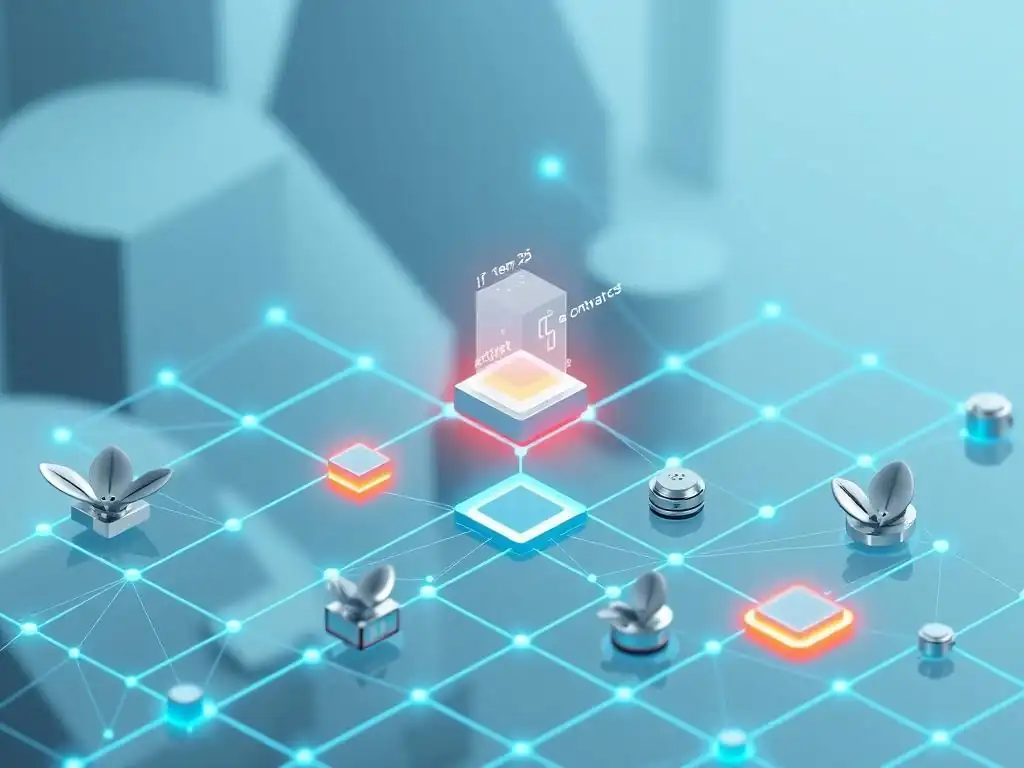
Smart contracts play a crucial role in enabling secure device authentication and authorization within P2P IoT networks. In a decentralized environment, verifying the identity of devices and managing access permissions becomes more complex than in centralized systems. Smart contracts provide a decentralized and tamper-proof mechanism for device identity management. Each device can be assigned a unique identity on the blockchain, and smart contracts can define rules for verifying these identities and granting access permissions based on predefined policies.
For example, when a new device joins a P2P IoT network, a smart contract can be used to authenticate the device's identity by verifying its cryptographic credentials against a decentralized registry. Once authenticated, the smart contract can authorize the device to access specific resources or services within the network based on its role and permissions. This decentralized authentication and authorization mechanism ensures that only legitimate and authorized devices can participate in the P2P network, enhancing overall security and trust. Smart contracts can also manage device revocation and permission updates in a transparent and auditable manner.
Automating Data Exchange and Payments Between IoT Devices Using Smart Contracts
Smart contracts are instrumental in automating data exchange and payment transactions between IoT devices in P2P networks, enabling efficient and trustless machine-to-machine interactions. In a P2P IoT data marketplace, for instance, devices can directly sell and purchase data from each other using smart contracts. A smart contract can define the terms of data exchange, including data quality, price, and delivery mechanism. When a device provides data that meets the specified criteria, the smart contract automatically executes the payment to the data provider.
Consider a network of smart weather stations in a P2P configuration. Each station can collect weather data and sell it to other devices or applications that require real-time weather information. Smart contracts can automate the entire process, from data request and delivery to payment settlement, without the need for intermediaries. This automation not only streamlines data exchange but also enables new business models for IoT data monetization, where devices can autonomously generate revenue by sharing valuable data within the P2P network.
Ensuring Data Integrity and Preventing Data Tampering in P2P IoT Networks
Data integrity and tamper-prevention are critical concerns in any IoT network, and smart contracts, combined with blockchain technology, offer robust solutions for P2P IoT environments. The immutability of blockchain ensures that once data is recorded on the ledger through a smart contract, it cannot be altered or tampered with retrospectively. In a P2P IoT network, smart contracts can be used to timestamp and digitally sign data generated by devices before storing it on the blockchain. This cryptographic signing provides proof of data origin and integrity.
For example, in a P2P IoT network for environmental monitoring, sensor readings can be recorded on the blockchain using smart contracts. Each data entry includes a timestamp and a digital signature from the sensor device. Any attempt to tamper with the data would invalidate the digital signature, making it easily detectable. This mechanism ensures that data collected from IoT devices in a P2P network is trustworthy and reliable, as its integrity is cryptographically guaranteed by the blockchain and enforced by smart contracts.
Smart Contracts for Decentralized IoT Device Management
Smart contracts can also facilitate decentralized IoT device management in P2P networks, enabling more efficient and autonomous device operations. Traditional centralized device management systems can be complex to scale and manage, especially in large and geographically distributed IoT deployments. Smart contracts offer a decentralized alternative by distributing device management functions across the network itself. For instance, smart contracts can be used to manage device configuration updates, software deployments, and firmware upgrades in a P2P IoT network.
When a new software update is available for a specific type of device, a smart contract can be deployed to the P2P network. Devices that meet the specified criteria can then automatically download and install the update, triggered and verified by the smart contract. This decentralized device management approach reduces reliance on central management servers, improves scalability, and enhances the resilience of IoT device management processes. Smart contracts can also automate device lifecycle management, including device provisioning, decommissioning, and resource allocation in a decentralized manner.
Use Cases of Smart Contract-Enabled P2P IoT Networks
Smart Contracts in Smart Home Energy Management Systems
Smart contracts can revolutionize smart home energy management systems by enabling peer-to-peer energy trading and automated optimization. In a smart home P2P energy network, homes equipped with solar panels or other renewable energy sources can sell excess energy directly to neighboring homes using smart contracts. Imagine a scenario where a home generates more solar energy than it consumes.
A smart contract can automatically list this excess energy for sale on a local P2P energy marketplace. Neighboring homes with energy deficits can then purchase this renewable energy directly from the generating home, with the smart contract handling the transaction and payment settlement automatically.
Smart contracts can also automate energy consumption optimization within smart homes. By integrating with smart appliances and sensors, smart contracts can dynamically adjust energy usage based on real-time energy prices, grid conditions, and user preferences. For example, a smart contract could automatically schedule appliance operation during off-peak hours when energy prices are lower, or prioritize energy usage based on renewable energy availability.
These smart contract-driven P2P energy systems promote energy efficiency, reduce reliance on centralized grids, and empower consumers to participate in decentralized energy markets. In Germany, for example, several pilot projects are exploring local energy communities using blockchain for P2P energy trading, demonstrating the practical feasibility of this approach.
Supply Chain Tracking and Traceability Using P2P IoT and Smart Contracts
Supply chain tracking and traceability can be significantly enhanced by leveraging P2P IoT networks and smart contracts. In a P2P supply chain network, IoT sensors attached to goods can continuously monitor their location, condition, and environmental parameters as they move through the supply chain. Smart contracts can be used to record this data on a blockchain, creating an immutable and transparent record of the product's journey. For instance, temperature-sensitive pharmaceuticals can be tracked using IoT sensors that monitor temperature and humidity. Smart contracts can record these readings at each stage of the supply chain, from manufacturing to delivery.
This P2P IoT and smart contract system provides enhanced visibility and traceability throughout the supply chain. Stakeholders, including manufacturers, distributors, retailers, and consumers, can access the blockchain to verify the authenticity and provenance of products, ensuring product integrity and reducing counterfeiting risks.
Smart contracts can also automate supply chain processes, such as automated payments upon delivery confirmation, or automatic alerts if products deviate from predefined conditions (e.g., temperature exceeding acceptable limits). According to a report by IBM, blockchain-based supply chain solutions can reduce shipping costs by 10-20% and improve delivery times by up to 50%, highlighting the potential efficiency gains from this technology.
Decentralized Data Marketplaces for IoT Data Monetization
Smart contract-enabled P2P IoT networks can facilitate the creation of decentralized data marketplaces, allowing IoT device owners to monetize the data they generate directly. In a decentralized IoT data marketplace, devices can act as data producers, selling their sensor data to data consumers through smart contracts. These marketplaces eliminate the need for centralized data aggregators and intermediaries, empowering device owners to retain control over their data and receive direct compensation for its value. Consider a network of environmental sensors deployed across a city. Each sensor can collect data on air quality, noise levels, and traffic conditions.
Through a decentralized data marketplace, sensor owners can offer this data for sale to researchers, urban planners, or businesses interested in environmental insights. Smart contracts can manage the data exchange process, ensuring secure data delivery and automated payment settlement. Data buyers can browse available data sets, specify their requirements, and purchase data directly from sensor owners using smart contracts.
This decentralized data monetization model incentivizes data sharing, fosters innovation, and creates new revenue streams for IoT device owners. Companies like Ocean Protocol are building platforms specifically designed to enable decentralized data marketplaces using blockchain and smart contracts, demonstrating the growing interest in this area.
Smart Contracts for Autonomous Vehicle Communication in P2P Networks
Smart contracts can play a vital role in enabling secure and efficient communication between autonomous vehicles in P2P networks. In a future with widespread autonomous vehicles, P2P communication will be crucial for coordinating traffic flow, sharing real-time road conditions, and enabling cooperative driving maneuvers. Smart contracts can facilitate secure vehicle authentication and authorization within these P2P networks, ensuring that only verified vehicles can participate in communication and data exchange. For example, when two autonomous vehicles approach an intersection, they can use smart contracts to negotiate right-of-way and coordinate their movements.
Smart contracts can define rules for priority, traffic flow optimization, and safety protocols. Vehicles can exchange data about their intended paths, speeds, and sensor readings through smart contracts, enabling them to make collaborative decisions to improve traffic efficiency and safety. Smart contracts can also manage micropayments for services such as charging or parking between autonomous vehicles and infrastructure providers in a P2P manner.
For instance, an autonomous vehicle could automatically pay for charging at a charging station through a smart contract, without human intervention. This smart contract-driven P2P communication infrastructure is essential for realizing the full potential of autonomous vehicle technology and creating intelligent transportation systems.
Challenges and Considerations for Implementing Smart Contract IoT Networks
Scalability Limitations of Blockchain for High-Volume IoT Data
Scalability is a significant challenge for implementing smart contract IoT networks, particularly when dealing with the high volume of data generated by IoT devices. Traditional blockchain platforms, especially those using proof-of-work consensus mechanisms, often have limited transaction throughput and can struggle to handle the massive data streams from millions or billions of IoT devices. For example, Bitcoin's blockchain can process only around 7 transactions per second, which is insufficient for many IoT applications that require real-time data processing and high transaction volumes.
While newer blockchain platforms and layer-2 scaling solutions are emerging to address scalability limitations, they are still under development and may not yet be fully mature for large-scale IoT deployments. Solutions such as state channels, sidechains, and sharding are being explored to improve blockchain scalability for IoT applications.
Another approach is to use hybrid architectures, where only critical data or transactions are recorded on the blockchain, while the majority of data processing is handled off-chain using more scalable technologies. Carefully evaluating the scalability requirements of specific IoT applications and selecting appropriate blockchain platforms or scaling solutions is crucial for successful implementation.
Interoperability Issues Between Different Blockchain Platforms and IoT Devices
Interoperability is another key challenge for the widespread adoption of smart contract IoT networks. The IoT landscape is highly fragmented, with a diverse range of devices, communication protocols, and data formats. Similarly, the blockchain ecosystem consists of numerous different platforms, each with its own standards and protocols. Bridging the gap between these disparate ecosystems and ensuring seamless interoperability between different blockchain platforms and IoT devices is a complex task. For example, an IoT device designed to communicate using a specific protocol may not be directly compatible with a blockchain platform that uses a different communication standard.
Developing standardized interfaces and protocols for blockchain-IoT integration is crucial for overcoming interoperability challenges. Initiatives such as the Interchain Foundation (Cosmos) and Polkadot are working on building interoperable blockchain networks, which could facilitate communication and data exchange between different blockchain platforms. Furthermore, developing middleware solutions and adapter layers that can translate between different IoT protocols and blockchain APIs is essential for enabling seamless integration. Addressing interoperability issues is vital for unlocking the full potential of smart contract IoT networks and creating a truly interconnected and interoperable ecosystem.
Regulatory and Legal Considerations for Smart Contract IoT Networks
Regulatory and legal considerations pose significant challenges for the deployment of smart contract IoT networks, as the legal status and regulatory frameworks for blockchain and smart contracts are still evolving in many jurisdictions. The enforceability of smart contracts under existing legal frameworks, data privacy regulations (such as GDPR), and liability issues in autonomous IoT systems are all areas that require careful consideration. For instance, determining legal jurisdiction and liability when a smart contract operating on a global blockchain network causes unintended consequences in a specific geographic location is a complex legal question.
Data privacy regulations, such as GDPR, impose strict requirements on the collection, processing, and storage of personal data. IoT devices often collect personal data, and using blockchain and smart contracts to manage this data needs to comply with these regulations. Ensuring data privacy, data security, and compliance with relevant regulations in smart contract IoT networks requires careful legal analysis and the development of appropriate legal and technical frameworks. Engaging with regulatory bodies and legal experts is crucial for navigating the evolving regulatory landscape and ensuring the legal compliance of smart contract IoT deployments.
Energy Consumption and Sustainability Concerns
Energy consumption and sustainability are growing concerns associated with blockchain technology, particularly for proof-of-work based blockchains like Bitcoin and Ethereum (prior to its transition to proof-of-stake). Running blockchain networks and executing smart contracts can be energy-intensive, raising concerns about the environmental impact of large-scale smart contract IoT deployments. For IoT applications with resource-constrained devices, the energy consumption of participating in blockchain networks and executing smart contracts can also be a limiting factor.
Exploring energy-efficient blockchain platforms and consensus mechanisms is crucial for addressing sustainability concerns in smart contract IoT networks. Proof-of-stake (PoS) and other alternative consensus mechanisms consume significantly less energy compared to proof-of-work. Furthermore, optimizing smart contract code for energy efficiency and using lightweight blockchain solutions tailored for IoT devices can help reduce energy consumption. Considering the environmental impact and energy efficiency of blockchain solutions is increasingly important for the responsible and sustainable development of smart contract IoT networks. Research and development efforts are ongoing to create more energy-efficient blockchain technologies and sustainable IoT solutions.
The Future of Smart Contract IoT Networks
Emerging Trends in Blockchain and IoT Integration
Several emerging trends are shaping the future of blockchain and IoT integration, promising to unlock new possibilities and address existing challenges. Edge computing is a significant trend, bringing computation and data processing closer to the edge of the network, where IoT devices are located. Combining edge computing with blockchain and smart contracts can enable faster data processing, reduced latency, and enhanced privacy in IoT systems. For example, edge devices can pre-process IoT data and execute certain smart contract logic locally, only recording essential data or transaction summaries on the blockchain.
Artificial intelligence (AI) integration with blockchain and IoT is another promising trend. AI algorithms can be used to analyze IoT data, identify patterns, and trigger smart contract executions based on intelligent insights. For instance, AI-powered predictive maintenance systems in industrial IoT can use smart contracts to automatically trigger maintenance requests or order replacement parts based on AI-driven predictions of equipment failures.
The development of specialized blockchain platforms optimized for IoT applications is also gaining momentum. These platforms are designed to address the specific requirements of IoT, such as scalability, low energy consumption, and interoperability, paving the way for more efficient and robust smart contract IoT solutions.
The Role of Smart Contracts in the Evolution of Decentralized IoT Ecosystems
Smart contracts are poised to play a pivotal role in the evolution of decentralized IoT ecosystems, driving the transition from centralized, siloed IoT systems to more open, interoperable, and autonomous networks. Smart contracts will be instrumental in enabling decentralized device management, secure data exchange, and automated machine-to-machine interactions in future IoT deployments. They will facilitate the creation of decentralized IoT marketplaces, where devices and data can be traded freely and transparently, fostering innovation and new business models.
Smart contracts will also empower IoT devices to become more autonomous agents, capable of making decisions and executing actions based on pre-defined rules and real-world conditions, without constant human intervention or centralized control. This evolution towards decentralized IoT ecosystems, enabled by smart contracts, promises to unlock the full potential of IoT technology, creating more resilient, efficient, and user-centric smart environments. The shift towards decentralized IoT is expected to accelerate as blockchain technology matures and adoption barriers are lowered, leading to a more interconnected and collaborative IoT landscape.
Advancements in Formal Verification and Automated Security Auditing for IoT Smart Contracts
Advancements in formal verification and automated security auditing are crucial for ensuring the security and reliability of smart contracts deployed in IoT networks, especially as IoT systems become increasingly critical and interconnected. Formal verification techniques use mathematical methods to rigorously prove the correctness and security properties of smart contract code, reducing the risk of bugs and vulnerabilities. Automated security auditing tools can automatically scan smart contract code for common security flaws and vulnerabilities, providing developers with valuable feedback and improving code quality.
These advancements are particularly important for IoT smart contracts, which often operate in resource-constrained environments and control critical infrastructure. Integrating formal verification and automated security auditing into the smart contract development lifecycle for IoT applications will enhance the trustworthiness and robustness of these systems. Research and development efforts are focused on making these security tools more accessible and user-friendly for smart contract developers, promoting the widespread adoption of secure coding practices and enhancing the overall security of smart contract IoT networks.
Conclusion: Empowering a Decentralized IoT Future with Smart Contracts
The Transformative Potential of Smart Contract IoT Networks
Smart contract IoT networks hold immense transformative potential for various industries and applications, promising to revolutionize how devices interact, data is exchanged, and systems are managed. By combining the strengths of blockchain, smart contracts, and IoT, this convergence enables the creation of decentralized, secure, and autonomous IoT ecosystems. From smart homes and supply chains to smart cities and autonomous vehicles, smart contract IoT networks offer solutions to critical challenges in traditional IoT deployments, enhancing security, efficiency, transparency, and scalability.
The ability to automate interactions, ensure data integrity, and facilitate peer-to-peer communication through smart contracts unlocks new possibilities for innovation and value creation in the IoT domain. As blockchain technology matures and adoption barriers are lowered, the transformative potential of smart contract IoT networks is expected to be increasingly realized, shaping a more connected, intelligent, and decentralized future. This convergence represents a paradigm shift towards a more collaborative and trustworthy digital economy, driven by the power of decentralized technologies.
Key Takeaways and Future Outlook
Smart contracts are a key enabler for building secure and efficient peer-to-peer IoT networks, offering numerous benefits over traditional centralized systems. They enhance security and trust through decentralized authentication and authorization, streamline automation and reduce operational costs, improve transparency and auditability, and empower autonomous IoT devices. While challenges such as scalability, interoperability, regulatory considerations, and energy consumption need to be addressed, ongoing advancements in blockchain technology, security practices, and regulatory frameworks are paving the way for wider adoption of smart contract IoT networks.
The future outlook for smart contract IoT networks is promising, with emerging trends such as edge computing, AI integration, and specialized IoT blockchains further enhancing their capabilities. As these technologies continue to evolve and converge, smart contract IoT networks are expected to play an increasingly significant role in shaping a decentralized and interconnected future, empowering a new era of intelligent and autonomous systems that improve efficiency, security, and user experiences across various domains.
Frequently Asked Questions
How do smart contracts enable peer-to-peer IoT networks?
Smart contracts automate trust and execution between IoT devices, removing the need for a central intermediary. This allows devices to directly interact and exchange data or value based on pre-defined contractual agreements.
What are the key benefits of using smart contracts in IoT networks?
Smart contracts enhance security and transparency in IoT data exchange. They also offer increased autonomy and efficiency by automating processes like data verification and payment settlements.
What are the main challenges in implementing smart contracts for IoT devices?
Challenges include the limited processing power and storage capacity of many IoT devices. Ensuring scalability and security of smart contracts on resource-constrained devices is also crucial.
How can smart contracts improve data integrity in IoT networks?
Smart contracts provide an immutable record of all data transactions. This makes it difficult to tamper with data, ensuring data integrity and auditability within the IoT network.
What role does blockchain regulation play in the future of smart contract IoT networks?
Regulation will likely influence how data privacy and security are addressed within these networks. Clear guidelines are needed to foster responsible innovation and adoption of blockchain-based IoT solutions.
Final Reflection: Embracing the Decentralized Future of IoT
The exploration of how smart contracts facilitate peer-to-peer IoT networks underscores a critical shift in technological paradigms. The potential for secure, autonomous, and decentralized IoT ecosystems is no longer a distant dream, but a rapidly approaching reality. This convergence promises to revolutionize industries, empower individuals, and reshape our interaction with the connected world, demanding a proactive understanding of its implications.
The ongoing evolution of smart contract IoT networks is profoundly shaping the cultural and social landscape, moving us towards a future where trust is algorithmically enforced, and data ownership is democratized. Witnessing this transformation firsthand inspires a sense of responsibility to understand and contribute to its ethical development. The future of the Internet of Things is not about connecting devices; it's about connecting people, processes, data, and things in a secure and intelligent way.
- Kevin Ashton, the father of IoT. This quote perfectly encapsulates the potential for smart contracts to unlock the true value of IoT.
As we stand on the cusp of this decentralized revolution, let us embrace the challenge of understanding and shaping its trajectory. Consider how you can leverage the principles of smart contracts and peer-to-peer networks to build more secure, transparent, and equitable systems in your own life and work. The future of IoT is not predetermined; it is a future we are actively creating. Let us strive to build a future where technology empowers us all.
Ignite Your IoT Revolution!
Thanks for diving into the world of smart contracts and peer-to-peer IoT networks. We hope you've gained valuable insights into how blockchain technology can revolutionize the way devices communicate and transact. Now, let's put that knowledge into action!
Here's how you can take the next step:
- Start Experimenting: Dive into a sandbox environment and deploy a basic smart contract to simulate an IoT data exchange. Don't be afraid to break things; that's how you learn! This is your primary action to reinforce the article's theme.
- Share Your Thoughts: Engage with other IoT enthusiasts! Share this article on LinkedIn or Twitter and spark a conversation about the possibilities and challenges of decentralized IoT.
- Brainstorm Alternative Applications: Think beyond the obvious! Where else could smart contracts and peer-to-peer networks revolutionize industries? Consider areas like energy distribution, supply chain management, or even decentralized weather forecasting.
What's the most creative application of smart contracts in IoT that you can imagine, and what steps would you take to make it a reality? Let us know in the comments!
Leave a Reply