
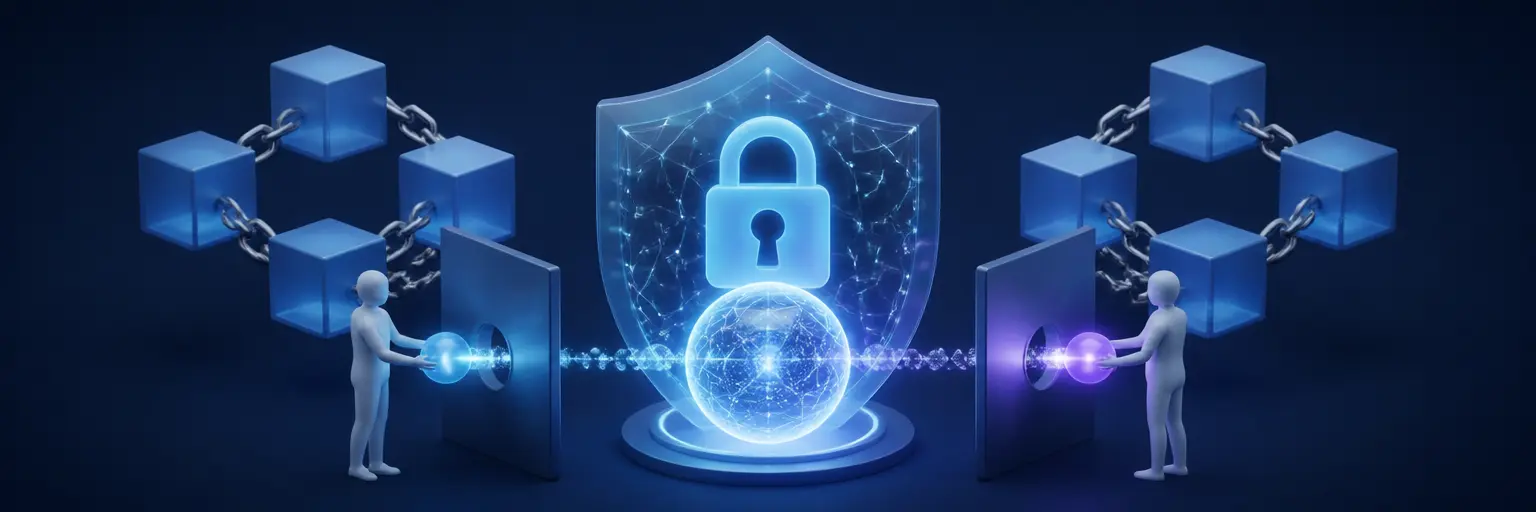
Implementing ZeroKnowledge Proofs: Challenges and Solutions for Blockchain Developers
Zero-Knowledge Proofs in Blockchain 🔐 explore how advanced cryptography enables users to verify information without revealing sensitive data. Discover privacy-preserving blockchain solutions, scalable transactions, secure identity verification, and trusted digital interactions shaping the future of decentralized systems. 🚀
70 articles
The Power of ZeroKnowledge Proofs to Transform Industries: From Finance to Healthcare
Demystifying the Complexity: Making ZeroKnowledge Proofs Accessible to Everyone
The Scalability Breakthrough: How ZeroKnowledge Proofs Enhance Blockchain Performance
The Future of Blockchain Confidentiality: ZeroKnowledge Proofs Leading the Way
The Role of ZeroKnowledge Proofs in Building Trustless Systems: Enhancing Blockchain Security
EnterpriseGrade Privacy: Implementing ZeroKnowledge Proofs in Supply Chain Management
The Cost of Privacy: Evaluating the Computational Overhead of ZeroKnowledge Proofs
Polkadot and ZeroKnowledge Proofs: Building a PrivacyFocused Blockchain Ecosystem
Beyond Cryptocurrency: Exploring ZeroKnowledge Applications in Enterprise Blockchain
The Mathematics of Privacy: Understanding the Cryptographic Foundations of ZeroKnowledge Proofs
ZeroKnowledge Proofs as a Foundation for a More Private and Secure Decentralized Future
The Importance of ZeroKnowledge Proofs for User Empowerment in the Decentralized Web
Data Privacy in Healthcare: Leveraging ZeroKnowledge Proofs for Secure Medical Records
The Potential of ZeroKnowledge Proofs to Enable Private Smart Contracts
The Role of ZeroKnowledge Proofs in Protecting Intellectual Property on the Blockchain
Exploring the Cutting Edge: The Latest Advancements in ZeroKnowledge Proof Research
ZeroKnowledge Proofs: From Niche Technology to Mainstream Adoption in Blockchain
Breaking Down ZeroKnowledge Proofs for NonTechnical Audiences: A Simple Explanation
ZeroKnowledge Proofs for IoT Security: Securing Connected Devices with Privacy
ZeroKnowledge Proofs and the Challenge of Quantum Computing: FutureProofing Privacy
ZeroKnowledge Proofs for Secure Cloud Computing: Extending Privacy to OffChain Data
How ZeroKnowledge Proofs are Revolutionizing DeFi Privacy
ZeroKnowledge Proofs and Supply Chain Traceability: Ensuring Data Privacy and Transparency
ZeroKnowledge Proofs for Secure MultiParty Computation: A Blockchain Perspective
The Impact of ZeroKnowledge Proofs on the Future of Decentralized Finance (DeFi)
Are ZeroKnowledge Proofs Truly Trustless? Examining the Security Assumptions
The Intriguing World of zkSNARKs: A Deep Dive into ZeroKnowledge Technology
The Role of ZeroKnowledge Proofs in Decentralized Autonomous Organizations (DAOs)
ZeroKnowledge Proofs and the Evolution of Privacy in the Digital Age
🔐 Zero-Knowledge Proofs in Blockchain
Explore how zero-knowledge proofs (ZKPs) are transforming blockchain privacy, scalability, identity, and cybersecurity. This subcategory from Blockchain Trends explains how users can verify information without revealing the underlying data, creating more secure and efficient decentralized systems beyond cryptocurrencies. Discover practical applications, technical concepts, emerging protocols, and the role of zero-knowledge technology in DeFi, enterprise blockchain, Web3 identity, regulatory compliance, and confidential transactions.
🧠 What Are Zero-Knowledge Proofs?
Zero-knowledge proofs are cryptographic methods that allow one party, known as the prover, to demonstrate that a statement is true to another party, known as the verifier, without disclosing the private information behind that statement. Readers can expect clear explanations of essential concepts such as prover and verifier models, mathematical soundness, completeness, privacy preservation, and trust minimization.
This section also explores how ZKPs differ from traditional authentication and data-sharing methods. Articles may cover interactive and non-interactive zero-knowledge proofs, zk-SNARKs, zk-STARKs, Bulletproofs, polynomial commitments, and other cryptographic techniques that support private and verifiable blockchain transactions.
⛓️ Zero-Knowledge Proofs and Blockchain Scalability
Blockchain networks must process more transactions while preserving decentralization and security. Zero-knowledge rollups address this challenge by executing transactions off-chain and submitting a compact cryptographic proof to the main blockchain. Readers will learn how zk-rollups improve transaction throughput, reduce gas fees, and strengthen Ethereum scalability.
Expect practical discussions of Layer 2 networks, validity proofs, data availability, sequencers, proof generation, and settlement on Layer 1. This content helps explain why zero-knowledge scaling is important for decentralized applications, Web3 gaming, DeFi platforms, NFT marketplaces, and high-volume blockchain infrastructure.
🛡️ Privacy, Security, and Confidential Blockchain Transactions
Privacy is a major concern for public blockchain users because transaction histories are often transparent and permanent. Zero-knowledge cryptography enables users to prove ownership, authorization, or compliance without exposing sensitive balances, identities, business information, or transaction details. Readers can discover how ZKPs support confidential transactions and privacy-preserving blockchain applications.
This section examines the relationship between zero-knowledge technology and cybersecurity. Topics may include protection against data leaks, minimized exposure of personal information, secure authentication, private smart contracts, anonymous credentials, and the risks associated with poorly designed privacy systems. The goal is to show how ZKPs can enhance security without sacrificing verifiability.
🪪 Decentralized Identity and Web3 Authentication
Zero-knowledge proofs are helping create more private digital identity systems. Instead of sharing a complete identity document, a user may prove they are over a certain age, live in a permitted jurisdiction, or meet a qualification without revealing unnecessary personal data. Readers will learn how zero-knowledge identity verification supports self-sovereign identity, decentralized identifiers, verifiable credentials, and privacy-preserving access control.
Articles in this section explain how ZKPs can reduce identity theft, limit centralized data collection, and improve user control over credentials. Coverage may include passwordless authentication, Sybil resistance, reputation systems, selective disclosure, Know Your Customer processes, and secure access to decentralized applications.
💰 Zero-Knowledge Proofs in DeFi and Financial Services
Decentralized finance requires transparent settlement, but institutions and users also need privacy, compliance, and protection for sensitive financial data. Zero-knowledge proofs can help prove solvency, transaction eligibility, collateral requirements, or regulatory status without publicly exposing complete financial records. Readers can expect analysis of ZKPs in lending, decentralized exchanges, stablecoins, payments, and institutional DeFi.
This section also explores how zero-knowledge systems may support confidential credit scoring, private trading strategies, proof of reserves, and compliant financial products. By combining cryptographic verification with selective disclosure, ZKPs can help bridge the gap between open blockchain networks and privacy requirements in banking and enterprise finance.
🏢 Enterprise Blockchain and Regulatory Compliance
Businesses often need to verify information while protecting trade secrets, customer records, and internal operations. Zero-knowledge proofs allow enterprises to demonstrate that data or processes meet specific requirements without revealing confidential details. Readers will discover applications in supply chain management, healthcare, insurance, logistics, intellectual property, and cross-organizational data verification.
Regulatory compliance is another important use case. ZKPs may help organizations prove that transactions follow jurisdictional rules, sanctions screening requirements, or financial controls while limiting unnecessary disclosure. This section considers the opportunities and challenges of using zero-knowledge blockchain systems in highly regulated industries.
⚙️ zk-SNARKs, zk-STARKs, and ZK Technology Explained
Understanding the major zero-knowledge proof systems is essential for evaluating blockchain projects and protocols. Readers can expect accessible comparisons of zk-SNARKs and zk-STARKs, including proof size, verification speed, scalability, transparency, post-quantum considerations, and trusted setup requirements.
Additional topics may include recursive proofs, proof aggregation, verifiable computation, hardware acceleration, prover costs, and developer tooling. These explanations are designed to help technical and non-technical readers understand how cryptographic design choices affect blockchain performance, privacy, security, and adoption.
🚀 The Future of Zero-Knowledge Blockchain Technology
Zero-knowledge proofs are becoming a foundational technology for the next generation of decentralized systems. Future developments may connect ZKPs with artificial intelligence, cross-chain interoperability, decentralized identity, private voting, enterprise applications, and scalable Web3 infrastructure. Readers will find forward-looking analysis of zero-knowledge adoption, protocol innovation, and the evolution of privacy-focused blockchain networks.
Blockchain Trends examines both the promise and limitations of this technology, including complex development, high proving costs, implementation risks, regulatory uncertainty, and user experience challenges. This balanced perspective helps readers understand where zero-knowledge proofs are delivering value today and where further research is required.
❓ Frequently Asked Questions About Zero-Knowledge Proofs
What is a zero-knowledge proof in blockchain?
A zero-knowledge proof is a cryptographic method that allows one party to prove a statement is true without revealing the information that makes the statement true. In blockchain, ZKPs can verify transactions, identities, balances, or computations while protecting sensitive data and improving network efficiency.
How do zero-knowledge proofs improve blockchain privacy?
ZKPs allow users to prove specific facts without sharing complete transaction details or personal information. For example, a user could prove eligibility for a service without disclosing their full identity. This supports confidential transactions, private authentication, and data minimization.
What are zk-SNARKs and zk-STARKs?
zk-SNARKs and zk-STARKs are two major types of zero-knowledge proof systems. zk-SNARKs generally offer compact proofs and efficient verification, while zk-STARKs provide transparent setup properties and stronger resistance to potential advances in quantum computing. Each system has different performance, security, and implementation considerations.
What are zero-knowledge rollups?
Zero-knowledge rollups are Layer 2 scaling solutions that process transactions away from the main blockchain and submit a cryptographic validity proof to Layer 1. They can increase transaction capacity, reduce network congestion, and lower fees while preserving the security of the underlying blockchain.
Are zero-knowledge proofs secure and suitable for businesses?
Zero-knowledge proofs can provide strong privacy and verification guarantees when they are correctly designed, audited, and implemented. Businesses should assess trusted setup requirements, cryptographic assumptions, software security, regulatory obligations, and operational costs before deploying ZK-based solutions. Professional audits and carefully selected infrastructure are essential.