
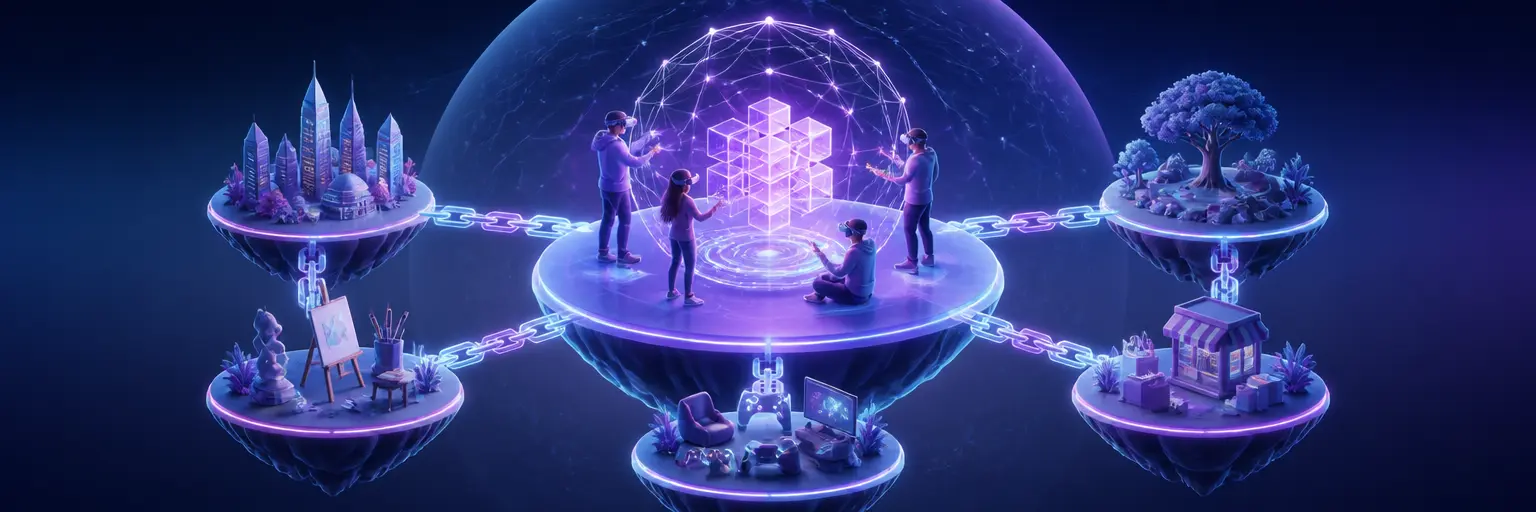
Comparing Decentralized Metaverse Platforms: Features, Communities, and Visions
Explore Decentralized Metaverse Platforms 🌐—immersive virtual worlds powered by blockchain, where users can own digital assets, control their identities, and participate in community-governed ecosystems. Discover how Web3 metaverse platforms, NFTs, smart contracts, and decentralized governance are reshaping gaming, social interaction, commerce, and digital ownership. 🚀 Gain insights into emerging technologies and the future of open, user-driven virtual experiences.
63 articles
Decentralized Metaverses vs. Centralized Worlds: A Paradigm Shift in Virtual Reality
Web3 and the Metaverse: The Foundation of Decentralized Virtual Experiences
The Future of Decentralized Metaverse Platforms: Predictions and Trends to Watch
The Privacy Question in Decentralized Metaverses: Data Ownership and Control
The Educational Potential of Decentralized Metaverses: Learning in Immersive Environments
The Tokenomics of Decentralized Metaverses: Understanding Virtual Currencies
The Community Power of Decentralized Metaverses: Collective Ownership and Governance
Building Your Own World: Development Tools for Decentralized Metaverses
The Commerce Revolution in Decentralized Metaverses: Virtual Marketplaces and Trade
Socializing in the Decentralized Metaverse: Connecting and Building Communities
The Virtual Real Estate Market in Decentralized Metaverses: Trends and Predictions
DAOs in the Metaverse: Governing the Future of Decentralized Platforms
The Future of Avatars in Decentralized Metaverses: Advanced Customization and AI
Exploring the Art Scene in Decentralized Metaverses: Virtual Galleries and Exhibitions
Decentralized Metaverse Platforms: A Deep Dive into the Technology and Vision
The Challenges and Opportunities of Building Decentralized Metaverse Platforms
The Economic Opportunities in Decentralized Metaverses: Building a Virtual Economy
Participating in Events in Decentralized Metaverses: Immersive Virtual Experiences
The Metaverse as a Decentralized Social Network: Building Communities in Virtual Worlds
Decentralized Metaverse Platforms: A New Paradigm for Digital Ownership
Are Decentralized Metaverses Truly Decentralized? Examining the Reality
The Metaverse Without Gatekeepers: The Rise of Decentralized Platforms
The Ultimate Guide to Decentralized Metaverse Platforms for Beginners
The Metaverse and Blockchain Interoperability: Connecting Decentralized Worlds
The Metaverse and NFTs: A Match Made in Decentralization
Understanding the Technology Stack of Decentralized Metaverse Platforms
The Governance Models of Decentralized Metaverses: Shaping the Future of Virtual Worlds
The Ownership Revolution: How Decentralization is Reshaping the Metaverse
The Security of Decentralized Metaverses: Protecting Your Assets in Virtual Worlds
🌐 Decentralized Metaverse Platforms: Explore the Future of Open Virtual Worlds
Decentralized Metaverse Platforms are blockchain-powered virtual environments designed to give users greater ownership, control, and participation. Unlike traditional online worlds managed by a single company, decentralized metaverses use distributed networks, smart contracts, digital assets, and community governance to create more open and user-driven experiences.
On Blockchain Trends, this subcategory explores the technologies, projects, opportunities, and challenges shaping the decentralized metaverse. Discover how blockchain enables digital ownership, interoperable identities, virtual economies, tokenized assets, decentralized governance, and user-generated experiences across immersive online environments.
🚀 What Are Decentralized Metaverse Platforms?
Decentralized metaverse platforms are persistent virtual worlds or digital ecosystems supported by blockchain infrastructure rather than controlled entirely by a centralized organization. Users may interact through avatars, attend events, build virtual spaces, trade assets, and participate in online communities while retaining verifiable ownership of selected digital items.
Readers can expect clear explanations of Web3 metaverse architecture, blockchain gaming platforms, virtual reality ecosystems, augmented reality experiences, smart contracts, NFTs, and decentralized applications. Our coverage helps newcomers and experienced users understand how these platforms differ from conventional social networks, multiplayer games, and centralized virtual worlds.
🔐 Blockchain Ownership and Digital Assets
A key feature of the decentralized metaverse is the ability to represent digital items on a blockchain. Virtual land, avatars, wearables, collectibles, tickets, and in-game resources can be issued as NFTs or other tokenized assets, creating transparent records of ownership and transaction history.
This section examines how NFT ownership, token standards, digital scarcity, asset marketplaces, custody, and blockchain wallets work in practice. You can also learn about the benefits and risks of owning metaverse assets, including liquidity concerns, intellectual property questions, scams, fees, and the difference between holding a token and receiving meaningful usage rights.
🏗️ Virtual Land, Buildings, and User-Generated Worlds
Many decentralized metaverse projects allow participants to acquire, develop, lease, or trade virtual land. These digital spaces may be used for galleries, retail experiences, games, education, entertainment, events, workplaces, and social communities.
Our articles explore virtual real estate, metaverse property development, 3D world building, creator tools, digital architecture, land economics, and user-generated content. Readers can discover how creators and businesses design immersive experiences while considering platform fees, discoverability, scalability, accessibility, and long-term community value.
🗳️ DAO Governance and Community Participation
Decentralized Autonomous Organizations, commonly known as DAOs, can give users a role in shaping platform rules, treasury decisions, upgrades, and community initiatives. Governance may involve token-based voting, delegated representation, proposals, or hybrid systems that combine on-chain and off-chain decision-making.
This subcategory explains DAO governance, decentralized decision-making, voting mechanisms, community treasuries, contributor incentives, and protocol coordination. Readers will gain insight into both the promise and limitations of participatory governance, including voter apathy, concentrated ownership, governance attacks, legal uncertainty, and the challenge of balancing efficiency with decentralization.
🔗 Interoperability, Identity, and the Open Metaverse
The vision of an open metaverse depends on users being able to move between compatible applications, carry digital identities, and use selected assets across multiple environments. Interoperability can connect games, marketplaces, social spaces, virtual events, and decentralized applications through shared standards and blockchain networks.
Explore topics such as cross-chain metaverse ecosystems, portable avatars, Web3 identity, decentralized identifiers, wallet-based authentication, open standards, and digital reputation. We also evaluate the practical barriers to interoperability, including incompatible protocols, technical limitations, network fees, fragmented user experiences, and platform-specific asset restrictions.
💼 Business, Brands, and the Creator Economy
Decentralized metaverse platforms are opening new possibilities for brands, artists, developers, educators, musicians, and independent creators. Organizations can experiment with virtual storefronts, token-gated communities, digital events, loyalty programs, immersive storytelling, and community-owned projects.
Our coverage considers metaverse marketing, virtual commerce, creator monetization, tokenized memberships, digital collectibles, brand experiences, and Web3 business models. Learn how companies can assess audience value, user privacy, regulatory requirements, sustainability, return on investment, and the risks of launching a virtual experience without a clear long-term strategy.
⚙️ Technology, Scalability, and User Experience
Successful decentralized metaverse platforms require more than attractive graphics. They must address blockchain scalability, transaction speed, storage, identity management, wallet usability, security, privacy, content moderation, and the performance demands of real-time virtual experiences.
Readers can expect analysis of Layer 1 and Layer 2 blockchain networks, decentralized storage, smart contract security, wallet onboarding, gas fees, rendering technology, spatial computing, and metaverse accessibility. We explain technical concepts in a practical way so readers can compare platforms and understand how infrastructure decisions affect everyday users.
🛡️ Security, Privacy, and Responsible Participation
Decentralized platforms can provide transparency and user control, but they also introduce new risks. Phishing attacks, fraudulent NFT collections, malicious smart contracts, compromised wallets, identity exposure, and misleading investment claims are important concerns for anyone entering a blockchain-based virtual world.
This section provides guidance on metaverse security, wallet protection, private keys, smart contract risks, privacy-preserving identity, scam detection, and responsible digital asset management. It also examines content moderation, harassment, child safety, data ownership, and the ethical responsibilities of developers and communities building persistent online spaces.
🔮 The Future of Decentralized Metaverse Platforms
The decentralized metaverse is still developing, and its future may be shaped by advances in artificial intelligence, spatial computing, virtual reality, blockchain interoperability, decentralized identity, and community-owned infrastructure. Some projects may evolve into specialized ecosystems, while others may connect through shared protocols and open standards.
Blockchain Trends follows emerging developments with a focus on long-term utility, sustainable token economics, real-world adoption, regulatory changes, enterprise use cases, and the future of decentralized systems. Our goal is to help readers distinguish durable innovation from short-lived speculation and understand where the open metaverse may create lasting value.
❓ Frequently Asked Questions About Decentralized Metaverse Platforms
What is a decentralized metaverse platform?
A decentralized metaverse platform is a blockchain-based virtual environment where ownership, identity, transactions, governance, or content distribution are supported by decentralized technology. It may allow users to own digital assets, participate in community decisions, and interact without relying entirely on one central company.
How do blockchain and NFTs support the metaverse?
Blockchain provides a transparent record of transactions and ownership, while NFTs can represent unique digital items such as virtual land, avatars, wearables, collectibles, or event passes. However, the usefulness of an NFT depends on the rights, utility, community, and platform support connected to that asset.
Can digital assets move between different metaverse platforms?
Some assets may be interoperable when platforms use compatible blockchain networks, token standards, file formats, and application programming interfaces. In practice, interoperability remains limited because platforms often use different technologies, rules, graphics systems, and licensing models.
Are decentralized metaverse platforms safe to use?
Safety varies by platform, smart contract quality, wallet practices, governance structure, and community reputation. Users should verify official links, protect private keys and recovery phrases, review transaction permissions, research projects carefully, and avoid assuming that decentralization eliminates scams or financial risk.
How can creators and businesses participate in the decentralized metaverse?
Creators and businesses can develop virtual experiences, sell digital goods, host events, build communities, offer token-gated services, or collaborate with established Web3 projects. A successful strategy should prioritize genuine user value, clear ownership terms, accessibility, privacy, regulatory compliance, and sustainable economics rather than speculation alone.