
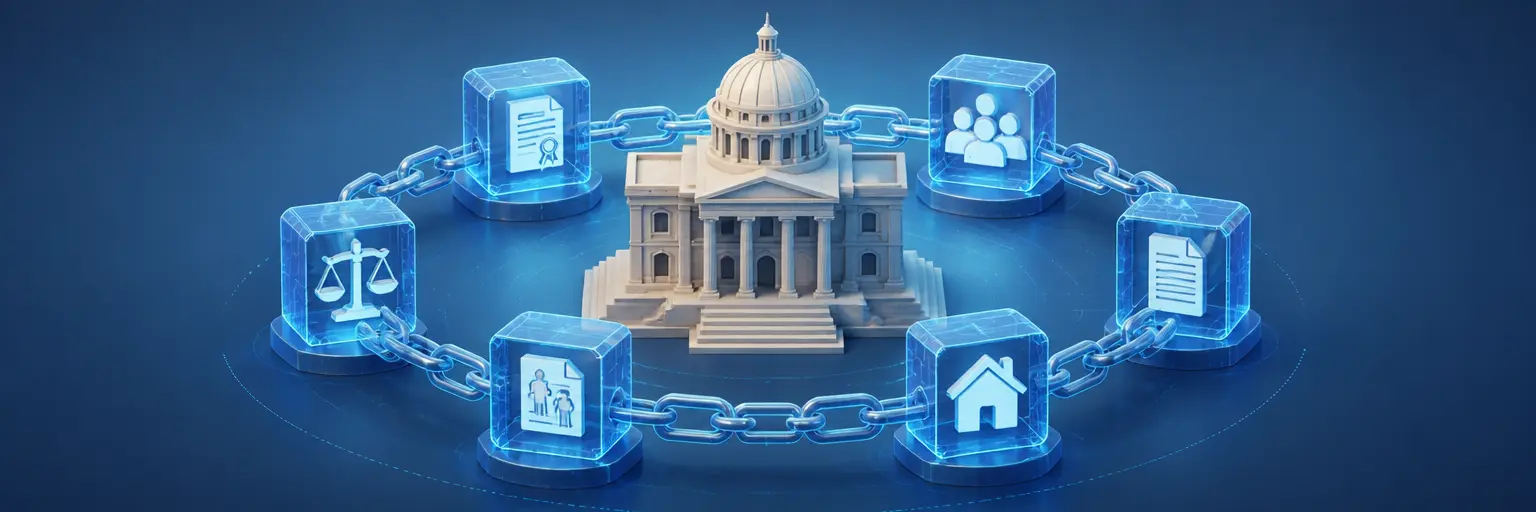
Blockchain and Freedom of Information: Enhancing Public Access to Government Data
Explore how blockchain for public records can transform government data management with secure, transparent, and tamper-resistant systems. From property deeds and birth certificates to licenses and court documents, decentralized ledgers can improve record accuracy, streamline verification, reduce fraud, and increase public trust. Discover emerging blockchain governance solutions shaping more efficient, accessible, and accountable digital public services. 🔐🏛️
54 articles
Supply Chain Transparency Starts with Records: Blockchain for Ethical Sourcing
Enhancing Data Privacy in Public Records: Exploring BlockchainBased Solutions
Fighting Fraud and Corruption: Blockchain's Potential in Public Record Management
Smart Contracts for Public Services: Automating Record Updates and Processes
The Journey to Decentralization: Gradual Adoption of Blockchain in Government Record Systems
Beyond Cryptocurrencies: Understanding the True Potential of Blockchain for Public Good
Digital Identity on the Blockchain: Securing Citizen Data and Public Records
The Convergence of AI and Blockchain for Smarter Public Record Management
Navigating Regulatory Landscapes: Blockchain and the Future of Legal Records
The Future of eGovernance: Blockchain's Role in Digital Public Services
RealWorld Examples: Governments Around the Globe Adopting Blockchain for Public Records
Data Integrity in the Digital Age: Blockchain as a Solution for Public Record Preservation
Unlocking Transparency: How Blockchain is Revolutionizing Public Record Management
The Digital Transformation of Public Records: Blockchain as a Key Enabler
The Ethical Implications of Blockchain in Public Records: Balancing Transparency and Privacy
From Bureaucracy to Blockchain: Streamlining Public Records with Decentralization
The Challenge of Scalability: Can Blockchain Handle the Volume of Public Records?
Healthcare Records Reimagined: Blockchain for Patient Privacy and Data Control
Blockchain and Open Government Initiatives: Promoting Transparency and Citizen Engagement
Revolutionizing Land Registry: Blockchain's Impact on Property Records
Blockchain's Impact on Archival Practices: Preserving Public Records for Future Generations
Decentralized Identity and SelfSovereign Identity for Public Record Access Control
Secure and Verifiable: Blockchain's Promise for the Future of Public Documents
Transforming Citizen Services: Blockchain Applications in Public Administration
Preparing for the Future: Upskilling Government Workforce for BlockchainBased Public Records
Securing Legal Documents with Blockchain: From Contracts to Court Records
Building Trust in Government: How Blockchain Can Enhance Public Confidence
The Case for BlockchainBased Voting Records: Ensuring Election Transparency
Exploring Consortium Blockchains for Government Collaboration on Public Records
📚 Blockchain for Public Records: Secure, Transparent, and Future-Ready Governance
Blockchain for Public Records explores how distributed ledger technology can modernize the way governments, municipalities, courts, and public institutions create, manage, verify, and share official information. Within Blockchain and Governance at Blockchain Trends, this subcategory examines practical applications such as land registries, birth certificates, business licenses, court documents, public spending records, academic credentials, and identity verification. Discover how immutable records, cryptographic security, decentralized verification, and transparent data management can improve public administration while also addressing privacy, accessibility, regulation, interoperability, and digital inclusion.
🏛️ Blockchain in Government Record Management
Learn how blockchain can support more reliable and efficient government record management. Articles in this section explore the use of distributed ledgers for storing and verifying official documents, reducing duplicate records, preventing unauthorized alterations, and improving coordination between public agencies. Readers can expect practical explanations of how blockchain-based public records work and why governments are investigating decentralized infrastructure.
This subcategory also examines the relationship between blockchain technology and existing public-sector databases. Topics may include permissioned blockchains, government data governance, administrative modernization, audit trails, smart contracts, and secure information sharing. The focus is on realistic blockchain adoption, including its benefits, limitations, implementation costs, and potential impact on citizens and public institutions.
🗺️ Blockchain Land Registries and Property Records
Blockchain-based land registries are among the most discussed applications of decentralized technology in public administration. Explore how property ownership records, title transfers, liens, zoning information, and real estate transactions could be recorded in a tamper-evident digital ledger. These systems may help reduce fraud, simplify verification, accelerate property transfers, and improve confidence in real estate markets.
Readers will also discover the challenges involved in connecting blockchain land records with legal ownership, local regulations, historical documents, and offline communities. Blockchain does not automatically guarantee that submitted information is accurate, so this section considers identity verification, trusted data entry, dispute resolution, privacy protection, and the role of land authorities in maintaining reliable property records.
🪪 Digital Identity and Civil Registration
Blockchain can provide new models for managing digital identity and civil registration records, including birth certificates, marriage records, death certificates, residency documents, and professional credentials. This section explains how decentralized identifiers, verifiable credentials, and cryptographic proofs can allow individuals to confirm important information without repeatedly exposing unnecessary personal data.
Content also addresses the sensitive balance between transparency and privacy in public records. Readers can learn about self-sovereign identity, selective disclosure, data minimization, identity security, and consent-based access. Special attention is given to the risks of permanent records, lost credentials, identity theft, exclusion from digital services, and the need for accessible recovery systems.
⚖️ Blockchain for Court, Legal, and Evidence Records
Discover how blockchain may strengthen the integrity of court filings, legal documents, evidence logs, notarizations, and timestamped records. By creating a verifiable history of when data was submitted or modified, blockchain systems can support chain-of-custody procedures and make document verification easier for courts, lawyers, agencies, and citizens.
However, legal recognition remains essential. This section explores whether blockchain timestamps and digital signatures are admissible in court, how privacy laws affect judicial records, and why governance standards are needed for correcting errors. Immutability must be balanced with legal rights, including data correction, deletion requirements, confidentiality, and due process.
💰 Public Spending, Procurement, and Government Transparency
Blockchain for public records can improve visibility into government procurement, budgets, grants, contracts, and public spending. Explore how agencies could use shared ledgers to publish verifiable transaction histories, track funds from allocation to completion, and reduce opportunities for corruption, duplicate payments, or unauthorized changes.
Readers can expect analysis of blockchain transparency tools, smart contract automation, public audits, open government data, and accountability mechanisms. The section also considers practical concerns such as confidential bidding information, data quality, scalability, accessibility, and the fact that transparent records are only valuable when citizens can understand and use them.
🎓 Academic, Professional, and Public Credentials
Educational institutions and public agencies are exploring blockchain credentials to issue tamper-resistant diplomas, licenses, certificates, and professional qualifications. This technology can help employers, universities, regulators, and individuals verify achievements quickly without relying on slow manual checks or vulnerable paper documents.
Learn how verifiable credentials can support lifelong learning, international mobility, workforce licensing, and public-sector employment records. Topics include credential wallets, decentralized identifiers, interoperability standards, fraud prevention, and privacy-preserving verification. Blockchain-based credentials can simplify verification while giving individuals greater control over their official records.
🔐 Privacy, Security, and Compliance in Public Records
Public records often contain sensitive personal, financial, legal, and property information, making privacy and cybersecurity central to blockchain adoption. This section examines encryption, access controls, permissioned networks, zero-knowledge proofs, off-chain storage, and pseudonymous identifiers designed to protect confidential data while preserving verifiability.
Readers will also find discussions of data protection regulations, records retention, the right to erasure, cybersecurity threats, governance responsibilities, and smart contract vulnerabilities. A responsible blockchain public records system must protect people as carefully as it protects data integrity.
🌍 Real-World Use Cases and the Future of Blockchain Governance
Explore pilot projects, government blockchain initiatives, municipal experiments, and international approaches to decentralized public records. Case studies can reveal how different jurisdictions apply blockchain to land ownership, identity, healthcare records, voting-related documentation, public finance, and administrative services.
This section looks ahead to interoperable government networks, digital public infrastructure, artificial intelligence integration, tokenized credentials, and citizen-controlled data. It also evaluates adoption barriers, including legacy systems, regulatory uncertainty, public trust, technical skills, cost, and digital inequality. The future of blockchain governance will depend on useful services, strong institutions, and human-centered design.
❓ Frequently Asked Questions About Blockchain for Public Records
What is blockchain for public records?
Blockchain for public records refers to using a distributed ledger to record, timestamp, verify, and share official information. Examples include property titles, licenses, certificates, court filings, government contracts, and civil registration documents. Depending on the design, the blockchain may be public, private, or permissioned.
Can blockchain make public records completely tamper-proof?
Blockchain can make recorded data highly resistant to unauthorized changes because transactions are cryptographically linked and distributed across multiple participants. However, it cannot guarantee that the original information was accurate. Reliable identity checks, trusted data sources, governance rules, and human oversight remain necessary.
Are blockchain public records private?
Not automatically. Public blockchains may expose transaction details, while permissioned networks can restrict access. Sensitive information is often protected through encryption, off-chain storage, access permissions, or zero-knowledge proofs. Public agencies must design systems that comply with privacy and data protection laws.
What are the main benefits of blockchain in government?
Potential benefits include stronger data integrity, faster document verification, improved transparency, reduced fraud, automated workflows, lower administrative costs, and better coordination between agencies. The value depends on appropriate implementation, interoperability with existing systems, and easy access for citizens.
What challenges prevent governments from adopting blockchain public records?
Major challenges include regulatory uncertainty, high implementation costs, legacy infrastructure, scalability, privacy requirements, cybersecurity risks, limited technical expertise, inaccurate input data, and digital exclusion. Successful projects require clear legal frameworks, strong governance, public consultation, and measurable benefits.