
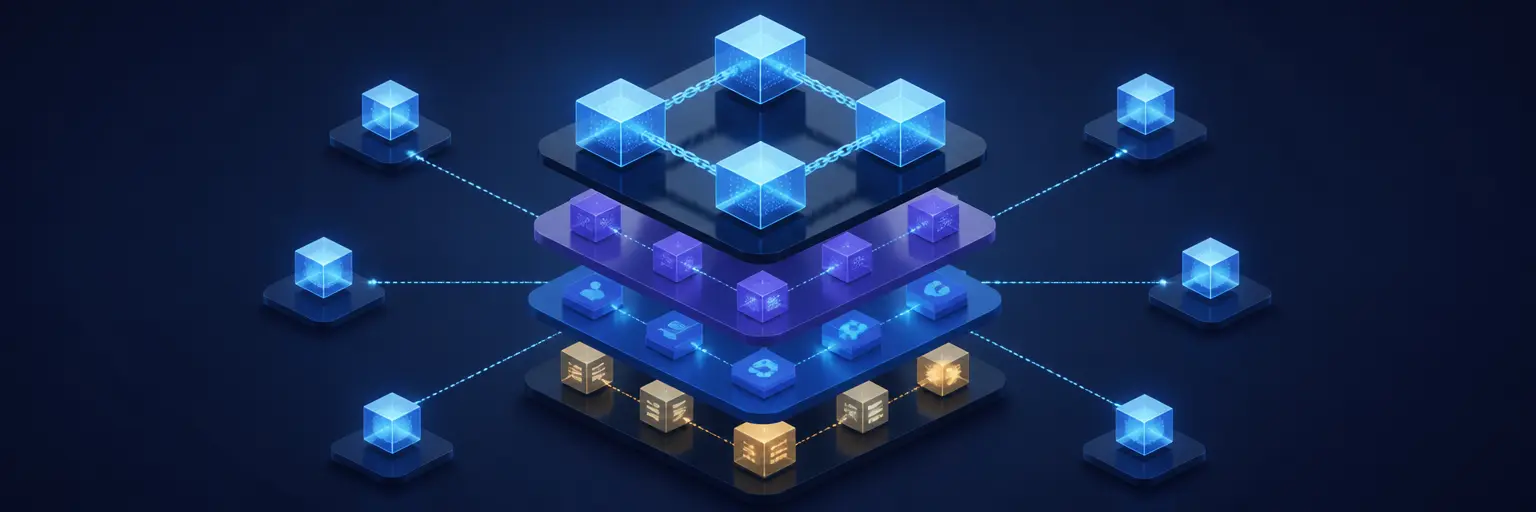
Hybrid Blockchain Architecture: Blending Public and Private for Optimal Solutions
Explore Blockchain Architecture to understand the core frameworks powering secure, scalable, and decentralized systems. Discover how consensus mechanisms, distributed ledgers, smart contracts, cryptographic protocols, and network design work together to support DeFi, enterprise blockchain, Web3 applications, and next-generation digital infrastructure. 🚀 Gain valuable insights into blockchain scalability, interoperability, security, and performance as decentralized technology continues to evolve.
58 articles
Nodes in Blockchain Architecture: Guardians of Decentralized Networks
Blockchain Architecture for Supply Chain Management: Transparency and Traceability
Testing and Quality Assurance in Blockchain Architecture: Building Robust Systems
Immutable Data Structures: The Foundation of Blockchain Data Integrity
Sidechains and Blockchain Architecture: Expanding Functionality and Interoperability
Layer2 Solutions: Architecting Scalable Blockchains Beyond Layer1 Limits
AI and Blockchain Architecture: Synergies and Potential Applications
Blockchain Architecture for IoT: Secure and Scalable Device Communication
Smart Contracts and Blockchain Architecture: Automating Trust and Execution
Delegated ProofofStake (DPoS) Architecture: Governance and Speed Tradeoffs
Modular Blockchain Architecture: Customizing Solutions with Interchangeable Components
Sharding in Blockchain Architecture: Scaling for Mass Adoption
Digital Signatures: Authenticating Transactions in Blockchain Architecture
Latency in Blockchain Architecture: Understanding and Minimizing Transaction Delays
Wallets and Keys: Secure Access Points in Blockchain Architecture
Interoperable Blockchain Architectures: Bridging Silos for a Connected Ecosystem
The Four Layers of Blockchain Architecture: Data, Network, Consensus, and Application
ZeroKnowledge Proofs and Blockchain Architecture: Enhancing Privacy and Security
Data Privacy in Blockchain Architecture: Design Considerations and Techniques
ProofofStake (PoS) Architecture: Energy Efficiency and Scalability Focus
Merkle Trees: Efficient Data Verification in Blockchain Architecture
Future Trends in Blockchain Architecture: Exploring Emerging Paradigms
Blockchain Architecture for Healthcare: Data Security and Interoperability
Transaction Flow in Blockchain Architecture: From Initiation to Confirmation
Beyond Linear Chains: Exploring DAGBased Blockchain Architectures
Cryptographic Hash Functions in Blockchain Architecture: Securing Data Integrity
CrossChain Communication: Architecting Seamless Asset and Data Transfer
ServiceOriented Architecture (SOA) in Blockchain: Integrating with Existing Systems
QuantumResistant Blockchain Architecture: Preparing for Future Security Threats
🏗️ Blockchain Architecture: Foundations of Decentralized Systems
Explore the core principles of blockchain architecture and discover how decentralized networks are designed, built, secured, and scaled. Within the Blockchain Technology Deep Dive section of Blockchain Trends, this subcategory examines the technical layers behind distributed ledgers, including consensus mechanisms, peer-to-peer networking, cryptographic security, smart contracts, blockchain nodes, data structures, interoperability, and enterprise blockchain infrastructure. Whether you are researching public blockchains, private networks, Layer 2 solutions, or the future of decentralized systems, these insights explain how blockchain components work together to deliver transparency, resilience, and trust without relying on a central authority.
🔗 Blockchain Layers and Core Components
Learn how a blockchain network is structured from the data layer to the application layer. Articles cover blocks, transactions, hashes, Merkle trees, digital signatures, wallets, nodes, and distributed ledgers, helping readers understand how information is recorded and verified across a decentralized network.
Readers can also explore the relationship between protocol rules, execution environments, consensus systems, and user-facing applications. This foundation is useful for anyone studying blockchain infrastructure, decentralized applications, Web3 architecture, or enterprise distributed ledger technology.
⚙️ Consensus Mechanisms and Network Security
Discover how blockchain networks reach agreement without a central administrator. This section examines Proof of Work, Proof of Stake, delegated consensus, Byzantine fault tolerance, proof-based systems, validator networks, and governance mechanisms.
Content also explains how consensus affects decentralization, transaction finality, energy consumption, security, and network performance. By comparing different blockchain consensus algorithms, readers can better evaluate the strengths and limitations of protocols used in DeFi, digital assets, supply chains, and enterprise applications.
🌐 Blockchain Networking and Node Infrastructure
Understand how blockchain nodes communicate, synchronize data, validate transactions, and maintain a consistent version of the ledger. Topics include peer-to-peer networking, node discovery, mempools, block propagation, full nodes, light clients, archival nodes, and validator infrastructure.
This subcategory also explores the operational side of blockchain deployment, including network reliability, node monitoring, cloud infrastructure, geographic distribution, and cybersecurity. These insights help developers and technology leaders design resilient decentralized networks with strong availability and fault tolerance.
📜 Smart Contracts and Execution Environments
Examine the role of smart contracts in modern blockchain architecture. Articles explain how programmable agreements are deployed and executed, with coverage of virtual machines, contract state, gas fees, transaction execution, decentralized applications, and smart contract security.
Readers can expect practical discussions of contract design, upgradeability, composability, testing, and common vulnerabilities such as reentrancy, access-control errors, and oracle manipulation. Understanding execution environments is essential for building reliable DeFi protocols, tokenized assets, blockchain games, and enterprise automation solutions.
📈 Scalability, Layer 2, and Blockchain Performance
Explore the architectural approaches used to improve transaction throughput, reduce fees, and support large-scale blockchain adoption. Key topics include Layer 2 networks, rollups, sidechains, state channels, sharding, parallel execution, modular blockchains, and data availability.
This content helps readers compare blockchain scalability solutions and understand trade-offs involving security, decentralization, latency, interoperability, and transaction costs. The section is particularly relevant to businesses and developers evaluating high-performance blockchain infrastructure for global applications.
🔄 Interoperability and Cross-Chain Architecture
Learn how separate blockchain networks exchange data and value through bridges, messaging protocols, interoperability layers, and cross-chain communication standards. Articles examine blockchain bridges, atomic swaps, cross-chain smart contracts, relay systems, interoperability protocols, and multichain applications.
Readers will also find guidance on the security challenges of interconnected networks, including bridge exploits, trust assumptions, validator risks, and message verification. These concepts are increasingly important as decentralized finance, enterprise systems, and Web3 applications operate across multiple blockchain ecosystems.
🏢 Enterprise Blockchain and Real-World Infrastructure
Discover how organizations adapt blockchain architecture for business use cases beyond cryptocurrencies. Topics include permissioned blockchains, consortium networks, identity management, supply chain tracking, tokenization, digital credentials, audit systems, and enterprise data privacy.
The section explains how companies evaluate blockchain platforms based on governance, compliance, performance, interoperability, and integration with existing databases and cloud services. This makes the content valuable for technology executives, solution architects, developers, regulators, and businesses exploring decentralized infrastructure.
🛡️ Privacy, Cryptography, and Blockchain Governance
Understand the cryptographic technologies that protect blockchain data and user interactions. Coverage includes public-key cryptography, zero-knowledge proofs, digital signatures, confidential transactions, decentralized identity, secure key management, and privacy-preserving computation.
Blockchain architecture also depends on governance: the processes used to update protocols, resolve disputes, manage validators, and coordinate communities. Readers can explore on-chain governance, off-chain decision-making, protocol upgrades, regulatory considerations, and the balance between transparency and privacy.
❓ Frequently Asked Questions About Blockchain Architecture
What is blockchain architecture?
Blockchain architecture is the technical structure that defines how a blockchain stores data, validates transactions, reaches consensus, communicates between nodes, and executes applications. It typically includes data, network, consensus, execution, incentive, and application layers.
What are the main components of a blockchain network?
The primary components include blocks, transactions, cryptographic hashes, digital signatures, wallets, nodes, validators, consensus mechanisms, peer-to-peer communication protocols, and smart contract execution environments. Together, these components maintain a secure and synchronized distributed ledger.
How does blockchain architecture provide security?
Blockchain security is supported by cryptography, decentralized validation, consensus rules, immutable data structures, and distributed network participation. Security also depends on correct smart contract design, secure key management, reliable node infrastructure, and protection against attacks such as Sybil attacks or transaction manipulation.
What is the difference between Layer 1 and Layer 2 blockchain architecture?
A Layer 1 blockchain is the primary network responsible for consensus, transaction settlement, and security. A Layer 2 solution operates on top of Layer 1 to process transactions more efficiently, often improving scalability and reducing fees while using the underlying blockchain for security or final settlement.
Why is blockchain architecture important for enterprise applications?
Blockchain architecture determines whether a system can meet business requirements for performance, privacy, governance, compliance, interoperability, and reliability. A well-designed architecture can support transparent supply chains, digital identity, asset tokenization, automated settlement, and secure data sharing across multiple organizations.