
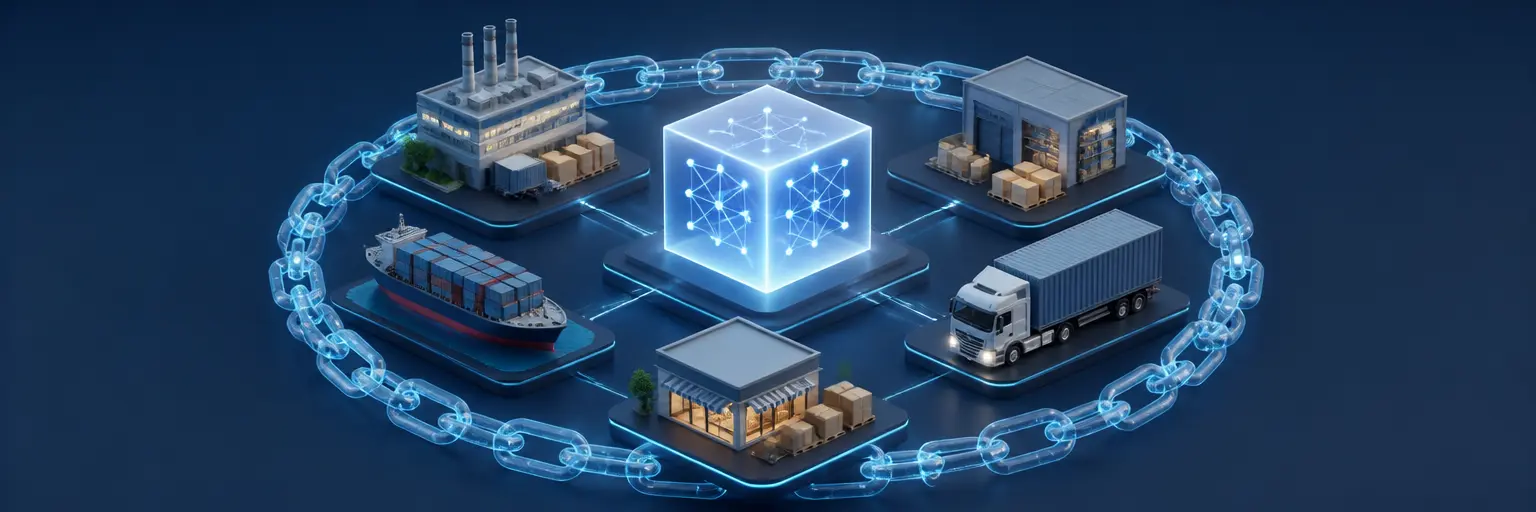
Building Trust in Global Supply Chains: The Role of Blockchain Technology
🔗 Blockchain for Supply Chain is transforming how businesses track products, verify origins, and manage logistics. Discover how enterprise blockchain solutions improve transparency, traceability, inventory management, and collaboration across global supply networks. From tamper-resistant records to smart contracts and real-time visibility, explore practical blockchain applications that help reduce fraud, streamline operations, and build trust from manufacturer to customer. 📦
67 articles
Blockchain for Chemical Supply Chains: Ensuring Safety and Regulatory Compliance
Blockchain and the Last Mile Delivery: Optimizing Efficiency and Transparency in Final Distribution
Transforming Supply Chain Management: The Disruptive Potential of Blockchain
From Farm to Fork: Tracing Food Origins with Blockchain for Enhanced Safety and Trust
Demystifying Blockchain for Supply Chain: Addressing Common Misconceptions and Myths
The Convergence of AI and Blockchain in Supply Chain: Enhancing Automation and Optimization
Blockchain and Supply Chain Finance: Improving Cash Flow and Access to Capital
Blockchain and Supply Chain Analytics: Gaining Insights from Data for Improved DecisionMaking
Reducing Supply Chain Costs with Blockchain: Exploring Efficiency Gains and Automation
The Strategic Advantages of Adopting Blockchain for Supply Chain Management
Securing Sensitive Data in Supply Chains: Leveraging Blockchain for Data Privacy and Protection
Exploring Blockchain Platforms for Supply Chain: Choosing the Right Solution for Your Needs
Blockchain in Manufacturing: Optimizing Processes and Enhancing Product Quality
From Raw Materials to Consumers: Tracking Products Every Step of the Way with Blockchain
Supply Chain Traceability Explained: How Blockchain Creates EndtoEnd Visibility
The Economic Impact of Blockchain on Supply Chains: Growth Opportunities and Market Disruption
The Impact of Blockchain on Global Trade and Supply Chains: Facilitating Seamless Transactions
The Human Element in BlockchainEnabled Supply Chains: The Importance of Skills and Training
Improving Supply Chain Visibility: The Power of BlockchainBased Tracking Systems
Blockchain and Supply Chain Compliance: Ensuring Regulatory Adherence and Transparency
The Evolution of Supply Chain Technology: From Traditional Systems to BlockchainBased Solutions
The Blockchain Revolution in Logistics: Streamlining Operations and Enhancing Efficiency
Blockchain and Supply Chain Digitization: Accelerating the Transformation of Traditional Processes
The Power of Distributed Ledger Technology in Supply Chain Management
Blockchain Solutions for Supply Chain Risk Management: Mitigating Disruptions and Enhancing Resilience
The Future of Supply Chain Transparency: Powered by Blockchain Technology
Measuring the Success of Blockchain Implementation in Supply Chain: Key Performance Indicators (KPIs)
The Immutable Ledger: Ensuring Data Integrity in Supply Chains with Blockchain
The Evolution of Trust in Supply Chains: Blockchain as a Foundation for Verifiable Data
🔗 Blockchain for Supply Chain: Enterprise Visibility, Trust, and Efficiency
Discover how blockchain for supply chain management is transforming procurement, logistics, manufacturing, inventory control, and global trade. This subcategory explores practical enterprise blockchain solutions that help organizations create tamper-resistant records, improve product traceability, reduce fraud, automate transactions, and build stronger relationships across complex supply networks. At Blockchain Trends, readers can learn how distributed ledger technology supports end-to-end supply chain visibility while addressing scalability, privacy, interoperability, compliance, and real-world implementation challenges.
📦 Supply Chain Traceability and Product Provenance
Explore how blockchain creates a shared and verifiable record of a product’s journey from raw materials and manufacturing to distribution, retail, and the end customer. Articles in this section examine blockchain product traceability, digital records, batch tracking, origin verification, and provenance management for industries such as food, pharmaceuticals, automotive, luxury goods, and electronics.
Readers can expect practical insights into using blockchain to verify authenticity, identify the source of quality issues, and support faster recalls. Learn how immutable transaction histories and connected data systems can improve consumer confidence while helping enterprises meet traceability, ethical sourcing, and sustainability requirements.
🚚 Logistics, Shipping, and Real-Time Supply Chain Visibility
This section focuses on the role of blockchain in logistics management, freight coordination, shipping documentation, and transportation networks. Discover how distributed ledgers can connect manufacturers, carriers, ports, customs authorities, warehouses, and retailers through a more consistent source of operational information.
Content covers blockchain supply chain visibility, shipment tracking, digital bills of lading, container monitoring, and data synchronization between business partners. Readers will learn how blockchain can reduce paperwork, minimize delays, prevent duplicate records, and improve coordination across international logistics ecosystems.
🤝 Smart Contracts for Procurement and Supplier Management
Learn how smart contracts support automated procurement workflows, supplier agreements, purchase orders, delivery confirmations, and payment processes. This subcategory explains how programmable blockchain transactions can execute predefined actions when verified conditions are met, such as delivery milestones, inspection approvals, or quality checks.
Readers can explore the benefits and limitations of smart contracts for supply chain management, including faster settlement, reduced administrative work, improved accountability, and fewer disputes. Topics may also address supplier onboarding, vendor verification, contract governance, and the importance of accurate data inputs from trusted systems and connected devices.
🛡️ Supply Chain Security, Compliance, and Anti-Counterfeiting
Blockchain can help enterprises strengthen supply chain security by creating auditable records that are difficult to alter without detection. This section examines blockchain applications for anti-counterfeiting, regulatory compliance, product authentication, secure data sharing, and risk management across global supply networks.
Expect clear explanations of how blockchain supports compliance-ready supply chains and improves accountability among suppliers, distributors, and logistics partners. Articles may cover pharmaceutical serialization, food safety, responsible sourcing, customs documentation, identity management, and methods for balancing transparency with confidential business information.
🌱 Sustainable and Ethical Supply Chains
Explore how blockchain technology can support sustainability initiatives by recording information about materials, suppliers, production practices, emissions, certifications, and labor standards. This section looks at the relationship between blockchain and sustainable supply chains, including responsible sourcing, circular economy models, and environmental, social, and governance reporting.
Readers will learn how verifiable supply chain data can help organizations distinguish genuine sustainability claims from unsupported statements. Topics include carbon tracking, ethical sourcing, recycled materials, fair-trade verification, renewable energy certificates, and the challenges of ensuring that sustainability data is accurate, complete, and independently validated.
🏭 Manufacturing, Inventory, and Digital Supply Chain Operations
This section explores blockchain use cases in manufacturing, inventory management, quality assurance, maintenance, and production planning. Learn how distributed ledger technology can connect operational data across factories, suppliers, warehouses, and sales channels to create a more reliable view of inventory and production activity.
Content highlights how blockchain can support digital supply chain transformation, reduce reconciliation problems, improve quality control, and strengthen collaboration between business units. Readers can also discover how blockchain works alongside IoT sensors, enterprise resource planning systems, artificial intelligence, and digital twins.
🔌 Enterprise Blockchain Platforms and Interoperability
Successful supply chain blockchain projects depend on selecting suitable platforms, integrating existing systems, and enabling communication between different networks. This section examines enterprise blockchain platforms, permissioned ledgers, consortium networks, APIs, identity frameworks, and interoperability strategies.
Readers can compare important considerations such as scalability, transaction speed, governance, privacy, access control, data ownership, and integration costs. Articles also explain why blockchain interoperability for supply chains matters when companies must exchange information across multiple partners, platforms, jurisdictions, and legacy business systems.
💡 Blockchain Supply Chain FAQs
What is blockchain for supply chain management?
Blockchain for supply chain management uses a shared, distributed ledger to record and verify transactions, product movements, documents, and events across a supply network. It can improve traceability, transparency, security, and coordination between manufacturers, suppliers, logistics providers, retailers, regulators, and customers.
How does blockchain improve supply chain traceability?
Blockchain records supply chain events in a tamper-resistant sequence, creating a verifiable history of a product’s origin and movement. When combined with QR codes, RFID tags, IoT sensors, or digital identities, it can help organizations track products, verify provenance, identify problems, and support faster recalls.
What are the main benefits of blockchain in supply chains?
Key benefits include improved visibility, stronger data integrity, reduced fraud, faster document processing, automated payments, better compliance reporting, and more efficient collaboration. Blockchain can also help reduce disputes by giving authorized participants access to a shared record of agreed transactions and delivery events.
What challenges can enterprises face when implementing supply chain blockchain?
Common challenges include integration with legacy systems, inconsistent data quality, limited partner participation, privacy concerns, unclear governance, regulatory uncertainty, scalability requirements, and implementation costs. Blockchain does not automatically guarantee accurate information, so enterprises need strong validation processes and reliable data sources.
Is blockchain suitable for every supply chain?
Blockchain is most valuable when multiple independent organizations need to share trusted records but do not rely on a single central database. Businesses should evaluate the use case, data requirements, governance model, partner readiness, and expected return on investment before deployment. In some situations, a conventional database may be simpler and more cost-effective.