
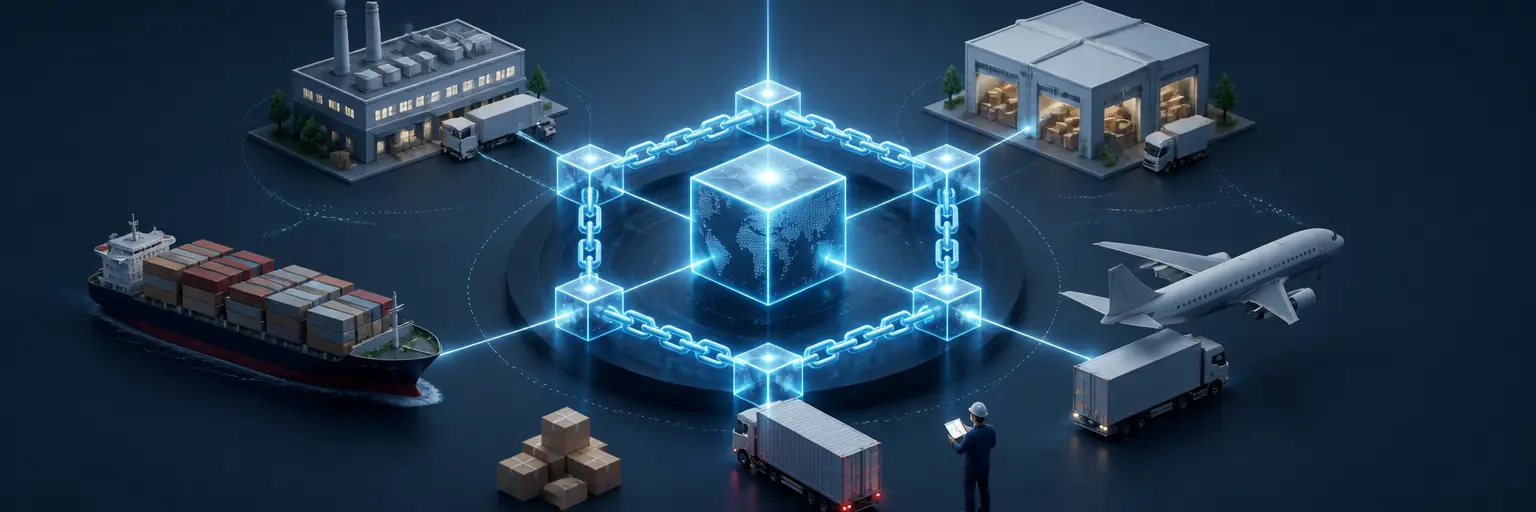
Blockchain and the Last Mile: Optimizing Delivery and Customer Experience in the Future
Explore how the future of blockchain in supply chain management is transforming global commerce with greater transparency, traceability, and trust. 🚚 Discover emerging trends such as smart contracts, decentralized data sharing, IoT integration, and real-time product tracking—helping businesses reduce fraud, improve efficiency, and build more resilient supply networks. Stay informed about the innovations shaping blockchain-powered supply chains and the next generation of enterprise logistics.
53 articles
Unlocking Circular Economy Potential: Blockchain for Sustainable Supply Chain Cycles
The Role of Layer 2 Solutions in Scaling Blockchain for Global Supply Chains
Blockchain Revolution in Supply Chains: What Will the Next 5 Years Bring?
From Farm to Fork, Reimagined: Blockchain's Role in Sustainable Food Supply Chains
The Investor's Guide to Blockchain in Supply Chain: Future Opportunities and Growth Sectors
Securing the Future of Global Trade: Blockchain's Promise for Supply Chain Security
Supply Chain as a Service (SCaaS): BlockchainEnabled Platforms for the Future
Beyond Efficiency: Exploring the Ethical Dimensions of Blockchain in Supply Chain Management
Will Blockchain Solve the Ethical Sourcing Challenge in Global Supply Chains?
Blockchain and AI: A Powerful Duo Reshaping the Future of Supply Chain Operations
The Future is Now: RealWorld Examples of Blockchain Transforming Supply Chains Today
Navigating Regulatory Hurdles: The Future of Blockchain Adoption in Global Supply Chains
The Evolution of Supply Chain Visibility: From EDI to BlockchainPowered RealTime Tracking
The Future of Supply Chain Collaboration: BlockchainEnabled Ecosystems and Partnerships
The Impact of Web3 on Supply Chain Management: Decentralization and New Paradigms
Blockchain and IoT: Powering the Autonomous Supply Chain of Tomorrow
The Future of Agricultural Supply Chains: Blockchain for Food Security and Farmer Empowerment
Beyond Transparency: How Blockchain Empowers Consumers in the Future Supply Chain
Decoding the Hype: Separating Fact from Fiction in the Future of Blockchain Supply Chain
Beyond Pilots: Strategies for Successful Blockchain Implementation in Supply Chains
The Future of Pharma Supply Chains: Ensuring Drug Integrity with Blockchain Technology
From Linear to Networked: Blockchain and the Transformation of Supply Chain Models
From Proof of Concept to Widespread Adoption: The Tipping Point for Blockchain in Supply Chains
Blockchain for Resilient Healthcare Supply Chains: Lessons from the Pandemic and Beyond
The Future of Manufacturing Supply Chains: Increased Efficiency and Traceability with Blockchain
The Convergence of Technologies: Blockchain, AI, and IoT Shaping the Future Supply Chain
The Quantum Leap for Supply Chains: How QuantumResistant Blockchain Will Secure the Future
The Future of Food Traceability: Will Blockchain Be the Key Ingredient?
Blockchain for Supply Chain Finance: Revolutionizing Payments and Working Capital
🚚 Future of Blockchain in Supply Chain
Discover how the future of blockchain in supply chain management is transforming logistics, procurement, manufacturing, inventory control, and global trade. This subcategory explores emerging blockchain use cases, decentralized supply chain networks, smart contracts, tokenization, digital product passports, and trusted data sharing. At Blockchain Trends, readers can follow how distributed ledger technology is helping organizations build supply chains that are more transparent, traceable, secure, resilient, and efficient beyond traditional cryptocurrency applications.
🔗 Blockchain-Powered Supply Chain Innovation
Explore the next generation of blockchain supply chain solutions and learn how distributed ledgers can connect suppliers, manufacturers, logistics providers, retailers, regulators, and customers through a shared source of truth. Articles in this section examine how blockchain reduces data silos, improves collaboration, and strengthens trust across complex multi-party ecosystems.
Readers can expect practical analysis of enterprise blockchain, permissioned networks, decentralized identifiers, verifiable credentials, and interoperable supply chain platforms. The content explains how businesses may use blockchain to improve product traceability, provenance tracking, supplier verification, and end-to-end visibility.
📦 Supply Chain Transparency and Product Traceability
Blockchain can create a tamper-resistant record of a product’s journey from raw materials to final delivery. This section focuses on blockchain traceability, provenance management, batch tracking, and real-time supply chain visibility across food, pharmaceuticals, electronics, automotive, luxury goods, and other industries.
Readers will learn how immutable transaction records can support faster recalls, improve quality assurance, combat counterfeiting, and provide consumers with more reliable product information. We also explore the importance of accurate data entry, IoT integration, and trusted participants when building transparent supply chain systems.
🤖 Smart Contracts and Automated Logistics
Smart contracts are expected to play a major role in the future of supply chain automation. This section examines how programmable agreements can automate purchase orders, shipment approvals, invoice reconciliation, customs documentation, insurance claims, and payment settlement when predefined conditions are met.
Our coverage explains how smart contracts may reduce administrative costs, limit disputes, shorten settlement times, and improve operational efficiency. Readers can also explore the challenges of smart contract security, legal enforceability, oracle accuracy, and integration with enterprise resource planning systems.
🌐 Interoperability and Connected Supply Chain Networks
The future of blockchain logistics depends on the ability of different platforms, companies, and data systems to communicate securely. This section explores blockchain interoperability, cross-chain communication, API connectivity, cloud integration, and standards for exchanging trusted supply chain data.
Expect insights into how interoperable networks can connect global suppliers and logistics partners without forcing every participant to use the same technology stack. We also examine digital identity, data ownership, permission management, and the standards required for scalable enterprise blockchain adoption.
🌱 Sustainability, ESG, and Ethical Sourcing
Blockchain technology may help companies document environmental and social performance throughout the supply chain. This section covers blockchain for sustainability, carbon tracking, ethical sourcing, responsible procurement, circular economy models, and verification of environmental, social, and governance claims.
Readers can discover how immutable records and digital product passports may support credible sustainability reporting and help identify labor, sourcing, or emissions risks. The content also addresses limitations, including energy consumption, incomplete datasets, greenwashing risks, and the need for independent verification.
💳 Tokenization and Supply Chain Finance
Tokenization is creating new possibilities for representing invoices, inventory, commodities, trade documents, and other real-world assets on blockchain networks. This section examines how tokenized supply chain finance can improve access to working capital and make trade transactions more efficient.
Readers will learn about blockchain-based invoices, programmable payments, digital trade finance, stablecoin settlement, and decentralized finance applications for businesses. We also discuss regulatory compliance, counterparty risk, liquidity, custody, and the practical requirements for safely adopting tokenized financial instruments.
🛡️ Security, Privacy, and Supply Chain Resilience
As supply chains become increasingly digital, security and data protection will remain essential. This section explores blockchain supply chain security, permissioned access, cryptographic verification, cybersecurity, privacy-preserving technologies, and protection against data manipulation.
Our articles consider how blockchain can support business continuity during disruptions, recalls, geopolitical events, and supplier failures. Readers will also gain a balanced understanding of blockchain limitations, including private-key management, scalability constraints, privacy concerns, fraudulent input data, and governance disputes.
📊 Enterprise Adoption, Regulation, and the Road Ahead
The evolution of blockchain in supply chain management depends on more than technical innovation. This section covers enterprise adoption strategies, regulatory developments, compliance requirements, consortium governance, return on investment, and the organizational changes needed to deploy blockchain successfully.
Readers can expect forward-looking analysis of global trade digitization, digital identity, central bank digital currencies, decentralized infrastructure, artificial intelligence integration, and emerging Web3 business models. The goal is to explain which blockchain trends are commercially realistic and which remain experimental.
❓ Frequently Asked Questions About the Future of Blockchain in Supply Chain
What is the future of blockchain in supply chain management?
The future of blockchain in supply chain management involves greater transparency, automated processes, secure data sharing, digital product passports, and improved coordination between trading partners. Blockchain is likely to complement existing ERP, IoT, artificial intelligence, and logistics systems rather than replace them entirely.
How can blockchain improve supply chain transparency?
Blockchain can record supply chain events in a shared, tamper-resistant ledger. Authorized participants may use these records to verify sourcing, manufacturing, shipment, delivery, and ownership information. This can improve product traceability, reduce disputes, support audits, and help identify counterfeit or non-compliant goods.
Can blockchain reduce supply chain costs?
Blockchain may reduce costs by automating administrative workflows, minimizing duplicate records, accelerating payment settlement, improving inventory visibility, and reducing errors in documentation. However, implementation expenses, integration requirements, governance, and staff training must be considered before calculating the potential return on investment.
What are the main challenges of blockchain adoption in supply chains?
Common challenges include scalability, interoperability, data privacy, regulatory uncertainty, inconsistent industry standards, complex onboarding, and the reliability of information entered into the network. Blockchain protects recorded data from unauthorized alteration, but it cannot automatically guarantee that the original data was accurate.
Is blockchain sustainable for global supply chains?
Blockchain sustainability depends on the network design and consensus mechanism. Permissioned and energy-efficient blockchain networks generally require fewer resources than energy-intensive proof-of-work systems. Organizations should evaluate energy use, infrastructure requirements, data storage, governance, and measurable sustainability benefits before deployment.